
Jalen Duren Contract Standoff and Trade Rumors Explained
Explore the latest on Jalen Duren's contract standoff, trade rumors, and what it means for the Detroit Pistons' future plans.
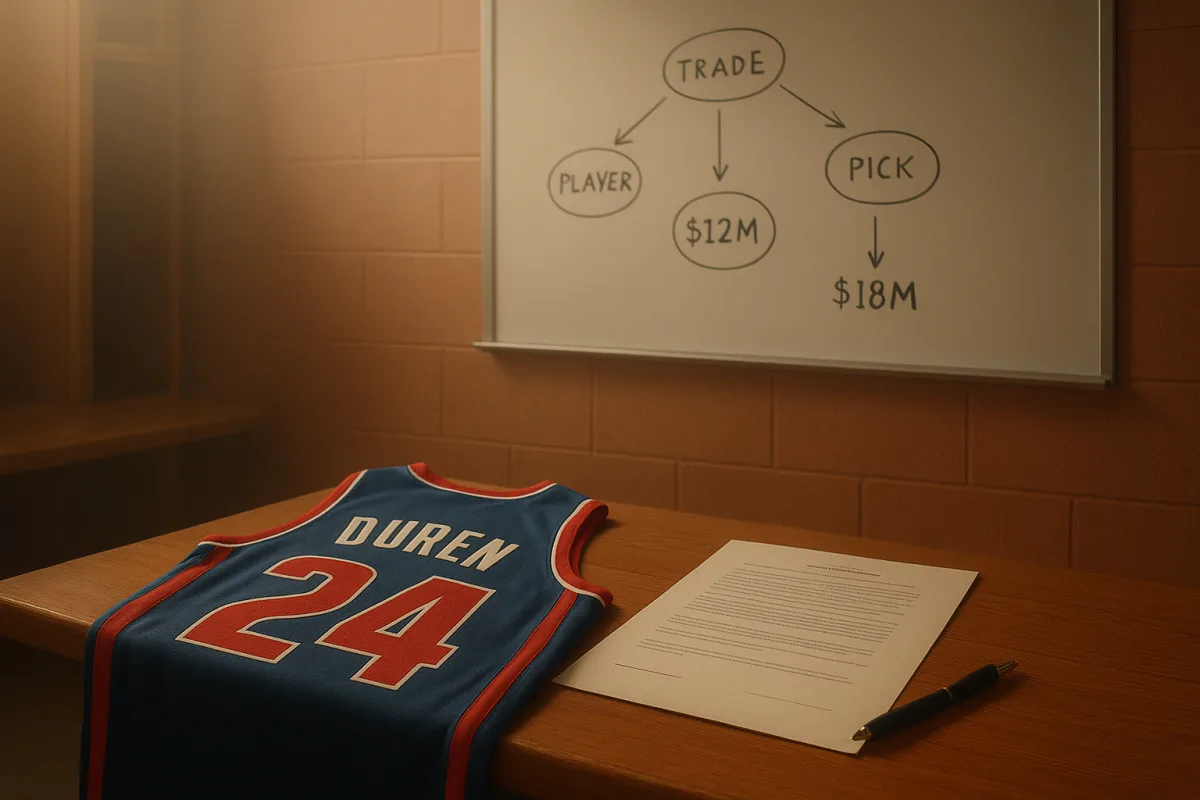
The quick list
Best overall: Jalen Duren’s reported five-year, $175 million Pistons extension, for Detroit if it believes his pick-and-roll finishing and defensive mobility will hold up in playoff matchups.
Best value: Jonathan Kuminga’s reported two-year, $12.4 million Timberwolves contract, for Minnesota if it wants upside without a major multiyear cap commitment. [9]
Best for small cap spaces: Jalen Duren on the roughly $8.9 million qualifying offer, for a team prioritizing one season of flexibility, though Detroit has the most to lose from that outcome. [4]
Best change-of-scenery theory: A Duren sign-and-trade, for a club seeking a young center without waiting for free agency, but Detroit’s reported position makes it unavailable for now. [1]
Best camp-depth move: Charlotte’s Exhibit 10 deal for forward Josiah Allick, for the Hornets and Greensboro Swarm as a low-cost development pipeline transaction, not a rotation-changing acquisition.
The price is not $175 million, it is the role Detroit is buying
A contract rumor becomes useful only when it is attached to possessions. The Pistons are not negotiating over an abstract young center archetype. They are deciding what portion of their offense and defense can credibly be organized around Jalen Duren.
The reported offer is five years and approximately $175 million, or about $35 million annually. Duren’s reported ask exceeds $40 million per season, leaving a gap above $5 million a year. [2][4] That difference is not trivial once it is multiplied over five years.
At $35 million annually, Detroit would be paying for a center expected to be more than a vertical lob target. The contract assumes he can create pressure as a screen setter, punish a low man who commits to the ball, finish quickly enough to stop help rotations, and remain playable when opponents alter the geometry.
That last part is the film-room question. In the regular season, a big can look central merely by screening high, rolling hard and finishing shots created by guards. In a playoff possession, the opponent can switch, top-lock off-ball shooters, pull the center into space, or put him in repeated actions.
Duren’s valuation therefore rests on what Detroit believes about the next layer of his game. Can he defend a guard after a switch without surrendering a straight-line drive? Can he play higher in pick-and-roll coverage without opening the pocket pass? Can he recover to the rim after showing?
Those are not box-score questions. Rebounds and blocks describe results, but they do not tell us whether a center held the nail, tagged the roller on time, or forced a handler away from the middle. Detroit would be paying for answers to those possession-level questions.
The reported $40 million-plus request carries a different standard. That is a number associated with a player who must stay on the floor when a series becomes a matchup hunt. It does not require Duren to become a high-volume scorer, but it does require defensive versatility or overwhelming offensive efficiency.
Comparison table: the available paths
| Option | Reported price | Contract layout | Roster and cap trade-off | What the tape has to validate | Current status |
|---|---|---|---|---|---|
| Pistons extension for Jalen Duren | Five years, about $175 million, roughly $35 million per year [2][[4]](https://www.bballrumors.com/2026/08/latest-intel-on-rfa-jalen-duran-pistons.html?utm_source=openai "Latest Intel On RFA Jalen Duran & Pistons | NBA Trade Rumors") | Long-term commitment | Cost certainty for Detroit, but a major annual center allocation | Reliable screen-and-roll pressure, rim protection, and playoff survivability in varied coverages |
| Duren’s desired extension range | More than $40 million per year [2] | Presumably long-term, exact structure unreported | Greater commitment and more pressure on future roster construction | A center who can avoid being schemed off the floor and consistently amplify Detroit’s creators | Reported negotiating position, not a finalized proposal |
| Duren qualifying offer | Roughly $8.9 million [[4]](https://www.bballrumors.com/2026/08/latest-intel-on-rfa-jalen-duran-pistons.html?utm_source=openai "Latest Intel On RFA Jalen Duran & Pistons | NBA Trade Rumors") | One-year bridge to unrestricted free agency | Maximum short-term flexibility, maximum risk of losing the player without compensation | Duren can preserve or increase value while carrying a larger burden |
| Duren sign-and-trade | No verified financial terms | Trade plus new contract | Could return players or draft value, but removes Detroit’s preferred retention route | Depends entirely on incoming personnel and lineup fit | Pistons reportedly ruled out sign-and-trades [[1]](https://www.rotoballer.com/player-news/pistons-rule-out-sign-and-trade-offers-for-jalen-duren/1919524?utm_source=openai "Pistons Rule Out Sign-and-Trade Offers for Jalen Duren - NBA News |
| Jonathan Kuminga with Minnesota | Two years, $12.4 million, with a player option in Year 2 [9] | Short deal with player control after one season | Low immediate cost, limited long-term team control | Whether a versatile forward can earn a stable two-way role quickly | Reported signed agreement [9] |
| Miami Heat pursuit around Giannis Antetokounmpo | Terms not confirmed | Rumored trade framework | Would require major outgoing value if it became real | The Heat would need a lineup that supports Antetokounmpo’s rim pressure with spacing and perimeter containment | Speculation only |
| Los Angeles Lakers’ reported pursuit of a $213 million wing | Exact player and proposed return not established in the supplied reporting | Rumored trade target | A large salary would reshape depth and matching-salary math | Los Angeles would need wing size without sacrificing its ability to defend point-of-attack actions | Speculation only |
| Charlotte Hornets Exhibit 10 deal for Josiah Allick | Salary terms not reported | Camp contract designed around G League affiliation | Minimal NBA roster risk, development value for Greensboro | Whether an energetic 6-foot-8 forward can defend, rebound and make quick low-usage decisions | RealGM reported the signing |
Why the qualifying offer is more dangerous than it looks
The qualifying offer is often described as a cheap alternative. That wording is misleading from Detroit’s perspective. The roughly $8.9 million figure is cheap for one season, but it is not a discounted version of a five-year extension. [4]
It is a different ownership structure. If Duren accepts it and plays through the season, he can move toward unrestricted free agency afterward, potentially allowing another team to bid without Detroit receiving matching rights or a trade return. That is why the low salary can become expensive.
Rookie-scale mechanics explain the leverage. First-round rookie contracts run four years, with the first two years guaranteed and team options in Years 3 and 4. Extension discussions normally become relevant before the player’s third season. [3][7]
That framework is why neither side should confuse timing with resolution. Detroit has a player it wants to retain, while Duren has a chance to translate a short NBA résumé into a much larger guaranteed number. The negotiation is not irrational just because it is uncomfortable.
Still, the longer the disagreement becomes public, the more it can affect basketball operations. A center’s defensive responsibilities depend on trust. Guards need to know whether he will be at the level, in drop, or switching. Wings need to know when to tag.
That does not mean a contract dispute automatically ruins chemistry. It means a team should avoid letting a negotiation contaminate the communication needed to defend simple actions, especially the spread pick-and-roll combinations that decide regular-season possessions and define postseason scouting reports.
Historical precedent offers caution, not a blueprint. Ben Simmons’ 2021-22 holdout eventually involved withheld salary and a grievance settlement after his trade request. [5] ESPN’s broader record of contract holdouts shows that disputes vary widely, from brief absences to longer ruptures. [6]
Duren’s situation should not be treated as a repeat of any prior case. There is no reported finalized trade, and there is no verified public evidence that he will sit out. The relevant lesson is narrower: leverage tactics can create costs beyond the contract number.
Why the sign-and-trade talk does not presently solve anything
The appeal of a sign-and-trade is easy to understand. Duren could choose a new destination, while Detroit could avoid the possibility of losing a starting center for nothing. On a transaction machine, it is the cleanest compromise.
But reported interest is not the same as a workable market. The Pistons have reportedly rejected sign-and-trade offers and signaled that retaining Duren is their preference. [1] That turns every proposed package into a hypothetical until Detroit changes its stance.
Reports have linked Duren to meetings with the Lakers and Kings, with hypothetical concepts involving Domantas Sabonis or a Milwaukee-oriented package including Ryan Rollins, Myles Turner and a top-five-protected 2031 first-round pick. Those frameworks remain unconfirmed and contested.
From a basketball standpoint, Detroit should judge any package by function, not headline value. Replacing Duren with a more polished offensive hub would change the offense’s rhythm. Replacing him with shooting or perimeter defense could open different driving lanes but weaken the rim-running layer.
That is why a proposed return cannot be graded only by counting names and picks. The Pistons must ask how the incoming group changes their base pick-and-roll coverage, their ability to finish defensive possessions, and the spacing available to their primary creators.
The other market items: different bets, different standards
Kuminga’s reported Minnesota deal is the clearest contrast to Duren’s standoff. According to AS, he took a two-year, $12.4 million contract, including a player option in the second year, rather than higher offers from Chicago, Portland and the Lakers. [9]
That is a small-price, short-layout bet. Minnesota obtains talent without placing a major multiyear weight on its cap sheet. Kuminga retains an early exit route if his role expands. The trade-off is obvious: the Timberwolves may have limited control just as the investment starts paying off.
The Miami Heat’s reported Giannis Antetokounmpo interest belongs in a separate category. A two-player package rumor is not enough to evaluate whether Miami can actually satisfy Milwaukee’s price, preserve depth, or build the shooting ecosystem that maximizes Antetokounmpo’s downhill game.
Likewise, the Lakers’ reported interest in an elite wing attached to a $213 million figure is a payroll signal, not a completed basketball plan. A wing with that salary must either solve a matchup problem or create enough offense to justify the depth lost in aggregation.
Charlotte’s transaction with Josiah Allick is smaller but more concrete. RealGM reported that the Hornets signed the 6-foot-8 forward to an Exhibit 10 contract designed to route him toward the Greensboro Swarm after a preseason waiver.
Allick appeared in 41 G League games for Greensboro last season, averaging 5.6 points on 65.8 percent shooting and 5.8 rebounds. Those figures describe efficiency and rebounding output, but the meaningful evaluation is whether he can make fast defensive reads and function without high usage.
Who each option suits
The reported $175 million Duren extension suits Detroit if its internal film work says his best possessions are repeatable against better opponents. The Pistons would be choosing continuity and betting that his role expands rather than hardens into a matchup-dependent regular-season job.
Duren’s reported $40 million-plus position suits the player if he believes the league will value his age, physical tools and upward trajectory more than Detroit’s current offer. The cost is accepting uncertainty while negotiations remain unresolved. [2]
The qualifying offer suits Duren only if maximizing autonomy outweighs long-term security. It suits Detroit only in the narrow sense that it delays a massive commitment. Asset retention, roster certainty and relationship management all point the other way. [4]
A sign-and-trade would suit an outside contender or retooling team that needs a young center and can meet Detroit’s basketball price. As long as the Pistons maintain their reported refusal, it is not an actionable option. [1]
Kuminga’s Minnesota agreement suits a team willing to trade long-term control for low upfront cost and optionality. [9] The Heat and Lakers rumors suit readers tracking possible league-wide leverage, but not anyone treating unconfirmed frameworks as imminent transactions.
Allick’s Exhibit 10 deal suits Charlotte’s development system. It is a sensible depth transaction for a franchise using the Swarm as an evaluation environment, and it should not be confused with the contract stakes surrounding Duren’s negotiations.
Frequently Asked Questions
What is the current status of Jalen Duren's contract standoff with the Pistons?
The Pistons have offered Duren a five-year, approximately $175 million contract averaging about $35 million per year, but Duren is reportedly seeking more than $40 million annually. This creates a gap of over $5 million per year, which remains unresolved. The negotiations have been described as "awfully nasty," and no agreement has been reached as of now.
Why is there a gap between Jalen Duren's salary demands and the Pistons' offer?
The Pistons’ offer reflects their valuation of Duren’s role as a rim-running, pick-and-roll center who can provide defensive versatility and playoff survivability. Duren’s higher salary demand implies expectations that he can consistently perform at a level requiring him to stay on the floor in matchup-heavy playoff situations. The disagreement centers on how much Duren’s game will develop in those critical areas.
What are the potential outcomes of Jalen Duren's contract negotiations?
If no extension is reached, Duren could play the 2026-27 season on a qualifying offer of about $8.9 million, giving him short-term leverage but risking unrestricted free agency afterward without compensation to Detroit. Alternatively, the Pistons might accept a long-term commitment at their offered rate or Duren’s asking price if negotiations progress. The team must weigh the risk of losing him for nothing against the cap implications of a large contract.
Is a sign-and-trade deal possible for Jalen Duren?
Currently, a sign-and-trade is not a practical option because the Pistons have ruled out facilitating such deals. Although Duren has shown interest and reportedly met with other teams like the Lakers and Kings, Detroit’s position is firm against sign-and-trades at this time.
How does Jalen Duren's contract situation impact the Pistons' roster and cap space?
Committing roughly $35 million annually to Duren would represent a major allocation of cap space, especially alongside other max-contract players, potentially limiting roster flexibility. If Duren plays on the qualifying offer instead, Detroit risks losing him as an unrestricted free agent without compensation. The ongoing standoff also reportedly affects team chemistry negatively.
How we researched this
This article was assembled from 1 video source, 7 published articles, 9 cited references.
Nothing here is based on hands-on testing. Where a figure or finding appears, it belongs to the source cited beside it, and the writing says so rather than implying otherwise. Every source is listed below so you can check it.
Sources
NBA Teams Who Rejected These Trades...And Paid The Price — Andy Hoops
New NBA Rumors on Jalen Duren's Contract Talks With Pistons, Timeline for Potential Resolution — Bleacher Report
Where Pistons, Jalen Duren stand in contract stalemate — ESPN
Why Detroit Pistons, Jalen Duren standoff should end this month — Detroit Free Press
Jalen Duren’s ‘Ballpark’ Contract Offer Revealed Amid Pistons Standoff — heavy.com
Miami Heat Linked to Major NBA Trade Around Giannis Using 2-Player Package — heavy.com
Lakers’ Top Trade Target Revealed as $213M Elite Wing as New Options Arise — heavy.com
Pistons Rule Out Sign-and-Trade Offers for Jalen Duren - NBA News | Fantasy Basketball
Report: Gap remains between Pistons, Jalen Duren - NBC Sports
Latest Intel On RFA Jalen Duran & Pistons | NBA Trade Rumors
Report: Nets' Simmons credited year of service for holdout | theScore
How Jalen Duren’s Big Money Dreams Could Complicate Detroit Pistons’ Future
Watch NBA Contract Standoffs and Trade Rumors: Jalen Duren and Others on Youtube
Related Articles
Jalen Duren Trade Rumors and Sign-and-Trade Analysis
Explore Jalen Duren trade rumors, sign-and-trade details, and how his playoff performance impacts Detroit Pistons' contract talks.

Ausar Thompson Contract Extension and Defensive Impact
Explore Ausar Thompson's $155M contract extension and how his defense shapes the Detroit Pistons' future.
Nikola Jokic Trade and Denver Nuggets Future Explained
Explore the Nikola Jokic trade rumors, Peyton Watson sign-and-trade, and how Denver Nuggets' salary cap affects their future roster moves.
New York Knicks 2026-27 Roster Moves and Season Preview
Explore the New York Knicks 2026-27 roster moves, preseason analysis, and key player updates including Brunson’s MVP case and Towns’ contract.