Ben Simmons Achilles Injury Impact on Kings and Career
Explore Ben Simmons' season-ending Achilles injury and its impact on his career and the Sacramento Kings' lineup and strategy.
The injury changes the hardest possessions first
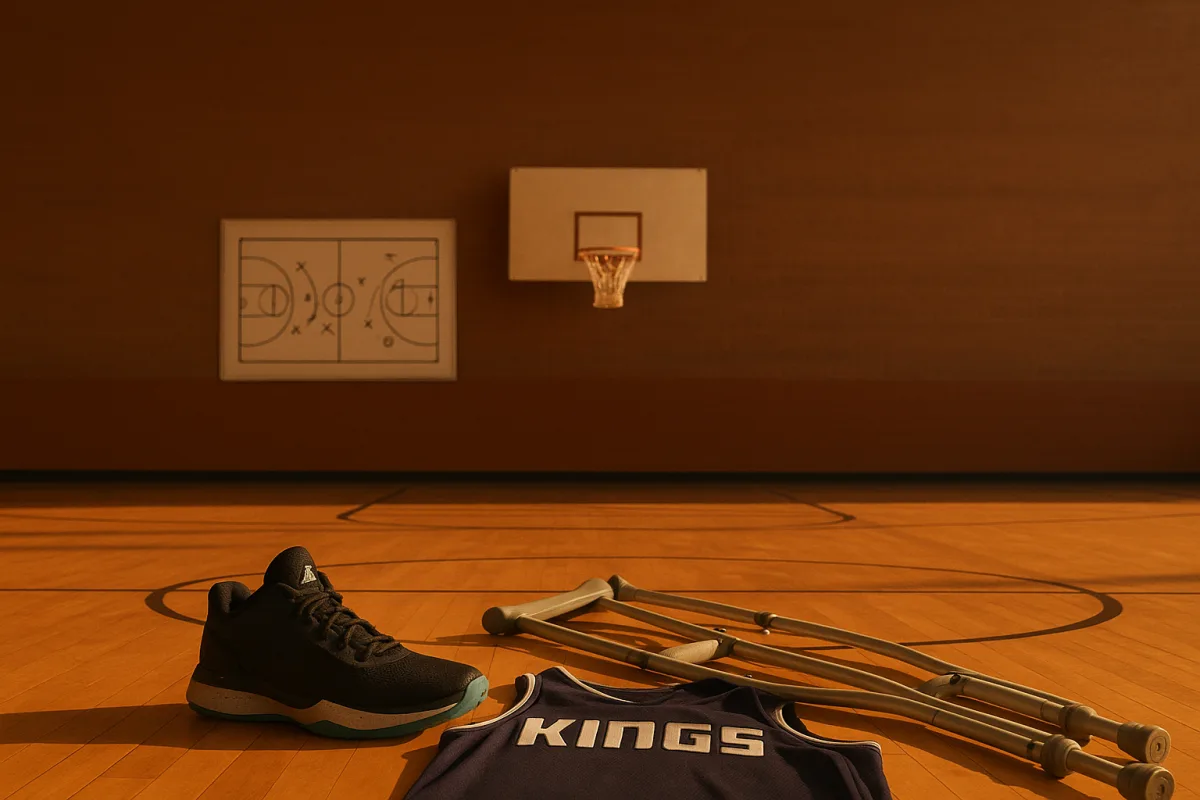
Sacramento announced that Ben Simmons tore his right Achilles tendon during an October 17 practice, with an MRI confirming the rupture. The Kings said he would undergo surgery, and reporting around the diagnosis expects him to miss the entire 2026-27 season. [2][3]
That timeline is important because this was not a midseason injury where a club can redistribute a settled role over 50 remaining games. Simmons was trying to establish a comeback place in a new Kings rotation.
He had signed a one-year, $3.5 million deal in September after missing the prior season with back and leg issues. In two preseason appearances, he averaged 10.5 points, four rebounds and four assists. [4][5]
Those numbers are not a projection, and two preseason games cannot establish form. What they do show is the intended job description: Sacramento was again giving Simmons on-ball possessions rather than treating him strictly as a nominal forward.
The useful way to assess his absence is not to ask where Sacramento replaces 10.5 points. The relevant question is which types of possessions lose a player who could rebound, advance the ball himself and defend across assignments.
An Achilles tendon connects the calf complex to the heel, transmitting force when a player pushes off, jumps, stops or changes direction. Basketball asks for repeated versions of that force transfer, often without the player having time to load both feet cleanly.
Consider a defensive possession against a high pick-and-roll. A switch defender must first absorb the guard’s change of direction, then slide to contain the drive, then plant and contest without yielding the passing lane behind him.
That is not merely “quickness.” It is braking force, lateral re-acceleration and balance after contact. Those are precisely the movements a player must regain to be trusted in a switching scheme after an Achilles rupture.
Simmons’ value, when healthy, was most visible in those connective possessions. He could take a defensive rebound, bypass an outlet pass and create an early offense situation before the opposing defense established its matchups.
That sequence changes lineup construction. A conventional center can secure the rebound, but often needs a guard to retrieve the outlet and initiate. Simmons allowed the same unit to defend bigger, then attack with a ball-handler already in motion.
Why the Kings cannot replace him with one substitution
The immediate temptation is to identify one player as Simmons’ replacement. That misses the way his role was built. Sacramento must divide the lost functions among a rebounder, a primary ball-handler and a defender capable of absorbing difficult matchups.
Rookie guard Darius Acuff Jr. is expected to receive more ball-handling responsibility in Simmons’ absence, according to the research briefing. That may replace some initiation, but it does not duplicate Simmons’ size at the point of attack.
The adjustment will show up in transition more than in a playbook diagram. When a big rebounds and must locate a guard, the defense gains a beat to retreat. When Simmons pushes immediately, that beat disappears.
There is also a defensive cost that box-score accounting will not isolate. Against a team hunting mismatches, a bigger guard who can switch lets the other defenders stay attached to shooters rather than pre-rotating early.
Without that option, Sacramento may have to choose between more conventional coverage rules. It can fight over screens and keep its center deeper, or switch selectively and accept more size mismatches against wings and power forwards.
Neither choice is necessarily disastrous. The cost is cumulative: more help rotations, more closeouts, and fewer possessions where the defense can survive an initial breakdown simply because one player can credibly cover two positions.
This is why Simmons’ fit should not be reduced to whether he shoots enough. The shooting limitation affects spacing, but the Kings were also buying lineup elasticity, the ability to use a large initiator without committing to a small defensive group.
The injury removes that experiment before Sacramento can determine its practical limits. Two preseason games supplied almost no meaningful evidence about how the Kings would handle playoff-style help defense, late-clock fouling or opponents sagging far into the lane.
An Achilles return is not a simple calendar problem
The Kings have not supplied a detailed public recovery schedule beyond the season-ending expectation and planned surgery. That restraint is appropriate, because a nominal rehabilitation timetable does not answer whether an NBA player regains his previous movement profile. [2][3]
A player can return to basketball activity before he is ready to make repeated maximal cuts against NBA athletes. He can also look functional in a straight-line drill while still lacking trust in the planted, reactive movements that decide defensive possessions.
The larger historical evidence is sobering without being deterministic. A study of 47 NBA players who suffered Achilles ruptures from 1970 through 2019 found that 72.3% returned to NBA play after surgery. [1]
Return, however, is not the same as restoration. In that study, players who returned averaged 3.1 post-injury seasons, compared with 5.8 for matched controls, and showed significant declines in games, minutes and player efficiency rating at one and three years. [1]
PER is a box-score-based estimate of per-minute statistical production. It can identify broad production decline, but it cannot tell us whether a defender has lost half a step on switches or whether a team has quietly changed his assignments.
That distinction matters especially for Simmons. If his eventual basketball utility depends heavily on guarding space, grabbing-and-going, and turning defense into transition, then marginal movement loss can have an outsized tactical effect.
None of that proves Simmons cannot return effectively. The study is historical, involves players with different ages and roles, and cannot predict one individual’s surgical outcome, rehabilitation or willingness to attack the game in the same way. [1]
It does explain why Sacramento’s immediate planning should treat this as more than a temporary vacancy. The Kings are losing the whole evaluation year on a player whose next contract will depend substantially on what he can physically do after recovery.
The documentary is context, not a transaction
ESPN’s documentary, “Being Ben,” premiered October 18, the day after Simmons was injured. ESPN and Andscape framed the project around his route back to the NBA and the arc of a career already shaped by injury, scrutiny and change. [7]
The timing naturally makes the film feel harsher. A project meant to document a return arrived just as the return was interrupted again, turning a current rehabilitation story into the dominant lens through which viewers may revisit older conflicts.
Reporting on the documentary has emphasized Simmons’ reflections on his Philadelphia exit, including criticism of former 76ers coach Doc Rivers. The Athletic’s short excerpt noted that the release coincided with the injury news.
But public discussion is not team-building evidence. As of October 19, there were no credible reports of a trade offer, active talks involving Simmons or a Kings plan to move him because of the film.
That point needs to stay clear because Philadelphia is not managing this injury. Simmons is a Sacramento player, and the 76ers’ current roster construction, salary structure and competitive ambitions do not create a direct contractual consequence here.
The documentary may influence fan reaction because it reopens familiar arguments about responsibility and perception. It cannot itself alter Simmons’ medical prognosis, change Sacramento’s available roster spots, or create a market where none has been reported.
What “trade bait” would actually mean
There has been speculation that Sacramento could use Simmons as trade ballast despite the injury. [8] That phrase can sound more valuable than it is, so it is worth defining the mechanism rather than treating it as a sign of demand.
In an NBA trade, a player’s contract can help a team legally match outgoing and incoming salary. The acquiring team may value the player, the contract’s structure, a draft asset attached to it, or simply the ability to clear money later.
Simmons’ reported deal is a one-year, non-guaranteed veteran-minimum contract worth about $3.52 million, with a $1 million opening-night guarantee. Reporting indicates the Achilles injury occurred after he made that roster, entitling him to the relevant salary protection. [9]
That makes the contract relatively small. A $3.5 million figure cannot independently match the salary of a major player, so any meaningful transaction would require other Kings contracts and likely other assets to carry the deal’s real weight.
The distinction is central. “Trade bait” does not mean another club is trading for an injured Simmons as a basketball solution. It can mean his contract is one component in an exchange whose actual target is elsewhere.
His expiring status can have administrative value to a team seeking future flexibility. Yet the acquiring club must still carry an injured player, assess insurance and roster implications, and decide whether the small salary is worth using a transaction slot.
There is no reason to manufacture urgency around that possibility. Sacramento has not announced plans to trade Simmons, and no team has been publicly linked to a Simmons deal since the injury.
For now, the concrete impact is on possessions, not rumors. The Kings have lost a particular kind of lineup connector, while Simmons has lost a season that was supposed to provide current evidence of his movement, role and durability.
Frequently Asked Questions
What is the impact of Ben Simmons' Achilles injury on the Sacramento Kings?
Ben Simmons’ torn right Achilles removes a versatile guard who contributed as a transition organizer and switch-capable defender from the Kings’ rotation for the entire 2026-27 season. His absence forces Sacramento to redistribute his unique combination of rebounding, ball-handling, and defensive versatility among multiple players, affecting their lineup flexibility and defensive schemes.
How does an Achilles rupture affect NBA players' performance?
An Achilles rupture primarily impairs movements requiring sudden braking, re-acceleration, and lateral recovery, which are critical for defensive versatility and open-floor creation. Players often struggle to regain the necessary force transfer and balance to perform at their previous level, especially in switching defensive roles and transition play.
What are the recovery prospects for NBA players after an Achilles tear?
Research shows that about 72.3% of NBA players return to play after Achilles surgery, but their post-injury careers and production generally decline. While many players do come back, the injury often results in reduced athleticism and effectiveness, warranting caution when projecting long-term impact.
Can Ben Simmons be traded after his season-ending injury?
Although Simmons is on a one-year veteran-minimum contract that could serve as minor matching salary in a larger deal, being injured on an expiring contract does not automatically make him useful trade value. As of October 19, 2026, there are no credible reports or trade offers involving Simmons, and the Kings have not announced any plans to trade him.
How will the Kings adjust their lineup without Ben Simmons?
The Kings will need to divide Simmons’ lost functions among several players, such as increasing ball-handling duties for rookie guard Darius Acuff Jr. However, no single player can replicate Simmons’ size and versatility at the point of attack. Defensively, Sacramento may have to choose between more conventional coverage or selective switching, accepting size mismatches and potentially more help rotations and closeouts.
How we researched this
This article was assembled from 1 video source, 8 published articles, 14 cited references.
Nothing here is based on hands-on testing. Where a figure or finding appears, it belongs to the source cited beside it, and the writing says so rather than implying otherwise. Every source is listed below so you can check it.
Sources
This Kristaps Porzingis Situation Is Getting Weird — A.M. Hoops
New Ben Simmons documentary has cruel timing of coming out after season-ending injury — The Athletic NBA
The 76ers seem to finally have everything they need, and it makes their season both thrilling and terrifying — CBS Sports NBA
The 76ers seem to finally have everything they need, and it makes their season both thrilling and terrifying — CBS Sports
NBA Power Rankings: Spurs enter season as team to beat — theScore
The 76ers seem to finally have everything they need, and it makes their season both thrilling and terrifying — CBS Sports
NBA Power Rankings: Spurs enter season as team to beat — theScore
The 76ers seem to finally have everything they need, and it makes their season both thrilling and terrifying — CBS Sports
The 76ers seem to finally have everything they need, and it makes their season both thrilling and terrifying — CBS Sports
Kings' Ben Simmons suffers torn Achilles at practice Sunday, will miss entire season - NBC Sports
Ben Simmons tears Achilles: Kings guard likely to miss entire season - CBS Sports
Ben Simmons sigue en una nube negra: se rompe el tendón de Aquiles
'Being Ben': 'E60' and Andscape explore Ben Simmons' road back to the NBA - ESPN Press Room
Ben Simmons: rotura del tendón de Aquiles y de su gran regreso
Ben Simmons Reflects on Trade Request and Coaching Decisions in ESPN Documentary - SSBCrack News
How Ben Simmons' Achilles Injury Impacts the Kings Off the Court
Watch Ben Simmons' Season-Ending Injury and Impact on Youtube
Related Articles
Jalen Duren Trade Rumors and Sign-and-Trade Analysis
Explore Jalen Duren trade rumors, sign-and-trade details, and how his playoff performance impacts Detroit Pistons' contract talks.

Ben Simmons NBA Comeback
Explore Ben Simmons NBA comeback, his role with Sacramento Kings, contract details, and challenges ahead for the 2026-27 season.
NBA Trade and Contract Updates for Stars and Teams 2026
Get the latest NBA trade and contract updates for 2026, including key player moves, team roster changes, and salary cap impacts.

LaMelo Ball Trade and Its Impact on Hornets Roster Changes
Explore how the LaMelo Ball trade reshaped the Hornets roster and offense, including Kon Knueppel's role and Naz Reid's impact.