
Kawhi Leonard Trade Impact and Clippers' Draft Pick
Explore the Kawhi Leonard trade impact, Clippers' lost draft picks, and NBA salary cap penalties shaping the teams' futures.
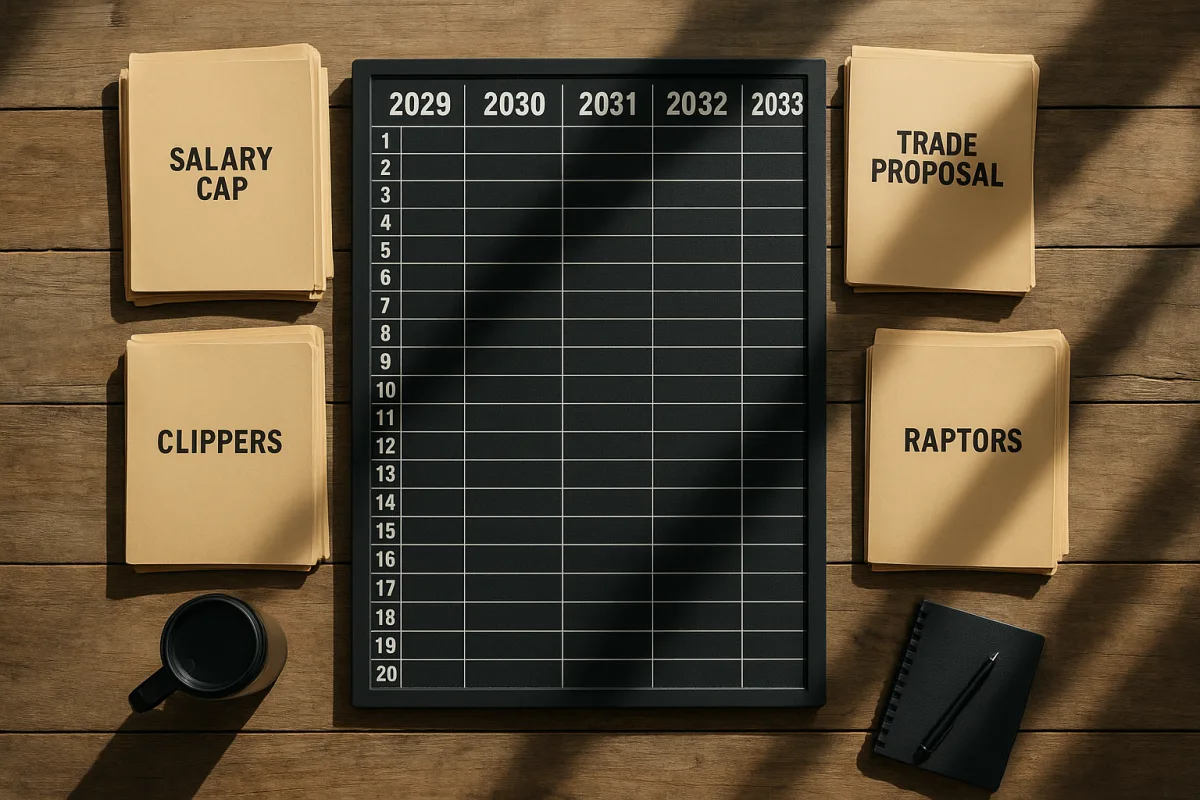
The punishment is really about pick control
The headline figure is $30 million, and the league’s finding that the Clippers circumvented salary-cap rules around Kawhi Leonard is the central scandal. But the basketball consequence is the forfeiture of five consecutive first-round picks, covering 2029 through 2033. [15]
That sounds straightforward until one asks what a first-round pick actually does for a front office. A pick is not merely an opportunity to select an 19-year-old prospect in June. It is a form of team control.
In NBA roster construction, first-round picks are useful in at least four distinct ways. A team can make the selection, trade the selection, attach it to salary in a larger deal, or use it as protection against the downside of an aging roster.
The Clippers have lost that menu for five years. The organization cannot decide in 2030 that it needs to move up the draft board. It cannot freely package its own 2031 first-rounder for a veteran wing. It cannot use a future first to convince another team to take an unwanted contract.
That is the real meaning of a pick forfeiture. It is not five players removed from a hypothetical roster. Most late first-rounders do not become stars. The damage is that the franchise loses five annual chances to choose among several roster-building routes.
The NBA’s formal announcement imposed the five-pick penalty alongside the fine and suspensions of owner Steve Ballmer, business executive Gillian Zucker and basketball-operations chief Lawrence Frank. Leonard was fined $700,000, while avoiding both a suspension and the voiding of his contract. [15]
The asymmetry matters. Leonard’s fine is a punishment on an individual. The forfeited picks are a restriction on an organization’s future optionality, including seasons that may arrive after every current decision-maker and player has left the building.
Why cap circumvention brings this kind of penalty
The NBA salary cap is not a hard spending ceiling in the simple sense. Teams can exceed it through exceptions, retained rights and other collectively bargained mechanisms. The system works only if every dollar used to recruit or retain a player is counted correctly.
A team cannot pay a player $40 million in salary under the cap rules, then arrange another $10 million through a friendly outside company in exchange for little or no genuine commercial work. That second payment may function like basketball compensation even if it is described as an endorsement.
The allegations surrounding Leonard centered on Aspiration Partners, an environmental-services company linked to the Clippers’ arena business, as well as Boingo Wireless, Daktronics and Lockton Insurance. Reports alleged that these companies provided Leonard off-court compensation connected to their business relationships with the franchise. [2]
The reported figure of roughly $48 million has circulated widely, described as a $28 million endorsement arrangement plus $20 million in company stock. But that precise breakdown has not been independently verified through public financial audits, NBA disclosures or released contracts.
That distinction is important. The league’s punishment reflects its investigative findings, not a public release of every contract, email or payment record. Readers should not treat every reported dollar figure as if it were a fully audited accounting statement.
Still, the NBA found sufficient evidence to conclude that the Clippers had circumvented the cap, and it described Ballmer as having knowingly sought to help Leonard obtain off-court income opportunities. [15] That is why this went beyond a routine tampering fine.
A cap system cannot function if the richest clubs can shift player compensation into sponsorships arranged through their corporate networks. The harm is competitive, not cosmetic. A hidden payment allows a team to offer more than the cap ledger shows.
The league’s response therefore targeted the franchise’s future team-building capacity. A large cash fine hurts even a wealthy owner, but it does not reduce the number of players he can pursue next summer. Draft forfeitures do.
Five missing picks does not mean five empty drafts
There is a subtle but crucial limitation to the penalty. The Clippers have lost designated first-round picks, but they have not been barred from receiving or purchasing draft assets through trades, subject to the normal rules governing such transactions.
That is where the completed Leonard trade with Toronto changes the texture of the punishment. The Raptors sent Brandon Ingram, Gradey Dick, unprotected first-round picks in 2031 and 2033, a 2027 swap, and second-round picks in 2030 and 2033 to Los Angeles. [16]
Those incoming Toronto assets do not restore the Clippers’ forfeited own picks. They are separate assets, with different protections, different odds of landing high in the draft and different utility in a future trade. But they give Los Angeles some badly needed inventory.
Think of draft picks less like a team’s annual allowance and more like a set of chips at a negotiating table. Losing one’s own picks removes the most reliable chips, because a club always knows it has direct control over its own future selections.
An acquired Raptors first-rounder can still be valuable, perhaps extremely valuable, if Toronto declines. But it cannot fully replace an unprotected Clippers pick if Los Angeles is the team that collapses in the standings. The timing and source of risk are different.
The 2027 pick swap is similarly conditional. A swap is not an extra first-round pick automatically arriving in Los Angeles. It gives the Clippers the right to exchange draft positions with Toronto if the terms make that exchange favorable.
For a rebuilding team, that distinction matters. A clean unprotected first gives a front office a defined asset. A swap produces value only when the other team’s pick lands in a more favorable slot than the team’s existing selection.
The Clippers’ immediate problem is that their own long-term decline could become somebody else’s opportunity. They already owed future pick control to Oklahoma City and Philadelphia through earlier transactions, which makes the post-penalty asset map especially thin. [3]
That is why the Toronto return looks less like a conventional star trade and more like emergency roster-capital replenishment. Los Angeles is not merely selling Leonard for players and picks. It is trying to regain enough draft flexibility to function after the league removed its own pipeline.
Toronto is buying a late-clock possession changer
For Toronto, the trade is not principally about nostalgia for Leonard’s 2019 championship run. It is about a specific offensive possession that has been difficult to solve when the Raptors cannot run in transition or create an early advantage.
CBS Sports reported that Toronto was nine points per 100 possessions worse with Ingram on the floor last season, according to Cleaning the Glass. [3] That number measures the scoring margin per 100 possessions during his minutes, not Ingram’s individual talent in isolation.
Lineup differential can be noisy, especially over one season. It reflects teammates, opponents, injuries and lineup usage. But the tape-level question is more useful: did the lineup’s preferred actions fit its personnel?
Toronto wants to pressure defenses with pace, early offense and Scottie Barnes’ passing from the middle of the floor. Ingram can score one-on-one, but a methodical isolation possession can flatten the very advantages Toronto is built to create.
Leonard is also an isolation scorer, but his value is more specific in playoff terms. When the first action fails and the defense has switched or shrunk the floor, he has a history of generating credible pull-up and midrange looks without requiring a complicated play call.
That could reduce the burden on Barnes. The Raptors no longer need every final possession to become a Barnes initiation, a difficult pass into traffic, or a contested attempt created after the offense has stalled.
The fit is not automatic. Barnes and Leonard prefer some of the same interior and midrange real estate, so Toronto will need cleaner spacing around them. Leonard’s three-point volume and Barnes’ willingness to screen, cut and make quick passing decisions will determine whether possessions stay fluid. [3]
Defensively, the appeal is more intuitive. Barnes can switch across matchups and cover ground as a helper, while a healthy Leonard can still provide strength on the wing and a credible answer against top perimeter scorers.
But “healthy Leonard” is not a throwaway qualifier. He played 65 games in 2025-26 and averaged 27.9 points, his most encouraging availability in years, yet he missed the entire 2021-22 season with a knee injury. [3]
Toronto is therefore acquiring a ceiling-raiser, not a certainty. The Raptors can manage regular-season possessions by staggering Barnes and Leonard, limiting Leonard’s workload and preserving their best half-court option for games that matter most.
What the league is trying to deter
The NBA and National Basketball Players Association reached an agreement confirming the penalties as final and binding, limiting the Clippers’ league-based avenues to challenge them. [3] Ballmer then accepted the punishment and said the organization would move forward. [1]
That decision may matter if the Clippers eventually seek leniency, but there is no automatic mechanism requiring the NBA to return any picks. The Minnesota Timberwolves had picks restored after their Joe Smith cap-circumvention case, yet that is precedent, not a contractual guarantee. [3]
The Clippers’ case also arrives in a different environment. Reporting has indicated that the Department of Justice has opened a criminal investigation, with the precise scope unclear. [5] The NBA’s competitive penalty and any federal inquiry are separate processes.
For the league, though, the message is already clear. A franchise cannot use a network of sponsors, arena partners or affiliated businesses to create compensation that functions as a hidden salary supplement, then claim the cap ledger remains intact.
For the Clippers, the penalty will be felt most sharply not in the next press conference but in future negotiations. Every time another team requests a first-rounder, Los Angeles will be negotiating from a thinner stack of assets.
For the Raptors, the calculation is cleaner but still demanding. They have added the player most equipped to solve their last-possession offense, and they did so without surrendering Barnes. Whether that becomes a genuine Eastern Conference contention window depends on Leonard’s availability, not the sentiment attached to his return.
Frequently Asked Questions
What is the impact of Kawhi Leonard's trade on the Clippers?
The trade of Kawhi Leonard to the Raptors provided the Clippers with significant assets, including Brandon Ingram, Gradey Dick, unprotected first-round picks in 2031 and 2033, a 2027 swap, and second-round picks in 2030 and 2033. This trade helps offset the Clippers' lost draft picks by giving them alternative draft capital and players, partially mitigating the long-term damage of their forfeited first-round selections. However, the Clippers still face challenges in building through their own draft picks for several years.
How do the Clippers' lost draft picks affect their future?
Losing five consecutive first-round picks from 2029 through 2033 severely limits the Clippers’ ability to add young, cost-controlled talent and reduces their flexibility in trades and roster building. First-round picks are valuable not only for selecting players but also as trade assets, salary absorbers, or protections in deals. The absence of these picks removes a key roster-building tool, forcing the Clippers to rely more heavily on free agency and player development, which is a competitive disadvantage.
Why did the NBA penalize the Clippers for salary cap circumvention?
The NBA found that the Clippers circumvented salary cap rules by facilitating off-court payments to Kawhi Leonard through companies linked to the franchise’s business network, such as Aspiration Partners. These payments, including a reported $28 million endorsement deal plus company stock, were not properly accounted for under the salary cap. The league views such hidden compensation as a competitive harm because it allows a team to exceed the cap unfairly, leading to severe penalties including fines, suspensions, and forfeiture of draft picks.
How does the Kawhi Leonard trade affect the Raptors?
The Raptors replaced a high-usage isolation scorer with Kawhi Leonard, who is considered a better late-clock shot creator. However, they are accepting substantial health risks given Leonard’s injury history and the final year of his contract. The trade gives the Raptors a different offensive dynamic but comes with uncertainty regarding Leonard’s availability and long-term durability.
What are the long-term consequences of forfeiting first-round picks?
Forfeiting first-round picks is not just about missing out on potential players; it means losing critical roster-building options in a league where first-round selections can be drafted, traded, or used to absorb salary in deals. This restriction limits a franchise’s flexibility and strategic choices over multiple seasons, affecting the team’s ability to adapt to changing circumstances and maintain competitiveness long term. The Clippers’ five-year loss of picks significantly diminishes their future optionality.
How we researched this
This article was assembled from 2 video sources, 6 published articles, 16 cited references.
Nothing here is based on hands-on testing. Where a figure or finding appears, it belongs to the source cited beside it, and the writing says so rather than implying otherwise. Every source is listed below so you can check it.
Sources
How Kawhi BURNED the Clippers On His Way Out — A.M. Hoops
There Are Major Problems With the Kawhi Trade — A.M. Hoops
Clippers, Raptors agree to Kawhi Leonard trade again: Toronto finally poised to move forward as East contender — CBS Sports NBA
Kawhi Leonard should pay back sponsorship money earned from Clippers' scheme, says former player — The Athletic NBA
The Clippers’ scandal has the DOJ investigating, and it could get so much worse — SB Nation NBA
Clippers, Steve Ballmer back down and accept NBA penalties -- does that mean they'll get any picks back? — CBS Sports NBA
Clippers, Raptors complete Kawhi Leonard trade after NBA doles out punishment — The Athletic NBA
Why is the Kawhi Leonard trade still on hold? Uncertain Clippers leadership reportedly among reasons — CBS Sports NBA
Steve Ballmer backs down on NBA punishment, apologizes as Clippers accept $30 million fine
Report: Clippers skirted NBA salary cap with Kawhi Leonard payment - ESPN
A Breakdown of the NBA's Rules Regarding Cap Circumvention - HEAVY
Clippers Lose Five First-Round Picks in Kawhi Leonard Sanction - Fantasy Nerds
Clippers news: LA's 1st-round pick situation after Kawhi Leonard investigation
San Antonio Spurs trade Kawhi Leonard to Toronto Raptors for DeMar DeRozan, others | NBA.com
Report: Raptors have held trade talks for Clippers' Kawhi Leonard - Sportsnet.ca
Raptors acquire Kawhi Leonard from the LA Clippers | NBA.com
Watch Kawhi Leonard Trade Drama and Impact on Youtube
Also from the sources
Related Articles
Clippers Kawhi Leonard Cap Circumvention Scandal Explained
Learn about the Clippers and Kawhi Leonard cap circumvention scandal, NBA penalties, and how endorsement deals led to salary cap violations.
Nikola Jokic Trade and Denver Nuggets Future Explained
Explore the Nikola Jokic trade rumors, Peyton Watson sign-and-trade, and how Denver Nuggets' salary cap affects their future roster moves.
Toronto Raptors Underrated Contenders in the 2026 NBA Season
Explore why the Toronto Raptors are underrated contenders, focusing on defense, Kawhi Leonard's impact, and roster changes in 2026.

NBA Rookie Contract Value Comparison: Wembanyama vs Flagg
Compare NBA rookie contract values and performance of Victor Wembanyama and Cooper Flagg to see who offers better team impact in 2026.