
Klay Thompson's Shooting Gravity and Role with Miami Heat
Explore Klay Thompson's shooting gravity and how it shapes Miami Heat's offense and spacing in the 2026 season.
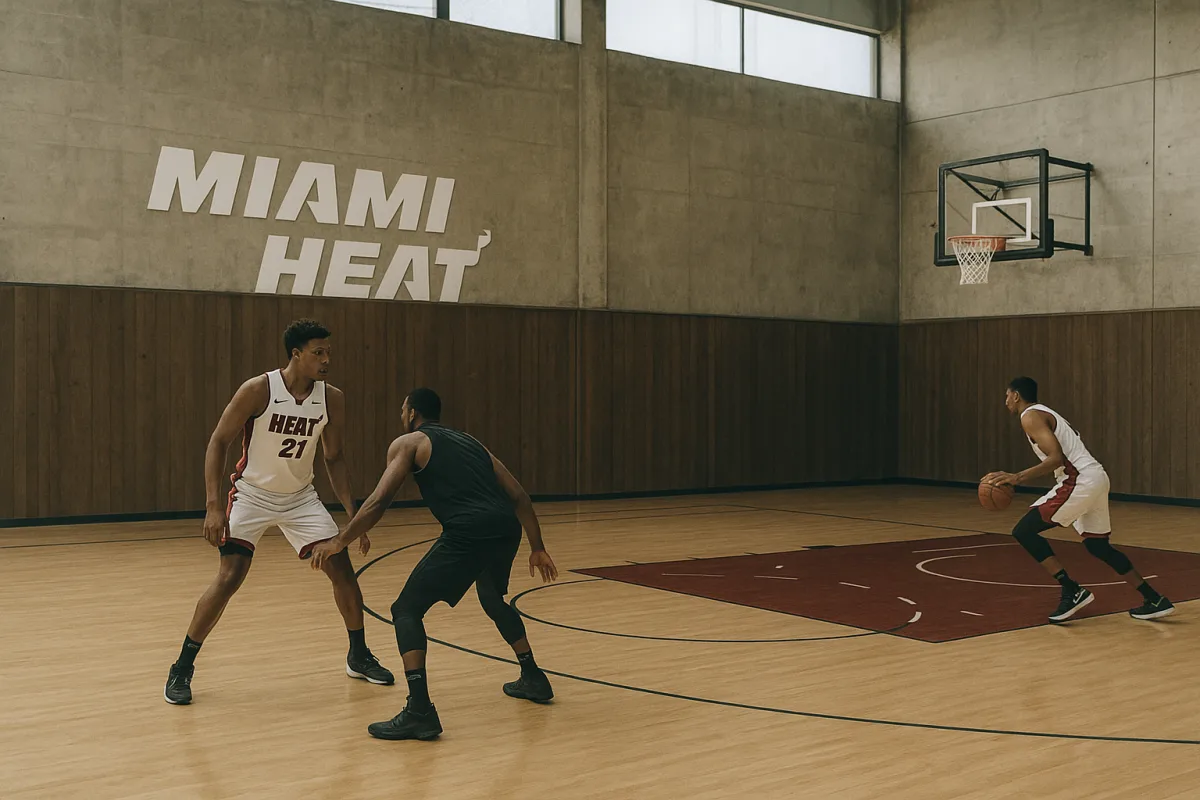
Miami did not sign Klay Thompson for points. It signed him for the defender he occupies.
The cleanest way to understand Klay Thompson’s move to the Miami Heat is not as a nostalgia bet on a four-time champion, or even as a simple attempt to add shooting around Giannis Antetokounmpo. It is a bet on one possession-level effect: Thompson’s gravity changes the help defender that Giannis sees on his first step.
That is the job. If Thompson can still force a defender to stay attached to him one pass away, Miami’s new offense has a chance to work at championship level. If opponents can treat him as a stationary, low-volume veteran shooter and send his defender into the paint anyway, the Heat will have paid for a name without solving their most important spacing problem.
The financial route into Miami matters because it reveals how specifically the Heat value that effect. Thompson reached a buyout agreement with the Dallas Mavericks on August 21, giving up roughly $9.8 million from the $17.5 million owed to him for 2026-27. He received approximately $7.7 million, while Dallas created about $9.8 million in cap relief, not the full $17.5 million disappearing from its books. [1] That distinction is important. A buyout is not necessarily a team erasing an entire contract. It is a negotiated settlement in which the player surrenders some salary to gain control of his destination.
After clearing waivers, Thompson agreed to a two-year Miami deal reported at approximately $11.5 million, with a player option in the second season and a 15 percent trade kicker. [9] Some reporting placed the total closer to $13 million, but the $11.5 million figure is the more precise recent reporting. [9] Either way, this is not Miami paying for the version of Thompson who made five straight All-Star teams in Golden State. It is Miami paying a modest number for a specialist skill that still travels through age: the ability to demand attention before the ball reaches him.
At his introductory press conference, carried by Chaz NBA, Thompson called 2026-27 a “redemption season” and described Miami as a chance to show he can still impact winning consistently. The word matters less than the role implied by it. Redemption cannot mean trying to recreate 2016 Thompson, when he could take top perimeter matchups, sprint through screens for 35 minutes and create a bigger share of his own offense. It has to mean becoming useful in a narrower, more severe job description.
What shooting gravity actually means
“Shooting gravity” is often used lazily. It does not mean a player shoots a good percentage. It does not mean every shooter creates the same spacing. And it certainly does not mean that putting four nominal shooters around a star automatically produces an efficient offense.
Gravity is the degree to which a defense changes its positioning before the shooter has touched the ball.
A player with real gravity makes a defender less available to help elsewhere. That can show up in several ways:
- The defender does not leave the shooter to tag a roller.
- The defender is late “nailing” into the lane to stop a drive.
- The defense is reluctant to switch a small defender onto a bigger player because it would place a weaker closeout defender on the shooter.
- A help defender closes out hard enough that a simple one-dribble attack becomes available.
- The player’s movement off screens occupies two defenders, briefly creating a four-on-three advantage somewhere else.
Thompson’s remaining value is strongest in the first four. He averaged 11.7 points per game in Dallas in 2025-26, a career low, but made 38.3 percent of his threes on 7.6 attempts per game. [6] The raw 38.3 percent is useful, but the volume is the key companion number. A player attempting more than seven threes per game cannot be defended like a low-volume corner option who might take one open shot in a half.
That does not make every Thompson shot a good shot. It does mean that a defender who wanders into Giannis’s driving lane is gambling with a high-value catch-and-shoot look.
TheFlightMike’s report framed Thompson’s recent Dallas output as evidence that his shot remained more dependable than the rest of his game. The basic direction is right, though the larger conclusion should be narrower. Thompson’s defense has declined from its peak, and his self-created offense is not what it was before his torn ACL in 2019 and Achilles rupture in 2020. Those injuries cost him two full seasons. [11] Miami should not ask him to be a primary stopper or a secondary creator. The value proposition works only if the Heat ask him to be a difficult man to leave.
The possession Miami is trying to create
Start with a basic Giannis-Adebayo action. Giannis has the ball above the break. Bam Adebayo is near the free-throw line or approaching to screen. Thompson is on the weak-side wing, with Andrew Wiggins or another capable connector in the corner.
The defense has a structural problem before any screen arrives.
Giannis is dangerous downhill, so his on-ball defender cannot simply absorb contact without help. Adebayo is a credible screener, short-roll passer and finisher. The traditional response is to bring a low man from the weak-side corner or wing into the paint. That defender “tags” the roll man or forms the early wall that Giannis has faced throughout his career.
Against a non-shooter, the low man can stand in the lane early. Against Thompson, that same defender has to make a choice.
If he stays home, Giannis sees a cleaner driving lane and Adebayo has more room to roll or short-roll. If he tags Bam or crowds Giannis, the Heat can make the simple pass out to Thompson. If Thompson’s defender closes late, he shoots. If the closeout is too aggressive, Thompson can swing the ball, use one or two dribbles to improve the angle, or make the next pass before the defense resets.
That is what Thompson meant at the Chaz NBA-carried press conference when he said he could “free [Giannis] up for lanes to drive” and expected quality looks generated by Giannis, Adebayo and Wiggins. It is not a vague claim about fit. It is a specific defensive tax.
The best version of this does not even require Thompson to touch the ball. Giannis attacking a lane without a second defender at the nail is already a successful outcome. The possession has been altered by Thompson’s location and the defense’s memory of what happens when it loses him.
This is why a 38.3 percent three-point shooter can matter more than his 11.7 scoring average suggests. Points per game measures how many points a player personally scores. It does not directly measure how many help rotations he prevents, how often his defender is unable to clog the paint, or how many cleaner driving opportunities a teammate receives because the defender is afraid to leave him.
Those are real offensive effects, but they are not contained in a conventional box score.
The cost of asking Thompson to provide it
There is a reason Miami could acquire Thompson through a buyout and a relatively small contract. Offenses do not get a free source of gravity. A 36-year-old perimeter player has to be protected somewhere, and Miami’s answer will likely involve its broader defensive structure.
The Miami Herald reported that Erik Spoelstra’s Heat led the NBA in zone possessions for the third consecutive season in 2025-26. [4] Zone is relevant here because it can reduce the number of long, isolated chases a veteran wing faces against elite shot creators. Thompson can guard an area, communicate switches and use Adebayo’s range behind him rather than being asked to mirror a speedy guard across 28 feet of empty floor every trip.
But zone is not a hiding place that carries no cost. It asks all five defenders to rebound out of space rather than from a man assignment. It can concede above-the-break threes if the ball movement is sharp. And it can be stressed by teams that place a shooter in the short corner, pull the low defender downward, then flash a passer to the middle.
The more central Thompson becomes to Miami’s rotation, the more Spoelstra has to decide which problems he prefers. Miami can use size with Antetokounmpo, Adebayo and Wiggins around Thompson, allowing those defenders to cover more ground and handle tougher matchups. But large lineups can constrict spacing if Thompson is the only player opponents truly fear from deep. Alternatively, Miami can put more shooting around Giannis and Thompson, but then may need Thompson to survive against quicker perimeter players.
That is the actual roster-building tension. Thompson improves the Heat’s offensive geometry, but his value depends on being surrounded by defenders who can absorb the difficult assignments and shooters who keep Miami from becoming too easy to load up against.
Why this is a better role than Dallas offered
Thompson’s 2024-25 line in Dallas, 14.0 points per game on 39.1 percent from three, was already a step down from his prime, even if the three-point efficiency remained viable. [5] In 2025-26, the scoring fell to 11.7 points, his field-goal percentage to 39.3 percent and his three-point percentage to 38.3 percent. [6] Those numbers do not prove that he is finished, nor do they prove he is physically restored. There are no detailed public medical or fitness reports that justify declaring either outcome.
They do establish the reasonable expectation: Miami should not depend on Thompson to manufacture offense when a possession breaks down.
Giannis changes that requirement. A possession beginning with Giannis pressure at the rim creates a more natural diet for Thompson: kickouts, relocations, flare screens, pin-downs and quick decisions against a rotating defense. The Heat need Thompson’s release speed and movement instincts to keep the first advantage alive, not to initiate every advantage himself.
FOX Sports reported that Thompson joined Miami’s reworked core alongside Antetokounmpo and Adebayo. [7] That is the context in which his “redemption” language becomes credible. The Heat are not asking him to be their past. They are asking him to make their present defensive choices harder.
The championship case is narrow, but real
Miami’s title aspirations will be decided by bigger questions than Thompson: whether Giannis and Adebayo can produce enough half-court offense together, whether the roster has sufficient creation late in games, and whether the defense can hold up through four playoff rounds.
But Thompson addresses a specific failure point that can ruin a Giannis-centric offense. When a defense can station an extra body in the lane without consequence, Giannis sees a wall. When that body has to remain attached to a shooter with Thompson’s résumé and current volume, the wall has one less brick.
That is why the Heat made this move after the Dallas buyout rather than treating Thompson as a ceremonial veteran addition. The contract is small enough that Miami is not demanding an All-Star return. The role is clear enough that Thompson does not need to become the old Klay Thompson.
He needs to make one defender hesitate. In a playoff possession, against a defense built to crowd Giannis, that hesitation can be the whole play.
Frequently Asked Questions
What does shooting gravity mean in basketball?
Shooting gravity refers to the degree to which a defense changes its positioning before the shooter even touches the ball. A player with strong shooting gravity forces defenders to stay close, limiting their ability to help elsewhere, which can disrupt defensive schemes and create advantages for teammates.
How does Klay Thompson's shooting gravity affect the Miami Heat offense?
Thompson’s shooting gravity forces his defender to stay attached to him on the weak side, preventing that defender from helping inside against Giannis Antetokounmpo’s drives. This spacing challenge opens cleaner driving lanes for Giannis and more room for Bam Adebayo to roll or short-roll, enhancing the Heat’s offensive efficiency.
Why did Miami Heat sign Klay Thompson despite his lower scoring?
Miami signed Thompson not for his scoring volume but for the defensive attention he commands as a shooter. His ability to demand a defender’s presence before receiving the ball helps solve Miami’s spacing problems, which is more valuable to the Heat’s championship-level offense than his individual point totals.
How does Klay Thompson's defender impact Giannis Antetokounmpo's driving lanes?
If Thompson’s defender stays close to him, it limits their ability to “tag” or help on Giannis’s drives, giving Giannis cleaner paths to the basket. Conversely, if the defender leaves Thompson open, Miami can exploit that for catch-and-shoot opportunities, forcing the defense into difficult decisions.
What role will Klay Thompson play on the Miami Heat in 2026?
Thompson is expected to play a specialized role focused on spacing and shooting gravity rather than primary scoring or defense. He will be a catch-and-shoot specialist who occupies defenders and creates offensive advantages for Giannis and the team, rather than a primary creator or top defender.
Sources
The Miami Heat Just Got Klay Thompson For Free — TheFlightMike
Klay Thompson To Miami Just Got Crazier — A.M. Hoops
Klay Thompson talks signing with Heat & playing with Giannis - Intro Press Conference — Chaz NBA
Klay Thompson Excited For 'Redemption Season' With Heat — RealGM
Georges Niang, Warriors Agree To One-Year, $3.9M Deal — RealGM
Klay Thompson buyout nets Mavericks small bit of salary cap relief | Mavs Moneyball
Klay Thompson signs with Heat after Mavericks buyout | NBA.com
South Beach Gravity: Why Klay Thompson Is the Perfect Fit for Miami Heat's New Core
Heat’s Spoelstra has a love-hate relationship with zone defense | Miami Herald
Klay Thompson joins Heat, set to team up alongside newly acquired Giannis Antetokounmpo | FOX Sports
Klay Thompson officially signs with Heat after clearing waivers
The Surprising Financials Behind Klay Thompson's Exit From Mavericks
Watch Klay Thompson's Move to Miami Heat on Youtube
Also from the sources
Related Articles
Klay Thompson's Impact on the Miami Heat: Analysis
Explore Klay Thompson's impact on the Miami Heat and how his addition reshapes the team's dynamics and playoff aspirations.
Ausar Thompson Contract Extension and Defensive Impact
Explore Ausar Thompson's $155M contract extension and how his defense shapes the Detroit Pistons' future.
Toronto Raptors Underrated Contenders in the 2026 NBA Season
Explore why the Toronto Raptors are underrated contenders, focusing on defense, Kawhi Leonard's impact, and roster changes in 2026.

Ben Simmons NBA Comeback
Explore Ben Simmons NBA comeback, his role with Sacramento Kings, contract details, and challenges ahead for the 2026-27 season.