
NBA Salary Cap 2027-28: Impact of Second Apron and Contracts
Explore the NBA salary cap for 2027-28 and how the second apron affects team building, trades, and contract strategies.
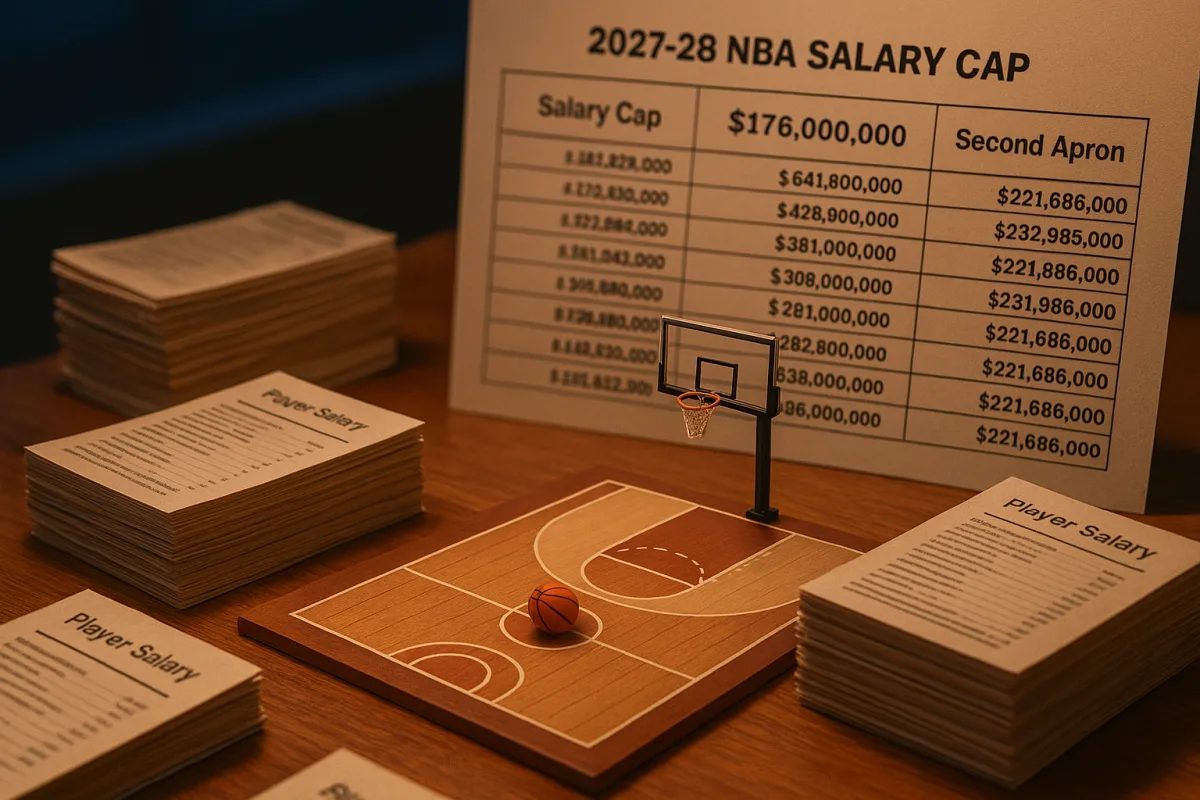
The Second Apron Is Not a Tax Bracket, It Is a Team-Building Coverage
The number that changes the possession
NBA cap analysis is often discussed as if payroll were a box score: add the salaries, compare the total to a threshold, then declare a team solvent or reckless. That misses what the second apron actually changes.
Think of it as a defensive coverage. A team can have the same star, the same payroll and the same championship ambition, but crossing one line changes which actions are available on the next possession.
For 2027-28, the NBA has told teams to work from a projected salary cap of $176 million, up from the previous $174 million projection. The projected luxury-tax line is $213 million. [1][2]
The second apron is projected at $221.686 million. That is only $8.686 million above the tax line, a relatively narrow strip of payroll space that can decide whether a front office can adjust a flawed roster. [3][4]
That gap is the important part. A club does not need a wildly extravagant payroll to reach the second apron. It can get there through one maximum contract, two upper-tier starters, a few retained role players and ordinary roster inflation.
The cap itself is a soft cap. NBA teams can exceed it through collectively bargained exceptions and through mechanisms allowing them to retain certain players. The problem is that those mechanisms do not operate the same way once a team reaches the apron tiers. [6][10]
In basketball terms, the cap is not necessarily the wall. The second apron is closer to a switching defense that takes away the easy read, then removes the counter once the first option fails.
Why $2 million can matter more than it sounds
The updated $176 million cap figure has a deceptively small headline effect. Two million dollars does not transform free agency, and it does not create another star slot for a capped-out contender. [1]
But apron planning is done at the margins. The difference may cover part of a veteran minimum contract, reduce a projected tax payment, or keep a team below a line on a date that determines its available tools.
That is why front offices build several payroll sheets rather than one. They model a roster with a departing free agent, a roster with that player re-signed, and versions including unlikely incentives or trade scenarios.
The final 2027-28 cap number will not be set until late June 2027, after the league reviews actual basketball-related income. The current figure is a projection, not a guarantee teams can safely spend against. [1][2]
That uncertainty matters because cap growth is tied to league revenue. Local media-rights changes and other revenue fluctuations can slow growth, which makes a contract signed on the assumption of an expanding cap more difficult to carry. [1]
A team sitting $1 million below a projected apron is not necessarily safe. Incentives, incomplete-roster charges and subsequent moves can alter the accounting picture. The relevant question is not today’s payroll, but the payroll at the point restrictions apply.
This is where the popular “the owner can just pay the tax” line becomes incomplete. Ownership can choose to pay money. It cannot simply buy back the team-building tools the collective bargaining agreement removes.
What the second apron actually takes away
The clearest restriction involves trade aggregation. Under the second-apron rules, teams cannot combine the salaries of multiple outgoing players to match the salary of a more expensive incoming player in a trade. [4][5]
That sounds technical, but it changes the shape of possible deals. A team with three useful mid-sized contracts cannot package them into one larger contract as readily as an unrestricted team could.
Suppose a contender needs a bigger wing creator because its late-clock offense has become too dependent on one guard. Below the apron, it might use two rotation salaries and draft compensation to chase that player.
Above the second apron, that two-for-one salary construction is unavailable. The club may still have players it would prefer to move, but it cannot turn their combined pay into a matching trade package. [4]
That is the roster-building equivalent of losing the screen that creates your preferred matchup. The player need has not disappeared. The assets may still exist. The pathway from need to solution has narrowed.
Second-apron teams also lose access to the mid-level exception, the mechanism teams commonly use to sign players above the minimum without conventional cap room. [4][5]
This matters most after an injury or an unexpectedly poor fit. A normal contender can identify a rotation weakness, then pursue a credible veteran using a designated exception. A second-apron club has fewer answers beyond minimum contracts and internal development.
The other long-horizon consequence involves draft picks. Second-apron rules can freeze future first-round picks, subject to conditions in the collective bargaining agreement. [4][5]
A frozen pick is not simply a bookkeeping issue. Draft picks are the cleanest trade currency for a team whose salary structure has become rigid, particularly when its own useful rotation players are already paid at market value.
The resulting problem is layered. The team cannot aggregate salaries easily, lacks the mid-level exception, and may face constraints on the future first-round pick it would normally use to compensate for an unfavorable contract.
The real price of a maximum contract
A maximum salary is not automatically bad business. The NBA’s best players are supposed to command a major share of their club’s resources, because elite creation and playoff scalability are scarce.
The useful question is whether the contract leaves the team with functional lineup answers. Can it still acquire a wing defender? Can it replace a departing center? Can it add shooting without needing a perfect bargain?
Phoenix Suns guard Devin Booker is a clean illustration of the distinction between a large number and a cap conclusion. ESPN reported that Booker signed a two-year, $145 million maximum extension in July 2025. [7]
Booker’s listed 2027-28 base salary is $61,015,192. That is roughly 34.7 percent of the current $176 million cap projection, an enormous share for one player but not, by itself, proof of a damaging deal. [1][8]
The A.M. Hoops channel’s video frames Booker’s future pay as a four-year, $251 million obligation and uses it as evidence that Phoenix cannot build a contender. Publicly reported contract information does not support that characterization. [7][8]
More importantly, the video’s premise confuses a player evaluation with a roster-construction evaluation. Whether Booker produces value is a basketball question. Whether Phoenix can build around his salary is an apron and asset-management question.
There are no official 2026-27 performance metrics available before that season begins, so projecting Booker’s next season from imagined results would be analysis without film. The contract mechanics, however, are already knowable. [8]
If Phoenix reaches the second apron, the cost is not simply that Booker’s salary occupies a big portion of payroll. The cost is that a front office has less ability to use its remaining salaries as a repair package.
That distinction applies to every expensive veteran contract. The issue is not that the player earns a large figure in isolation. It is whether the team has enough inexpensive contributors, movable medium salaries and draft capital around him.
Why roster fit and cap fit are connected
Film analysis starts with roles. A non-shooting big can be valuable, but his value changes if the other frontcourt player also operates inside. A scorer can be useful, but his fit changes if no one else creates advantages.
Cap work should be read with the same discipline. A team that commits heavily to several players with overlapping roles is not just paying for talent, it is paying to narrow the ways it can change lineups later.
The Hoops Reference channel’s offseason video repeatedly identifies roster problems as fit problems: a lack of ball handling, insufficient spacing, a redundant center pairing, or veterans occupying developmental touches. Those are valid categories of basketball analysis.
But the second apron is what turns some ordinary fit problems into structural problems. A team below it can make a multi-player adjustment. A team above it may have to wait for contracts to expire or settle for a lesser solution.
That is why the worst contract is not always the largest one. A short expensive deal on a team with young cheap talent and draft assets can be manageable. A smaller multi-year overpay on an apron team can be harder to escape.
Luxury-tax payments still matter. Tax penalties rise as a team moves further above the tax line, and repeat taxpayers face harsher rates after paying tax in three of four seasons. [5][6]
Yet the tax bill is only the visible cost. The hidden cost is opportunity: the trade the team cannot structure, the rotation player it cannot sign with an exception, and the future pick that loses immediate utility.
The NBA’s punishment of the Los Angeles Clippers and owner Steve Ballmer over improper payments connected to Kawhi Leonard is a separate matter from apron accounting, but it underscores the stakes of financial compliance. [9]
Teams are not merely balancing competitive ambition against payroll. They are operating inside a rulebook where improper conduct creates reputational and league penalties, while legal overspending can still reduce practical roster flexibility.
For 2027-28, the most disciplined approach is to treat $221.686 million as more than a number on a payroll spreadsheet. It is the line where a team’s next adjustment gets materially harder to execute. [3][4]
Frequently Asked Questions
What is the NBA salary cap for the 2027-28 season?
The NBA’s projected salary cap for the 2027-28 season is $176 million, which is a $2 million increase from the prior estimate of $174 million. This figure is provisional and will be finalized in late June 2027 after the league reviews actual basketball-related income.
How does the second apron affect NBA team building in 2027-28?
The second apron, set at $221.686 million for 2027-28, acts as a threshold that limits a team’s roster-building options. Teams above this line lose the ability to combine salaries in trades, use the mid-level exception, and have their future first-round draft picks frozen except in limited cases. It effectively restricts how teams can adjust or repair their rosters.
What restrictions come with exceeding the NBA second apron?
Teams exceeding the second apron cannot aggregate salaries in trades, lose access to the mid-level exception for signings, and have their future first-round draft picks frozen except under specific conditions. Additionally, luxury tax penalties escalate with the amount a team is above the tax line, and repeat offenders face steeper rates.
How does the 2027-28 salary cap projection impact NBA contracts?
The modest $2 million increase in the projected salary cap does not drastically change free agency or create new star slots for capped-out teams. However, it can cover part of a veteran minimum contract, reduce projected tax payments, or keep a team below critical salary thresholds that determine available roster-building tools.
Why does a $2 million increase in the NBA salary cap matter?
Though seemingly small, a $2 million increase matters because apron planning is done at the margins. This difference can influence whether a team can sign a veteran minimum player, reduce luxury tax costs, or remain under the second apron line, which affects the team’s flexibility in trades and signings.
How we researched this
This article was assembled from 2 video sources across 2 channels, 10 cited references.
Nothing here is based on hands-on testing. Where a figure or finding appears, it belongs to the source cited beside it, and the writing says so rather than implying otherwise. Every source is listed below so you can check it.
Sources
The 7 Worst Contracts in the NBA — A.M. Hoops
Every NBA Team's Biggest MISTAKE This Offseason — Hoops Reference
NBA salary cap rises to $176M for the 2027-28 season - Eurohoops
NBA sets salary cap for 2026-27 season at $164.961 million | NBA.com
NBA Second Tax Apron Explained: Rules and Penalties - LegalClarity
How the NBA salary cap works · NBA Team Wiki | NBA Team Wiki
Devin Booker agrees to 2-year, $145M max extension with Suns - ESPN
Devin Booker (G) - Phoenix Suns 2026-27 NBA Contract & Salary Details | FTA
Watch NBA Salary Cap and Contract Issues for 2027-28 Season on Youtube
Also from the sources
Related Articles
Nikola Jokic Trade and Denver Nuggets Future Explained
Explore the Nikola Jokic trade rumors, Peyton Watson sign-and-trade, and how Denver Nuggets' salary cap affects their future roster moves.
Steph Curry Warriors Contract Future and Over-38 Rule
Explore Steph Curry's contract future with the Warriors and how the Over-38 Rule shapes his extension options and team roster decisions.

NBA 2026 Offseason Analysis: Key Moves and Team Strategies
Explore the NBA 2026 offseason analysis with insights on major trades, signings, and team-building strategies shaping the upcoming season.

Lakers Roster Challenges and Trade Options in 2026
Explore the Lakers' 2026 roster challenges, defensive issues, and trade options for a wing defender amid salary cap limits.