
NBA Trade Rumors Involving Miami Heat and Los Angeles Lakers
Explore the latest NBA trade rumors involving the Miami Heat and Lakers, including roster moves, player targets, and strategic analysis.
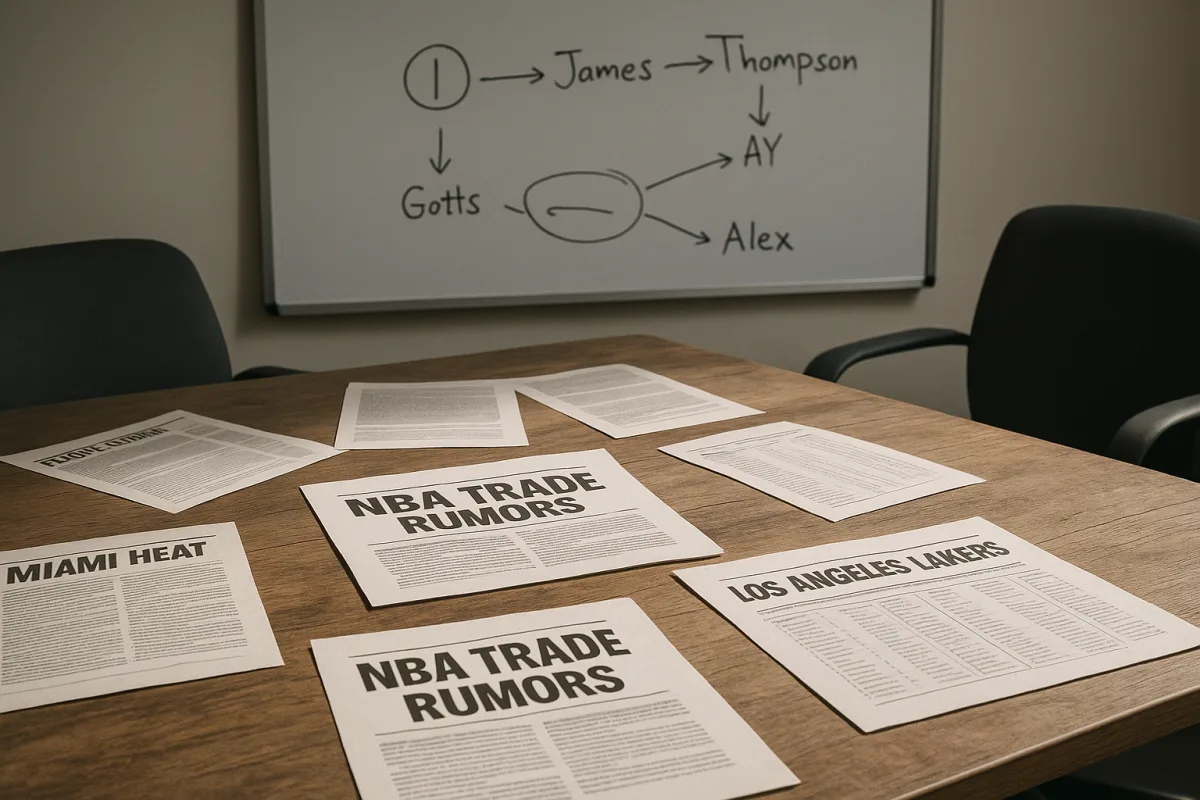
The decision point is not whether Miami or Los Angeles can be attached to another star in an aggregator headline. It is whether the proposed move changes the possessions that have held each team back, without creating a payroll or lineup problem larger than the one it solves.
Miami’s actual work has been aggressive at the top of the roster. The Lakers’ actual work has been more unsettled, shaped by a speculative center proposal and a major ownership fight. Those are not comparable situations. The Heat are trying to layer enough handling and shooting around Giannis Antetokounmpo and Bam Adebayo. The Lakers are trying to decide whether a floor-spacing rim protector is worth giving up mobile defensive depth, a young guard and even limited draft capital while their ownership structure remains in dispute.
The key distinction: Miami’s rumored point-guard pursuit lacks a confirmed player, package or negotiation. The Lakers’ Myles Turner proposal at least has a defined basketball hypothesis, even if it remains a projection rather than reporting.
Miami’s point-guard rumor is not a transaction
The Yahoo Sports item is framed around a projected trade that would put a 17-points-per-game rising point guard next to Antetokounmpo in Miami. Readers should treat that framing as a proposal, not a report of an active negotiation. As of August 26, there was no confirmed reporting that the Heat were pursuing a specific 17-point-per-game guard, nor was there a verified offer to evaluate.
That does not mean Miami’s backcourt issue is imaginary. It means the debate should start with the roster move that actually happened. NBA.com reported that Klay Thompson joined Miami after a Mavericks buyout on a two-year deal worth about $11.5 million. [2] Thompson changes the geometry of a possession even when he does not touch the ball. A defense that top-locks him off pindowns or trails him around a dribble handoff has fewer bodies available to sit in Antetokounmpo’s driving lane.
That is especially meaningful beside Adebayo. In a typical Giannis-Bam frontcourt possession, the spacing question is not simply whether both bigs can make a jumper. It is whether one can occupy the weak-side defender while the other screens, dives, short-rolls or attacks from the elbow. Thompson’s movement shooting can pull a defender above the free-throw line and open a clearer low-man decision. The low man either tags Antetokounmpo’s roll or stays attached to Thompson. That is the choice Miami wants to force.
But Thompson does not by himself solve the ball-handling demand. He is a finisher of an advantage, not a full-time organizer who can repeatedly manipulate a switch, get two feet in the paint and create a passing window on the second side. That is why a playmaking-guard search makes basketball sense.
Chat Sports reported that Miami was exploring options involving young forward Nikola Jovic in pursuit of a playmaking guard, with Kyrie Irving mentioned as a possible target. [3] That is still a long distance from confirmed talks. More importantly, an Irving-level acquisition and an unspecified rising 17-point-per-game guard are different roster choices.
A high-usage creator can solve late-clock offense. In film terms, he gives Miami a player who can beat the first defender without needing a perfect screen angle, then punish the helper with a corner pass or a pull-up. The trade-off is that possessions become more dependent on one creator’s decisions, and the Heat would have to ensure Antetokounmpo remains an active screener, cutter and transition threat rather than an expensive stationary outlet.
The unnamed 17-point scorer, by contrast, is impossible to assess properly without knowing how those points are produced. Seventeen points per game can mean a transition guard, a pull-up shooter, a high-volume pick-and-roll initiator or a player who benefits from another star bending the defense first. It does not measure passing vision, turnover resistance, screen navigation, point-of-attack defense or playoff shot creation. Miami should not be evaluated as though it has already identified the right archetype.
The Heat’s real price is financial flexibility
Miami is not operating with unlimited room to correct a bad fit later. Hot Hot Hoops reported the Heat were roughly $2 million above the luxury-tax line and $10.6 million below the $209.015 million first apron as of August 23. [5] The same outlet reported that Miami used its $16.8 million trade exception to acquire Bobby Portis and allowed a separate $5.6 million exception to expire on August 15. [5]
That is the price side of the Heat’s decision. A roster can look deep on a whiteboard and still be constrained in practice if every subsequent move must clear matching-salary rules and apron restrictions. Coldmast reported that Miami had only about $10 million remaining for 2026-27 additions under its hard-cap constraints. [6] The exact legal mechanisms matter because the Heat cannot simply identify a guard and assume the rest follows.
Jovic is also more than a name in a rumor package. Moving a young, bigger forward for a smaller guard may improve the first-side pick-and-roll, but it reduces lineup elasticity. A Jovic-sized forward can preserve some switchability and frontcourt depth in regular-season minutes. A guard acquisition raises the offense’s ceiling only if Miami can still survive the defensive possessions after a switch, a cross-match or a missed shot that becomes transition defense.
That concern becomes sharper with Antetokounmpo, Adebayo and Thompson already requiring distinct tactical accommodations. Antetokounmpo needs driving corridors. Adebayo needs enough space to operate as a screener and short-roll passer. Thompson needs movement actions that do not stagnate into watching a superstar isolation. The answer is not simply to collect scoring average. It is to find a guard who can create without turning the other four players into spectators.
The Lakers’ Turner proposal has a cleaner on-court logic
The Lakers’ most concrete rumor is still only a hypothetical. Heavy projected a deal in which Los Angeles would receive Milwaukee center Myles Turner for Jarred Vanderbilt, Rob Dillingham and a 2031 second-round pick. [7] There is no official indication that the Lakers and Bucks are close to such a transaction, so this is not an imminent-move report.
Still, it is a more legible basketball case than Miami’s unnamed 17-point guard. Turner is listed at 6-foot-11, and Heavy’s proposal rests on a profile that is unusually useful in modern playoff construction: a center who can protect the rim while making defenses account for him beyond the arc. [7] In 2024-25, Turner reportedly led the NBA in blocks per game, made more than 100 threes and shot 38 percent from three. [7]
Those numbers describe separate traits. Blocks per game are not a complete measure of defense, since they do not capture whether a big can contain the ball, deter attempts or recover after a rotation. Three-point percentage does not prove shooting versatility, because volume, shot difficulty and whether attempts are above the break all matter. But the combination points to a valuable lineup effect: Turner can station himself above the break or in the corner, pulling the opposing center away from the basket while retaining the size to contest at the rim on the other end.
That changes the layout for Los Angeles more directly than a conventional center would. If the Lakers’ lead creators run high pick-and-roll, Turner’s defender cannot comfortably camp at the nail and invite a pick-and-pop three. If the Lakers use five-out spacing, the lane has a better chance to remain open for drives and post entries. Defensively, Turner permits more aggressive help from wings because he can be the back-line shot deterrent.
The cost is not trivial. Vanderbilt’s value is not captured by the fact that he is not a shooter. He offers a different defensive answer, namely the ability to take difficult wing assignments, scramble through help rotations and switch more comfortably than a traditional center. Dillingham represents a young perimeter bet, the type of player a team may need if its current stars cannot create every late-clock advantage forever. Even a 2031 second-round pick is a future optionality chip, particularly when a franchise may eventually need inexpensive contributors around high salaries.
Los Angeles has already made real roster changes. The Los Angeles Times reported that the Lakers sent Deandre Ayton to Washington in July for Jaden Hardy and two second-round picks. The club also acquired Luke Kennard in February for Gabe Vincent and a 2032 second-round pick, according to NBA.com. Those transactions point toward an offense seeking more perimeter skill and shot-making. A Turner deal would push the same direction, but with a much stronger defensive-big component.
Ownership uncertainty is the Lakers’ hidden trade cost
The Lakers’ situation cannot be reduced to a normal roster optimization exercise. Axios reported that Bob Iger and Joshua Kushner agreed to buy the franchise for $12.5 billion. [1] The Los Angeles Times subsequently reported that Jeanie Buss contested the proposed sale of the Buss family’s 17.8 percent stake, arguing that five siblings’ votes could not override her approval rights. [4]
No public report establishes a specific post-sale trade target or a change in basketball operations policy. It would be irresponsible to claim that ownership uncertainty means the Lakers will or will not trade for Turner. But it is a genuine context variable. A front office negotiating a multiyear commitment has to know who has final authority, how aggressively ownership will spend into tax territory and whether a major organizational transition changes its appetite for giving up young players and picks.
That uncertainty also makes the separate Heavy headline predicting that the Lakers could move on from a failed first-round pick while a Jonathan Kuminga deal looms difficult to treat as actionable reporting. The supplied excerpt does not establish a player, a package or a confirmed negotiation. A headline can identify a roster tension. It cannot establish that a transaction is near.
The common lesson is patience, not passivity
Recent star movement offers a useful warning against treating every expensive move as an obvious upgrade. Sports Business Journal reported that Boston characterized its July trade of Jaylen Brown to Philadelphia as a basketball decision amid the burden of carrying two players at 35 percent of the cap. [8] CBS Sports’ assessment of Milwaukee’s Antetokounmpo trade process similarly centered on whether the Bucks waited too long and whether they chose the right package. [9]
That is the real comparison between Miami and Los Angeles. Miami has already paid the premium for star power and now has to protect the lineup around it. The Lakers have a plausible upgrade available in theory, but must decide whether Turner’s rare two-way center profile is worth sacrificing switchable depth and developmental upside during an ownership dispute.
Miami’s best option suits a team that can identify a genuine organizer at a manageable salary, preferably one who defends his position and creates advantages without monopolizing possessions. The Heat should resist treating an unverified 17-point scorer as a solution by default.
The Lakers’ Turner concept suits a team prioritizing five-out spacing, rim protection and a cleaner pick-and-roll structure around established creators. It does not suit a team that believes Vanderbilt’s defensive versatility and Dillingham’s long-term guard development are essential to its next roster cycle.
Frequently Asked Questions
What are the latest NBA trade rumors involving the Miami Heat and Los Angeles Lakers?
As of late August 2026, Miami’s rumored pursuit of a 17-points-per-game rising point guard remains unconfirmed, with no verified offers or specific players identified. The Heat have explored trade options involving Nikola Jovic and mentioned Kyrie Irving as a possible target, but no concrete talks are reported. For the Lakers, the most discussed trade proposal involves Myles Turner, but it remains hypothetical amid ongoing ownership disputes and no confirmed roster moves.
How could a Myles Turner trade impact the Lakers' roster?
The Lakers’ Myles Turner trade proposal is centered on acquiring a floor-spacing rim protector to improve defense and spacing. However, the team would have to give up mobile defensive depth, a young guard, and some draft capital. This trade hypothesis is still speculative and reflects the Lakers’ unsettled roster situation amid ownership turmoil.
What is the status of Miami Heat's search for a playmaking guard?
Miami is actively seeking to add handling and shooting around Giannis Antetokounmpo and Bam Adebayo but has not confirmed any specific trade or player for a playmaking guard. The team’s acquisition of Klay Thompson addresses shooting and spacing but does not solve the full-time ball-handling and playmaking need. Rumors include exploring trades involving Nikola Jovic and targeting Kyrie Irving, but these remain unconfirmed.
How does Klay Thompson's addition affect the Miami Heat lineup?
Klay Thompson’s arrival changes Miami’s offensive spacing by pulling defenders away from the paint, which helps create driving lanes for Antetokounmpo and screens for Adebayo. His movement shooting forces defensive choices that can open clearer opportunities for the low man in pick-and-roll actions. However, Thompson is more of a finisher than a primary ball-handler, so he does not fully address Miami’s need for a playmaking guard.
What financial constraints affect the Heat's trade decisions?
The Heat are about $2 million over the luxury tax line and roughly $10 million below the first apron, with only about $10 million remaining under hard-cap rules for 2026-27 additions. They have already used a $16.8 million trade exception to acquire Bobby Portis and lost a $5.6 million exception in mid-August. These salary cap and trade exception limits restrict Miami’s flexibility to make additional moves without creating larger payroll or lineup problems.
Sources
NBA Teams Who Rejected These Trades...And Paid The Price — Andy Hoops
Projected NBA Trade Gives Miami Heat 17 PPG Rising Star PG Next to Giannis — Yahoo Sports
Lakers Predicted To Cut Ties With Failed First-Round Pick As Kuminga Deal Looms — heavy.com
Eight years after Brett Brown went ‘star hunting,’ the one he really wanted lands in Philly — SB Nation
Projected NBA Trade Gives Lakers 6’11” Elite 3-Point Shooter, 2x Blocks Champ — heavy.com
Damian Lillard Projected to Join Celtics in Blockbuster 3-Player NBA Trade — heavy.com
Josh Kushner and Bob Iger buying the LA Lakers for $12.5 billion
Klay Thompson signs with Heat after Mavericks buyout | NBA.com
Jeanie Buss contests family sale of Lakers ownership stake - Los Angeles Times
Heat are running out of time to use final trade exception - Hot Hot Hoops - Miami HEAT NBA Blog
Heat pursuing DeRozan despite hard cap constraints - Coldmast
Projected NBA Trade Gives Lakers 6'11" Elite 3-Point Shooter, 2x Blocks Champ
Boston Celtics defend Jaylen Brown trade as 'basketball decision'
Watch NBA Trade and Roster Rumors Involving Heat and Lakers on Youtube
Related Articles

Lakers Roster Challenges and Trade Options in 2026
Explore the Lakers' 2026 roster challenges, defensive issues, and trade options for a wing defender amid salary cap limits.

NBA Top Player Trade Candidates and Rankings for 2026
Explore NBA top player trade candidates and rankings for 2026, including detailed analysis of Michael Porter Jr. and Myles Turner.
Nikola Jokic Trade and Denver Nuggets Future Explained
Explore the Nikola Jokic trade rumors, Peyton Watson sign-and-trade, and how Denver Nuggets' salary cap affects their future roster moves.

Klay Thompson's Impact on the Miami Heat: Analysis
Explore Klay Thompson's impact on the Miami Heat and how his addition reshapes the team's dynamics and playoff aspirations.