
NBA Training Camp Contract Types and Roster Rules Explained
Learn about NBA training camp contract types, roster rules, and how Exhibit 10 and two-way deals impact preseason battles and G League pathways.
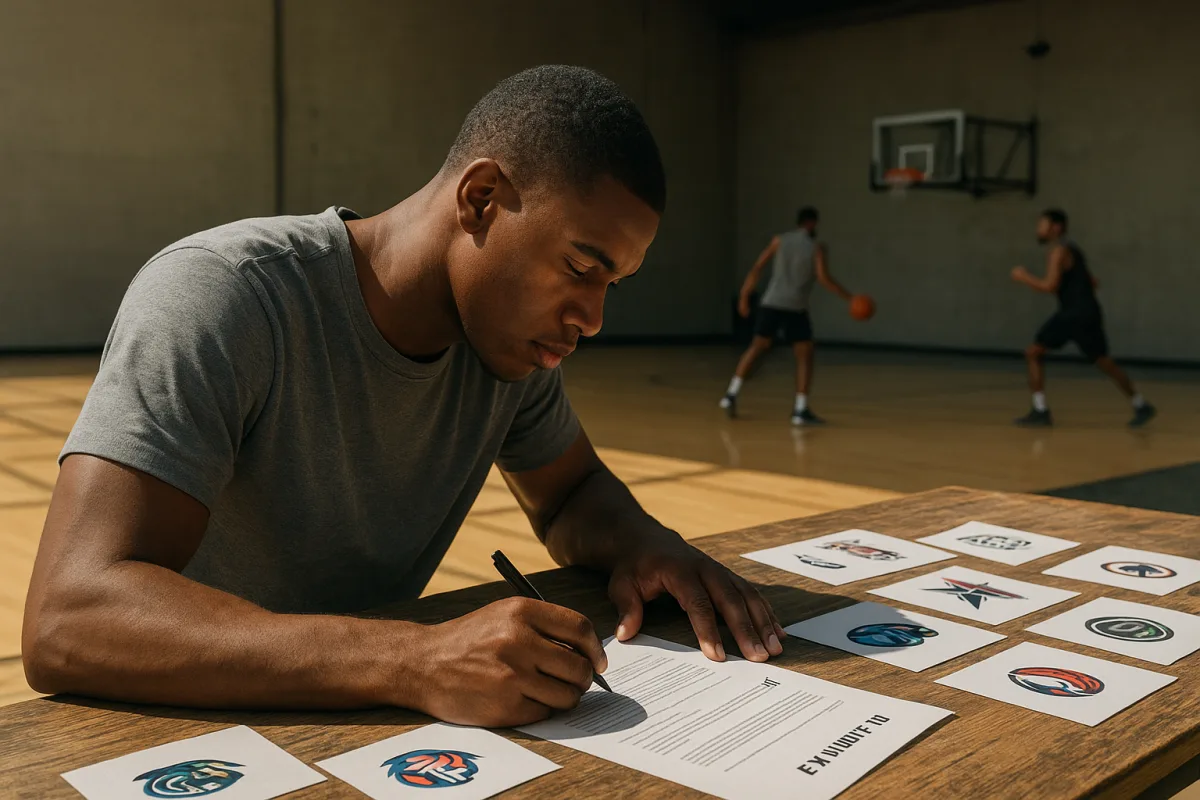
NBA Training Camp Signings and Roster Updates: How to Read the 2027 Camp Battles
Start with the contract, because the transaction label matters
Training-camp news can look like a stream of additions and cuts, but an Exhibit 10 deal is not the same as a standard NBA contract or a two-way contract. It is a one-year, non-guaranteed minimum contract that can be converted to a two-way deal before the regular season. [1][2]
The practical incentive is the affiliate route. If a player is waived and then joins that team’s G League affiliate under the required conditions, the deal can include a bonus of up to approximately $85,000. [1][2]
That explains the quick churn reported across the league. A player may sign on Monday, be waived later that week, and still be part of the organization’s basketball plan for the winter rather than abruptly out of work.
Readers should therefore resist treating every waiver as a verdict on the player’s talent. The better question is whether the NBA club has a standard slot, a two-way slot, or simply wants to retain that player’s G League rights.
The roster math is stable heading into the 2027 season. Teams can carry 15 players on standard NBA contracts and up to three on two-way contracts, creating a maximum 18-player NBA roster structure. [3][4]
Two-way eligibility also matters in evaluating who can plausibly win a spot. Players must have fewer than four years of NBA service, and a two-way player can be active for a maximum of 50 regular-season games. [3][4]
That structure changes what teams are watching on tape. A standard-roster candidate has to show he can survive a defined NBA role immediately. A two-way candidate can win with a developmental skill that the club believes will translate after more affiliate reps.
Find the real opening before evaluating the player
Chicago offers the most defined battle in this group. RealGM reported that the Bulls entered camp with one open standard roster spot and one available two-way position after signing Brandon Boston Jr., Drew Peterson, Orlando Robinson and Marquel Sutton to camp deals, while waiving Houston Mallette.
The first useful distinction is positional. Peterson is a forward whose prior G League profile included connective production, while Robinson is a large frontcourt player whose earlier G League work showed high-volume scoring, rebounding and rim protection. Boston is a wing scorer returning from a season with Fenerbahçe.
Those labels do not settle the competition, but they identify the possessions each player must win. Peterson’s path is likely to run through fast decisions, spacing discipline and defensive rotations. Robinson’s path is more about screening angles, interior finishing, defensive rebounding and whether he can protect the rim without breaking the scheme.
RealGM identified Peterson and Peter Suder as possible competitors for Chicago’s two-way opening. That should be read as an open evaluation, not an announced head-to-head. No public reporting details Chicago’s internal grading process or identifies a preferred candidate.
Chicago’s camp begins September 29 after Peterson and Suder signed camp contracts on September 25, according to the independent reporting brief. The most meaningful evidence will be preseason possessions, particularly who fits beside the Bulls’ existing ballhandlers and bigs without requiring the offense to be rebuilt around them.
There is also an important information limit here. No updated performance or scouting data beyond the prior season was identified for Boston, Peterson, Robinson or Sutton. Do not project a leap, decline or new role before camp reporting establishes one.
Watch fit possessions, not G League totals in isolation
G League production is useful context, but it does not transfer automatically to NBA rotation value. A player averaging efficiently in a larger G League role may be asked to take far fewer shots, make quicker reads and defend more complex screening actions in NBA preseason minutes.
For a player like Peterson, the relevant clips are not only catch-and-shoot makes. Watch whether he remains available after initiating a dribble handoff, whether he makes the next pass against a closeout, and whether he can switch or stunt without losing the weak-side corner.
For Robinson, a box score can tell readers that he produced inside. It cannot tell them whether he can play at the level of the screen against pull-up shooting, recover to his man, and still finish the defensive possession with a rebound.
Boston’s overseas season should similarly be handled carefully. RealGM reported that he played for Fenerbahçe last season, but there is no newer scouting information in the research brief to support broad claims about how his game has changed.
The standard-roster opening makes Chicago’s decision more consequential than a simple affiliate assignment. Standard contracts provide a regular NBA roster place, while a two-way contract offers a more limited route that still permits meaningful regular-season availability. [3][4]
Read the camp-to-affiliate pipeline correctly
Sacramento’s moves present a cleaner affiliate case. RealGM reported that the Kings signed wing Leaky Black to an Exhibit 10 deal and waived Gabe Levin and Tyrone Marshall Jr., with all three expected to join the Stockton Kings after preseason.
Black’s NBA experience on a prior Washington two-way deal makes him the name to watch if Sacramento needs a wing defender in a short-term stretch. Still, the Exhibit 10 label means the immediate transaction does not promise a Kings roster place.
The tape question for a defense-oriented wing is specific. Can he absorb a primary assignment, navigate off-ball screens, rotate early enough to protect the nail, and make the simple offensive play after a stop? Those are the possessions that turn a G League call-up into playable NBA minutes.
Utah followed a similar pattern, signing center Jonas Aidoo and guard Jaelen House to Exhibit 10 deals while waiving Ibrahima Diallo and Justin Harmon. RealGM expects all four to join the Salt Lake City Stars after the preseason.
House’s prior G League assist output makes playmaking the obvious entry point, but teams will also watch whether a smaller guard can be targeted defensively. The key film is not just a highlight pass, it is whether he creates an advantage without overdribbling into a trapped pick-and-roll.
Aidoo’s evaluation is more frontcourt-specific. A center competing for organizational minutes must show dependable screen contact, defensive communication, paint positioning and rebounding outside his immediate area. Those details determine whether a coach can use him in a second unit with a real scheme.
Toronto also made an affiliate-oriented reshuffle. RealGM reported that the Raptors signed guards Nimari Burnett and Tyreke Key to Exhibit 10 contracts, waived AJ Hoggard, and expect all three to join Raptors 905 after preseason.
Key already played for Raptors 905 last season, which gives Toronto a degree of continuity. Burnett’s route is different, as an undrafted guard entering the organization’s development environment. Neither profile should be judged solely by preseason points.
Separate guard battles from big-man battles
San Antonio’s three Exhibit 10 additions illustrate why roster battles cannot be reduced to “best player wins.” The Spurs added guards R.J. Davis and Jon Elmore and center Malik Williams, then waived guard Jayden Nunn, according to RealGM.
Davis and Elmore are both guards with prior G League creation experience, but their paths can diverge quickly. One may be asked to organize second-unit offense, while another might need to prove he can play off the ball beside a higher-usage creator.
Williams has a clearer positional test. A big man earns trust through screen-and-roll timing, coverage versatility and defensive finishing. A blocked shot is one event, while a sound possession includes calling the coverage, tagging the roller and securing the rebound afterward.
All four are expected to join the Austin Spurs following preseason, RealGM reported. That projected landing spot matters because the affiliate provides the repetitions that camp cannot, especially for players needing on-ball reps or a chance to learn the parent club’s terminology.
Minnesota’s move is more interesting because the incoming player already has two-way experience. RealGM reported that the Timberwolves signed guard Antonio Reeves, waived forwards Payton Sandfort and Nate Santos, and were also expected to bring forwards K.J. Martin and Drew Timme to camp.
Reeves’ prior Charlotte two-way season gives him a familiar framework, but it does not guarantee Minnesota’s roster construction will fit him. On a team with established creators, a scoring guard must demonstrate that he can defend, relocate and make rapid reads when he is not the first option.
The reported additions of Martin and Timme would make Minnesota’s forward minutes especially crowded in camp. That means Sandfort and Santos being waived should be interpreted through the Iowa Wolves pathway RealGM reported, rather than as evidence that their development has stopped.
Understand why teams make quick waivers
Portland waived Keylan Boone, Barry Dunning Jr. and Mark Sears after all three had signed Exhibit 10 contracts earlier in the week. RealGM expects each player to join the Rip City Remix.
Detroit made the same kind of move with Jordan Riley and Romeo Weems, both of whom RealGM expects to join the Motor City Cruise. These are organizational transactions that preserve a development connection while avoiding the implication of a guaranteed NBA opportunity.
The economic choice is not trivial for the players involved. The Exhibit 10 bonus creates an incentive to remain in a team’s system, but the research brief notes that overseas opportunities can sometimes offer substantially higher seasonal earnings than the G League route.
That does not make either choice universally better. The NBA system offers proximity to call-ups, team-specific development and a familiar pathway to two-way conversion. Overseas basketball may offer a larger role or better immediate pay, depending on the market and contract.
There is no reliable public success-rate figure for Exhibit 10 players reaching standard NBA contracts. Any claim that a waiver is a routine stepping stone to the league would overstate a highly competitive process.
What to monitor once preseason games begin
For every guard in this group, chart the first three actions after he enters. Is he being trusted to initiate offense, stationed as a spacer, or used to defend the opponent’s primary ballhandler? That role assignment says more than a single scoring burst.
For wings, watch whether coaches keep them on the floor after substitutions change the matchup. A wing who can defend up a position, make the low-man rotation and keep the ball moving can solve lineup problems that a pure scorer cannot.
For centers, track coverage responsibility. If a big repeatedly plays in drop coverage, that may reflect the team’s system rather than a limitation. If he is asked to switch, hedge or play at the level, the coaching staff is testing a broader range of outcomes.
Finally, distinguish a preseason invitation from a roster win. The meaningful checkpoints are conversion to a two-way deal before the season, a standard-contract signing, or the expected G League affiliate assignment that keeps the player in the organization’s development pipeline.
Frequently Asked Questions
What is an Exhibit 10 contract in the NBA?
An Exhibit 10 contract is a one-year, non-guaranteed minimum salary deal that can be converted into a two-way contract before the regular season. It often serves as an affiliate-building move, allowing a waived player to join the team’s G League affiliate and earn a bonus of up to approximately $85,000 under certain conditions.
How do two-way contracts work during NBA training camp?
Two-way contracts allow players with fewer than four years of NBA service to split time between the NBA and G League, with eligibility to be active for up to 50 regular-season NBA games. Players on two-way deals must be converted to a standard contract before the playoff roster deadline to participate in the postseason.
What are the roster limits for NBA training camp?
NBA teams can carry up to 15 players on standard contracts and up to 3 players on two-way contracts, for a maximum roster size of 18 players. These limits shape the available openings during training camp and influence roster battles.
How do NBA teams use G League affiliates with training camp signings?
Teams often sign players to Exhibit 10 contracts and then waive them to retain their rights for the G League affiliate. This pathway includes a financial incentive for the player and allows the team to develop talent within their system without occupying an NBA roster spot.
What should fans know about NBA training camp roster battles?
Roster battles depend heavily on the actual openings available, such as standard or two-way slots, and the positional needs of the team. Performance in preseason possessions and fit with existing players often matter more than past G League statistics, and waivers after Exhibit 10 signings frequently reflect planned developmental assignments rather than outright rejection.
How we researched this
This article was assembled from 8 published articles, 10 cited references.
Nothing here is based on hands-on testing. Where a figure or finding appears, it belongs to the source cited beside it, and the writing says so rather than implying otherwise. Every source is listed below so you can check it.
Sources
Sacramento Kings Sign Leaky Black To Camp Deal; Waive Gabe Levin, Tyrone Marshall Jr — RealGM
Jazz Sign Jonas Aidoo, Jaelen House; Waive Ibrahima Diallo, Justin Harmon — RealGM
Raptors Sign Nimari Burnett, Tyreke Key; Waive AJ Hoggard — RealGM
Spurs Sign RJ Davis, Jon Elmore, Malik Williams; Waive Jayden Nunn — RealGM
Trail Blazers Waive Keylan Boone, Barry Dunning Jr, Mark Sears — RealGM
Timberwolves Sign Antonio Reeves; Waive Payton Sandfort, Nate Santos — RealGM
NBA Two-Way, 10-Day & Exhibit 10 Contracts, Explained (2026-27)
Comprehensive Guide to NBA Two-Way Contracts: Roster Rules, Cap Impact, and Development
NBA G League Player Financial Planning Guide 2026 | Athlete Advisor Match
Chicago Bulls Training Camp Roster: A Look at the Official 21-Player Group
Related Articles

NBA Training Camp Signings and Roster Battles Explained
Explore NBA training camp signings and roster battles, including contract types and player roles in team depth and rotation decisions.
New York Knicks Training Camp Roster Battles Explained
Explore the New York Knicks training camp roster battles, key players, and salary cap impact on 2026 roster decisions.
NBA Salary Cap 2027-28: Impact of Second Apron and Contracts
Explore the NBA salary cap for 2027-28 and how the second apron affects team building, trades, and contract strategies.

Stephen Curry Contract Talks and Warriors 2026-27 Outlook
Explore Stephen Curry contract talks, NBA rules, and how his decisions shape the Warriors' 2026-27 roster and salary cap outlook.