
NBA Training Camp Signings and Roster Battles Explained
Explore NBA training camp signings and roster battles, including contract types and player roles in team depth and rotation decisions.
The quick list
- Best overall fit: Bruce Brown, Knicks Exhibit 9 signing, for New York if it wants a proven playoff connector and lineup-flexible guard-wing rather than another developmental project.
- Best frontcourt insurance: Drew Eubanks, Knicks Exhibit 9 signing, for the Knicks if the immediate question is surviving non-Karl-Anthony Towns center minutes.
- Best upside swing: James Wiseman, Knicks Exhibit 9 signing, for a team willing to accept medical and rotation uncertainty in exchange for size and former No. 2-pick pedigree.
- Best two-way wing audition: Ochai Agbaji, Knicks Exhibit 9 signing, for a contender that wants to test whether a young wing can defend a role without demanding touches.
- Best low-usage connector: John Konchar, Knicks Exhibit 9 signing, for a roster seeking a supplementary wing who can keep possessions organized.
- Best Warriors development bet: Obi Agbim, Warriors Exhibit 10 signing, for Golden State if it wants a 6-foot-3 guard to develop through Santa Cruz.
- Best G League production case: Jayden Nunn, Spurs Exhibit 10 signing, for San Antonio if it values an affiliate guard coming off 15.3 points per game with Austin.
- Best specialist guard bet: Markquis Nowell, Pelicans Exhibit 10 signing, for New Orleans if it wants to evaluate a small lead guard with professional experience in North America and Europe.
- Best affiliate continuity play: David Stockton, waived by the Suns after an Exhibit 10 deal, for Phoenix’s Valley Suns infrastructure rather than its NBA rotation.
- Best size-only developmental look: Will Baker, waived by the Hawks after an Exhibit 10 deal, for Atlanta’s College Park Skyhawks as a center development option.
- Best veteran affiliate stabilizer: Stephen Thompson, Timberwolves Exhibit 10 signing, for Minnesota’s Iowa Wolves pipeline after three seasons with Wisconsin.
- Best waived-depth option: Jules Bernard, waived by the Timberwolves after an Exhibit 10 deal, for Iowa’s affiliate depth rather than a current Minnesota roster opening.
The actual decision: rotation help or organizational depth?
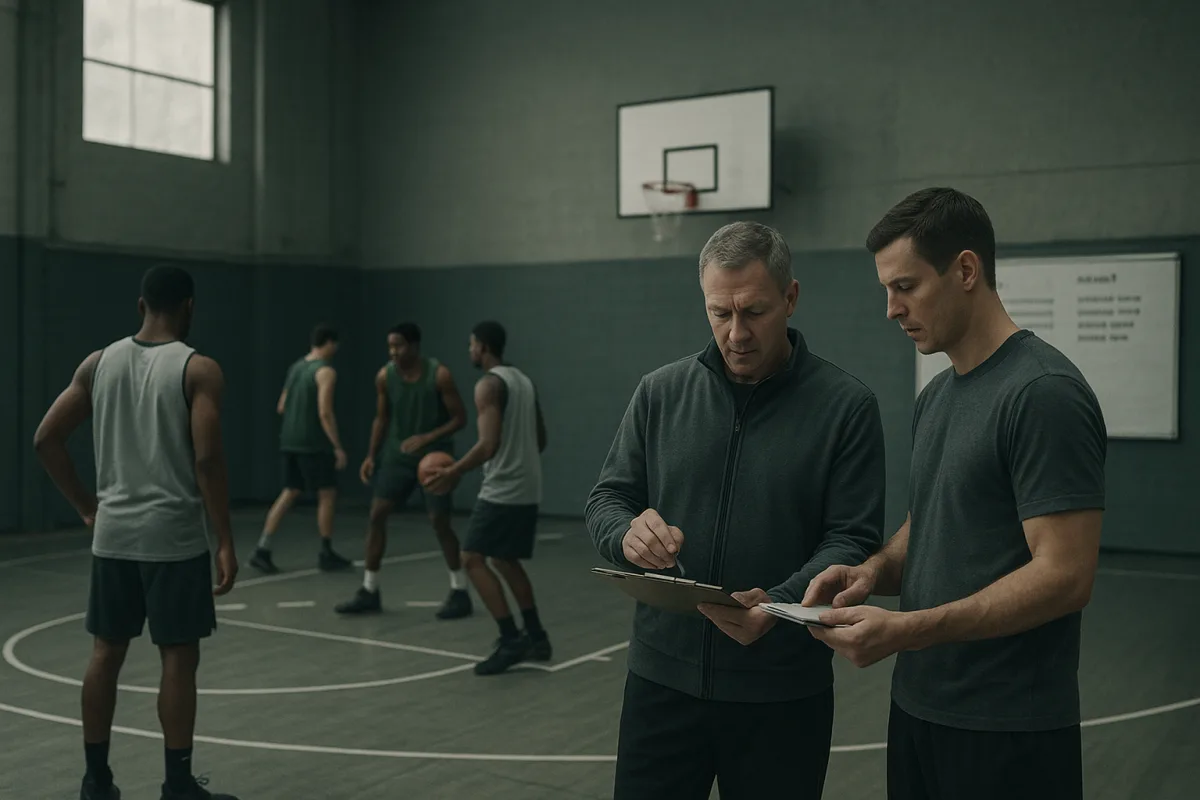
Training-camp transaction lists can look like a scramble for the final 15th man. The more useful distinction is between a team trying to solve a real NBA matchup problem and a team using camp to stock its G League affiliate.
The Knicks fit the first category. CBS Sports reported that New York entered camp with 13 guaranteed contracts and a little more than $3 million below the second apron, leaving practical room for one standard roster addition before the season. The 2026-27 second apron is $221.686 million. [1][2]
That cap context changes the tape question. New York does not need another player who can merely survive preseason possessions. It needs to identify someone who either protects the center minutes behind its core or creates enough lineup flexibility to help acquire that player later.
The Warriors, Spurs, Pelicans, Suns, Hawks and Timberwolves examples are different. Their Exhibit 10 moves read primarily as affiliate-routing decisions, where preseason practices and games determine whether the player can earn a two-way conversion or a G League bonus.
That distinction matters because the contract label does not measure NBA readiness. Exhibit 9 contracts are non-guaranteed camp deals, while Exhibit 10 contracts can include bonuses for players who remain with the affiliated G League club for 60 consecutive days. Neither contract is a promise of rotation minutes.
Comparison table
| Player and team move | Contract price or status | Size | Roster layout | Main trade-off | Best suited for |
|---|---|---|---|---|---|
| James Wiseman, Knicks | Exhibit 9, exact terms undisclosed | Center, height not supplied | Competing for New York’s limited open roster space | Size and pedigree, but only five NBA games across the past two seasons after an Achilles tear | A team seeking a developmental center swing |
| Bruce Brown, Knicks | Exhibit 9, exact terms undisclosed | Guard-wing, height not supplied | Competing in a crowded Knicks perimeter group | Established playoff utility, but does not directly solve center depth | A contender needing lineup flexibility |
| Ochai Agbaji, Knicks | Exhibit 9, exact terms undisclosed | Wing, height not supplied | Perimeter audition | Youth and wing profile, but few available wing minutes | A team needing a defensive wing test |
| John Konchar, Knicks | Exhibit 9, exact terms undisclosed | Wing, height not supplied | Perimeter audition | Connector skills, but must overcome existing backcourt depth | A roster needing low-usage support |
| Drew Eubanks, Knicks | Exhibit 9, exact terms undisclosed | Center, height not supplied | Center-depth audition | Direct positional fit, but limited evidence he changes a playoff series | A contender needing regular-season big depth |
| Obi Agbim, Warriors | Exhibit 10, exact terms undisclosed | 6-foot-3 guard | Expected Santa Cruz route | Development path, not a clear NBA roster path | Golden State’s guard pipeline |
| Jayden Nunn, Spurs | Exhibit 10, exact terms undisclosed | 6-foot-4 guard | Expected Austin route | Productive G League scorer, limited immediate security | San Antonio’s affiliate backcourt |
| Markquis Nowell, Pelicans | Exhibit 10, exact terms undisclosed | 5-foot-7 guard | Expected Laketown route | Playmaking experience, severe size constraints | A development program seeking point-guard creation |
| David Stockton, Suns | Waived after Exhibit 10 | Guard, height not supplied | Expected Valley Suns route | Familiarity and affiliate value, no current NBA deal | Phoenix’s organizational depth |
| Will Baker, Hawks | Waived after Exhibit 10 | Center, height not supplied | Expected College Park route | Center size, but waived before season | Atlanta’s G League frontcourt |
| Stephen Thompson, Timberwolves | Exhibit 10, exact terms undisclosed | 6-foot-4 guard | Expected Iowa route | Experienced pro, but not a guaranteed NBA role | Minnesota’s affiliate continuity |
| Jules Bernard, Timberwolves | Waived after Exhibit 10 | Guard, height not supplied | Expected Iowa route | Affiliate option, no present NBA contract | Iowa Wolves depth |
Knicks: a roster battle shaped by the second apron
The Athletic reported that James Wiseman, Bruce Brown, Ochai Agbaji, John Konchar and Drew Eubanks were among the Knicks’ camp additions competing for open roster places. CBS Sports framed the group as a five-man competition for what was effectively one available spot.
The price is intentionally opaque. The reported Exhibit 9 contracts are non-guaranteed, and the specific salaries or guarantee dates for Wiseman, Brown, Agbaji, Konchar and Eubanks have not been publicly disclosed.
If one makes the opening-night roster, the general Exhibit 9 structure allows conversion to a one-year minimum contract, with possible guarantees later in the season. That is the financial layout, but it does not tell us which player helps New York’s actual possessions.
Drew Eubanks is the cleanest positional answer
CBS Sports identified Eubanks and Wiseman as the Knicks’ center fliers after the club lost Mitchell Robinson and unsuccessfully pursued other big-man options. Eubanks is the straightforward answer because his position matches the hole.
The relevant film-room question is not whether Eubanks is a Robinson replacement. He is not being asked to reproduce Robinson’s rim deterrence, rebounding range and playoff defensive mobility. The question is whether he can keep the structure intact in short bench stretches.
That means setting a credible screen, arriving on time as the low man, finishing basic interior chances and avoiding possessions where the defense has to over-help because the center is out of position. Those functions can matter more than raw scoring.
The trade-off is ceiling. CBS Sports noted that Eubanks received occasional minutes with Sacramento last season, but also doubted he would become a major Knicks playoff-rotation piece. That is a reasonable read of the role rather than a dismissal of the player.
James Wiseman is the larger variance bet
Wiseman offers the more dramatic physical upside, and CBS Sports noted his No. 2 overall selection in the 2020 draft. But draft position is not a current rotation skill, particularly for a center whose defensive responsibilities are mostly read-and-react.
CBS Sports also reported that Wiseman played only five games over the past two seasons after a torn Achilles tendon. The concern is not simply availability. A center returning from a long absence must recover timing in drop coverage, screen defense and second-effort rebounding.
For New York, Wiseman would be worth the spot only if the vertical spacing and size show up without forcing tactical concessions. If the Knicks must simplify coverages or overprotect him with their perimeter defenders, the apparent upside becomes expensive in playoff possessions.
Bruce Brown has the best established NBA case
Brown is the least direct response to New York’s center issue, but he may be the best player in the group if he resembles the versatile contributor who helped Denver win the 2023 title. CBS Sports noted both that championship pedigree and Denver’s later decision not to retain him.
His fit would be about lineup elasticity. A guard-wing who can defend across assignments, move the ball quickly and survive without high usage can let a coach keep stronger offensive players on the floor without surrendering every defensive matchup.
The obstacle is roster layout. CBS Sports described the Knicks as already having substantial perimeter depth, including Landry Shamet, Jose Alvarado, Jordan Clarkson, Miles McBride, Mohamed Diawara and Tyler Kolek. Brown would need to be clearly better than an existing role solution.
Agbaji and Konchar are competing with the depth chart
Agbaji is the younger wing upside bet. Konchar is the lower-usage connector option. Both must first overcome the same basic issue: New York’s apparent shortage is in the frontcourt, while its camp competition includes three perimeter players.
That does not make their signings pointless. A wing who earns a spot can preserve the value of another guard or wing as a trade piece, especially if New York later seeks a center. CBS Sports specifically identified McBride’s affordable final contract year as a plausible trade variable.
Still, the Knicks should not confuse a useful preseason wing with a solved center problem. The second apron restricts team-building options, including access to the mid-level exception and certain trade mechanisms. [2] Positional redundancy is only useful if it creates a later transaction path.
Warriors and the Exhibit 10 development model
RealGM reported that Golden State signed Obi Agbim to an Exhibit 10 contract and expected him to join the Santa Cruz Warriors after preseason. The former Baylor guard is listed at 6-foot-3 and averaged 10.7 points, 2.7 rebounds and 3.1 assists as a super senior.
Agbim’s case is not a final-roster battle in the Knicks sense. It is a development audition. Golden State is evaluating whether his guard skills translate into the organization’s pace, decision-making demands and off-ball movement principles before committing a scarce NBA roster slot.
For Exhibit 10 players, the price is not publicly disclosed in standard salary terms. The contract can offer a G League bonus ranging from $5,000 to $85,300 if the player spends 60 consecutive days with the affiliate, but it remains non-guaranteed.
That makes the trade-off clear. The team gains a low-risk evaluation period. The player gets access to an NBA system and possible affiliate money, but can be waived without the security attached to a standard NBA contract.
The rest of the league: development pipelines, not false roster drama
RealGM reported that San Antonio signed 6-foot-4 guard Jayden Nunn to an Exhibit 10 deal, with an expected return to the Austin Spurs. Nunn averaged 15.3 points, 3.3 rebounds and 1.2 steals last season for Austin.
That profile suits the Spurs’ development model. Nunn already has an affiliate baseline, so camp can test whether he has improved the details that move a guard upward: decision speed, defensive navigation and whether his scoring fits beside higher-usage creators.
The Pelicans’ Markquis Nowell is a different archetype. RealGM reported that the 5-foot-7 guard signed an Exhibit 10 contract and is expected to join the Laketown Squadron after time with Toronto’s system, Rio Grande Valley and Baskonia.
Nowell averaged 5.9 points and 3.1 assists with Baskonia last season, according to RealGM. His size makes the evaluation unusually specific: can his ball pressure, passing and change of pace create enough advantage to offset the matchups opponents will target?
Phoenix’s David Stockton and Atlanta’s Will Baker were each waived after Exhibit 10 agreements, with RealGM expecting Stockton to join the Valley Suns and Baker to join the College Park Skyhawks. Their value is organizational depth, not an implied NBA roster opening.
Minnesota’s sequence is similarly revealing. RealGM reported that the Timberwolves signed 6-foot-4 guard Stephen Thompson to an Exhibit 10 contract, waived Jules Bernard, and expected both players to join the Iowa Wolves.
Thompson has spent three seasons with the Wisconsin Herd and has played in Puerto Rico and for the Puerto Rican national team, according to RealGM. That makes him more of an experienced affiliate stabilizer than a conventional rookie lottery ticket.
Why camp competition can matter without becoming mythology
Training-camp battles matter most when they settle responsibilities early. A 2024 study covering the 2015-2023 seasons found statistically significant relationships between team chemistry, roster composition and team success, though correlation does not prove a camp signing caused wins. [3]
Older research also found continuity correlated with an average increase of roughly 0.33 wins per season across the 1979-2008 sample. [5] That is a small effect, but it supports a practical coaching point: fewer uncertain roles can make early-season execution cleaner.
For the Knicks, the contest is consequential because it intersects with a narrow cap margin and a specific frontcourt concern. For Golden State, San Antonio, New Orleans, Phoenix, Atlanta and Minnesota, the better framing is pipeline management.
Who each option suits
James Wiseman, Knicks: suits New York if it wants to chase center upside and believes its coaching structure can restore his timing after extended injury disruption. The undisclosed Exhibit 9 terms keep the financial risk low, but the basketball risk is real.
Bruce Brown, Knicks: suits a contender that values proven playoff adaptability. He is the strongest option if the Knicks decide their best path is adding another dependable perimeter connector and solving center through a later trade.
Ochai Agbaji, Knicks: suits a team seeking a developmental wing defender. His fit depends on whether he can distinguish himself in a crowded Knicks perimeter rotation rather than simply looking competent in preseason minutes.
John Konchar, Knicks: suits a roster that wants low-usage connective play. His pathway is narrow because New York already has guards and wings competing for minutes, but those players can become more valuable as trade assets.
Drew Eubanks, Knicks: suits the Knicks if the priority is a conventional backup-center body who can preserve basic lineup functionality. He is the cleanest positional match, even if he may not be the most talented player in camp.
Obi Agbim, Warriors: suits Golden State’s Santa Cruz development track. The immediate objective is not to force an NBA role, but to see whether a 6-foot-3 guard can grow into one within the Warriors’ system.
Jayden Nunn, Spurs: suits San Antonio’s Austin affiliate because he already has productive G League evidence. His 15.3-point average is a useful starting point, not proof that NBA scoring will translate unchanged.
Markquis Nowell, Pelicans: suits New Orleans if it wants to evaluate a creative, undersized guard in a controlled development setting. The central question is whether his playmaking can beat the physical limitations of the NBA matchup environment.
David Stockton, Suns: suits Phoenix’s Valley Suns continuity more than its active NBA roster. His waived status makes clear that the affiliate path, rather than an opening-night job, is the relevant opportunity.
Will Baker, Hawks: suits Atlanta’s College Park frontcourt depth. As with Stockton, being waived after the Exhibit 10 signing means the developmental destination is more important than any presumed NBA competition.
Stephen Thompson, Timberwolves: suits the Iowa Wolves as an experienced guard who has already handled professional environments. Minnesota gets a low-cost evaluation of whether that maturity can translate into its player-development system.
Jules Bernard, Timberwolves: suits Iowa’s depth chart if he joins the affiliate as expected. His waiver should be read as roster sorting, not necessarily as a verdict on his ability, because Exhibit 10 decisions often reflect numbers and fit more than talent alone.
Frequently Asked Questions
What are NBA training camp signings and how do they impact rosters?
NBA training camp signings typically involve non-guaranteed contracts, such as Exhibit 9 or Exhibit 10 deals, used to evaluate players before the season starts. These signings allow teams to address specific roster needs, like the Knicks seeking center depth, or to build organizational depth through their G League affiliates. However, these contracts do not guarantee a spot on the opening-night roster.
How do Exhibit 9 and Exhibit 10 contracts affect NBA roster decisions?
Exhibit 9 contracts are non-guaranteed deals that allow players to compete for roster spots during training camp, with potential conversion to standard contracts if they make the team. Exhibit 10 contracts often include bonuses for players who spend at least 60 days with the team's G League affiliate but offer little job security and can be terminated at any time. Both contract types are low-cost evaluation tools for teams but do not ensure meaningful NBA playing time.
Which players are competing for roster spots in NBA training camps?
Players like Bruce Brown, Drew Eubanks, James Wiseman, Ochai Agbaji, and John Konchar are competing for roster spots with the Knicks on Exhibit 9 contracts. Other players such as Obi Agbim (Warriors), Jayden Nunn (Spurs), and Markquis Nowell (Pelicans) are signed to Exhibit 10 deals, indicating their immediate path is more likely through G League development rather than NBA rotation roles.
How do NBA teams use training camp signings to build depth or solve rotation issues?
Teams like the Knicks use training camp signings to address specific rotation problems, such as replacing lost center depth while managing salary cap constraints. Other teams, including the Warriors, Spurs, and Pelicans, primarily use Exhibit 10 signings to stock their G League affiliates, developing players who may earn two-way contracts or bonuses but are not expected to contribute immediately at the NBA level.
What is the difference between NBA roster battles and affiliate development?
NBA roster battles involve players competing for limited spots on the main team, often to solve immediate lineup needs, as seen with the Knicks’ focus on center depth. Affiliate development refers to signing players, usually on Exhibit 10 contracts, with the intention of having them develop in the G League, where they can earn bonuses and potentially be called up later, but without a guaranteed NBA role at the start of the season.
How we researched this
This article was assembled from 8 published articles, 6 cited references.
Nothing here is based on hands-on testing. Where a figure or finding appears, it belongs to the source cited beside it, and the writing says so rather than implying otherwise. Every source is listed below so you can check it.
Sources
James Wiseman, Bruce Brown among deep list of Knicks training camp signings — The Athletic NBA
Knicks staging another training camp battle for final roster spot after last year's helped win them the title — CBS Sports NBA
Suns Waive David Stockton — RealGM
Hawks Waive Will Baker — RealGM
Timberwolves Sign Stephen Thompson To Camp Contract; Waive Jules Bernard — RealGM
NBA sets salary cap for 2026-27 season at $164.961 million | NBA.com
NBA Second Tax Apron Explained: Rules and Penalties - LegalClarity
NBA Training Camp: Eastern Conference camp battles - CBS Sports
Related Articles
New York Knicks Training Camp Roster Battles Explained
Explore the New York Knicks training camp roster battles, key players, and salary cap impact on 2026 roster decisions.

Youth Basketball Rising Stars and Rankings
Explore youth basketball rising stars and rankings with practical evaluation and training tips from grade 2 through high school.

NBA 2026 Offseason Analysis: Key Moves and Team Strategies
Explore the NBA 2026 offseason analysis with insights on major trades, signings, and team-building strategies shaping the upcoming season.
Klay Thompson's Impact on the Miami Heat: Analysis
Explore Klay Thompson's impact on the Miami Heat and how his addition reshapes the team's dynamics and playoff aspirations.