
NBA Viewership Growth: Ratings Up 37% in 2026-27 Season
Explore NBA viewership growth with a 37% ratings increase in 2026-27, driven by new broadcast and streaming deals.

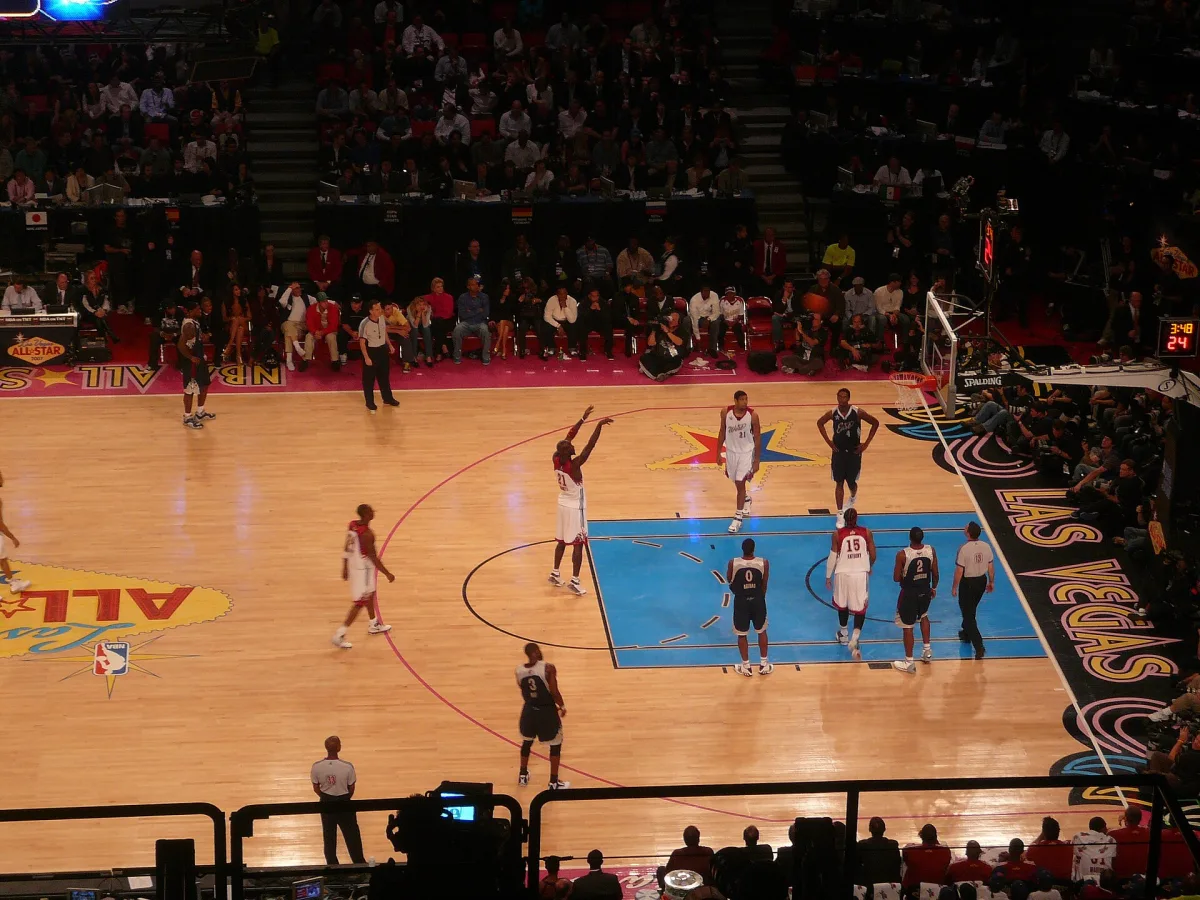
Photo: James Moore200, CC BY-SA 4.0, via Wikimedia Commons
The number on the screen: 2.62 million viewers
The NBA’s national windows averaged 2.62 million viewers during the opening month of the 2026-27 season, up 37 percent from the same point last year. Total viewing across NBC, ESPN, and Amazon Prime Video rose 20 percent. [6]
Those figures can sound interchangeable, but they answer different questions. The 2.62 million number measures the average audience for one nationally televised game. The 20 percent figure measures total viewing accumulated across the national schedule.
Put differently, average audience asks how many people showed up for a game window. Total viewing also rises when the league puts more games into windows that can be measured and watched nationally.
That is the central mechanic behind this early-season growth. The NBA did not only improve the appeal of a single broadcast. It changed the number of national doors through which a fan can enter the schedule.
The league’s 11-year rights agreements with Disney, NBCUniversal, and Amazon Prime Video run through the 2035-36 season. Disney carries games through ESPN and ABC, NBCUniversal brings the NBA back to NBC and Peacock, and Amazon has the league’s first exclusive U.S. streaming package. [14]
The agreements have been reported at roughly $76 billion by Brio Stories and $77 billion by The Information, a difference that likely reflects rounding rather than a different structure. [1][2] Either way, the annual rights fee sits near $7 billion.
For fans, the important part is not the headline price. It is the inventory. ESPN and ABC, NBC and Peacock, and Prime Video each need games that feel like events, so the league has more national windows and more outlets competing to make them matter.
More games can raise total viewing without raising every game equally
A 37 percent increase in the average national audience is substantial. It says the games themselves, on average, reached far more people than last season. But it does not mean every team, matchup, network, or platform grew by 37 percent.
The league’s 2.62 million average combines different kinds of windows. An ABC Saturday showcase, an NBC broadcast game, an ESPN cable telecast, and a Prime Video exclusive do not begin with the same potential audience or the same viewing habits.
Broadcast television remains the widest front door. NBC can reach homes without requiring a cable bundle, league subscription, or streaming app. That changes the starting point before a promotion, a star matchup, or a close fourth quarter has done anything.
Sports Media Watch reported that the league’s opening-month numbers benefited from the return of NBA games to broadcast television. [6] The NBA had been absent from NBC since 2002, and the return brings both a familiar network brand and broad over-the-air availability.
Amazon works differently. Its games ask the fan to enter through a Prime Video account, but its package gives the NBA a dedicated streaming partner that can market games inside a massive entertainment platform and deliver them directly to connected TVs and mobile devices.
The league is effectively buying reach in different forms. NBC supplies broad television exposure. ESPN and ABC retain a well-established national sports audience. Amazon supplies exclusive streaming distribution and a direct relationship with subscribers who already use the service for other programming.
That mix can raise the average audience if the packages are scheduled well. A nationally relevant matchup needs an accessible window, promotion ahead of the game, recognizable stakes, and a game that remains competitive long enough for viewers to stay.
The last piece is often overlooked. A national broadcast can acquire an audience through pregame promotion, but it keeps that audience with possessions. A one-possession game in the final six minutes gives the broadcast more chances to retain casual viewers than a 24-point margin.
National games and NBA games are not the same bucket
The label “NBA viewership” can hide an important split. A game watched locally, a game streamed through League Pass, and a game carried nationally are all NBA games, but they are counted within different viewing products and serve different business purposes.
CBS Sports’ November 23 listings placed Grizzlies-Hornets on League Pass, not on a national NBC, ESPN, or Amazon window. That game may still attract viewers, particularly in Memphis and Charlotte, but it does not function like a national showcase in the 2.62 million average.
This is why national growth and local growth can both be true without one explaining all of the other. The NBA reported that local broadcasts were up 24 percent in the opening month across all 30 teams. [6]
Local viewership measures the fan who wants to see their own team on an ordinary Tuesday, including games that will never become national programming. Those viewers are the backbone of a regular season, even if they do not create the biggest single-night audiences.
The age breakdown makes the local increase more encouraging. Viewership among adults ages 18 to 34 rose 50 percent, while viewership among viewers ages two through 17 rose 57 percent in the opening month. [6]
Those are audience figures, not subscription numbers or guarantees of future loyalty. Still, they suggest the NBA’s distribution changes are reaching viewers who are younger than the traditional broadcast-TV core, especially through digital and streaming access.
CBS Sports’ early 2027 draft coverage offers a related reminder about what fans follow. A prospect such as Kansas freshman Tyran Stokes or Illinois freshman Quentin Coleman can become part of the NBA conversation long before draft night, extending the league’s year-round attention beyond the actual national-game schedule.
That does not mean draft interest caused the 37 percent increase. No published breakdown assigns viewership growth to prospect coverage. It does show why the NBA values a media system that can turn games, draft storylines, highlights, and player development into connected programming.
Why the total audience can grow faster than the old TV model
The NBA said its 2025-26 regular season reached 170 million viewers, the league’s highest total in 24 years. [5] That is a reach figure, meaning the number of people who watched at least some NBA programming over the season, not the average audience for one game.
This is where readers can get tripped up. A game average tells you the size of a typical window. Reach tells you how many different people crossed paths with the product over months of programming. Neither number replaces the other.
A league can grow seasonal reach by creating more opportunities for light viewers to sample games. A fan may watch an NBC doubleheader one week, an ABC Sunday game another week, and a Prime Video NBA Cup game later without becoming a nightly League Pass customer.
The new deal is designed to capture that fan. The NBA has more national inventory, more promotional engines, and distribution across broadcast, cable, and streaming. That makes the league easier to encounter, even if following every game has become harder.
The cost is fragmentation. A fan who wants the complete national package cannot rely on one channel or one service. NBC and Peacock, ESPN and ABC, and Prime Video divide games among separate platforms. [10]
We would not read the early ratings as proof that fans enjoy that fragmentation. The reported audience increase tells us people are finding games. It does not reveal how many subscriptions they keep, how often they miss a game, or whether they abandon a service after a season ends.
Amazon’s arrival is especially important because it changes the old cable logic. A Prime Video exclusive does not require a traditional pay-TV bundle, but it does require a paid streaming ecosystem, and it places a live game alongside shopping, films, and series.
That can lower the barrier for an existing Prime subscriber while raising it for a fan who only wants basketball. The league gains a new distribution channel, but you may have to keep track of another app, another login, and another schedule.
The measurement issue: what counts as a viewer
Ratings growth also depends on what a measurement system captures. Nielsen ratings are built from a combination of panel data and large-scale viewing data, and measurement changes can alter the reported audience without changing how many people physically watched a game.
Nielsen has been testing wearable-device measurement intended to capture co-viewing, the people watching alongside the account holder or designated panel member. Its pilot found about a 4.19 percent average increase for major live events.
That pilot result has not been incorporated into the official ratings used by advertisers, and no public NBA-specific estimate shows how much co-viewing measurement has affected the league’s current figures. The 37 percent opening-month increase should not be credited to that unimplemented adjustment.
The cleaner reading is that the NBA has a real distribution gain, with a measurement caveat. The size of the gain is large enough that a roughly four percent pilot effect would not explain it, but future methodology changes could complicate year-to-year comparisons.
This is also why the 2.62 million figure deserves precision. It is not a head count at arenas, a count of subscriptions, or a measure of how many people watched the whole game. It is a reported average television and streaming audience for national telecasts.
For advertisers, that average is valuable because it describes a repeatable national window. For the league, total reach is valuable because it describes the size of its broader audience. For you, neither figure guarantees that your team’s next game will be easy to locate.
Better national numbers have not fixed the local-rights problem
The strongest counterweight to the ratings story sits in local media economics. National rights fees have risen dramatically, and each team received about $143 million in national television revenue during the deal’s first season, according to Brio Stories. [1]
Yet local broadcast revenue reportedly fell 25 percent in 2025-26 to an average of $33 million per team, down 32 percent from 2023-24. Across the league, the reported loss was about $453 million. [9]
That split explains why the NBA’s media strategy has become so national. The new national packages offer scale and long-term certainty. The local model, built around regional sports networks and cable subscriptions, has been under pressure as viewers leave traditional pay television.
Fans feel that tension in access. A national broadcast is often easier to find, especially on NBC. A local game can still sit behind a regional network, a direct-to-consumer team product, or a blackout structure that differs by market.
The NBA has not solved that problem by adding national partners. It has shifted part of the business toward national inventory, where a Lakers-Celtics game or a rising young team in a marquee window can be sold to the entire country.
That strategy is working in the first month by the numbers available. National games are up 37 percent, local broadcasts are up 24 percent, and younger local audiences are growing even faster. [6]
We would focus on the distribution change, not chase a single explanation such as star power or one network’s promotion. The NBA has created more prominent windows, placed them across more types of services, and given viewers multiple paths to arrive.
The unresolved test comes later. The league must keep the national schedule easy to find, preserve local-team access, and make the added platforms feel like more basketball rather than more obstacles. The opening-month audience says the new system has momentum. It has not yet shown that it has eliminated the old friction.
Frequently Asked Questions
What factors contributed to the NBA viewership growth in 2026-27?
The NBA’s 37 percent increase in national viewership during the opening month of the 2026-27 season was driven by a larger distribution system with more national windows. The return of NBA games to broadcast television on NBC and the addition of Amazon Prime Video’s exclusive streaming package expanded the league’s reach. More games were available across multiple platforms, increasing both average audience per game and total viewing.
How did NBC and Amazon Prime impact NBA ratings?
NBC’s return to NBA coverage brought broad over-the-air availability, reaching homes without cable or subscriptions, which helped increase the potential audience. Amazon Prime Video introduced the league’s first exclusive U.S. streaming package, leveraging its large entertainment platform to market games and deliver them directly to connected TVs and mobile devices. Together, these partners expanded the NBA’s national exposure in different ways.
What is the difference between NBA national and local viewership?
National viewership counts audiences for games broadcast on NBC, ESPN, ABC, and Amazon Prime Video, representing games intended as national showcases. Local viewership measures fans watching their own team’s games on regional broadcasts, including many games not nationally televised. Both national and local audiences grew in the 2026-27 season, but local broadcasts serve as the regular-season foundation despite lower revenue.
How does NBA streaming affect overall audience numbers?
Streaming through Amazon Prime Video adds a dedicated, exclusive platform for NBA games, reaching subscribers who access content on connected devices. This expands the league’s distribution beyond traditional TV and contributes to total viewing growth. However, streaming requires fans to have specific subscriptions, which fragments the viewing map compared to broadcast TV’s broad availability.
Why did NBA viewership increase by 37% in the opening month?
The 37 percent rise in average national audience per game reflects both the increased number of national broadcast windows and improved accessibility through NBC’s broadcast return and Amazon’s streaming exclusives. The league’s strategy to offer games across multiple platforms with strong promotion and competitive matchups helped attract more viewers per game, according to Sports Media Watch.
How we researched this
This article was assembled from 3 published articles, 14 cited references.
Nothing here is based on hands-on testing. Where a figure or finding appears, it belongs to the source cited beside it, and the writing says so rather than implying otherwise. Every source is listed below so you can check it.
Sources
Today's top games to watch, best bets, odds: Bengals vs. Commanders on MNF, Grizzlies vs. Hornets and more, CBS Sports NBA
NBA National Games Averaging 2.62M Viewers, Up 37 Percent From Last Season, RealGM
2027 NBA Draft Big Board: Quentin Coleman's meteoric rise, Tyran Stokes stays at No. 1, returners boost stock, CBS Sports NBA
NBA Announces $77 Billion TV and Streaming Deals with Amazon, Disney and NBCU, The Information
New NBA media rights money is in, but impact not in plain sight
NBA Media Rights Settlement: The WBD Deal Explained - LegalClarity
NBA regular season delivers most viewers in 24 years | NBA.com
NBA sets new viewership mark for opening month of season - Sports Media Watch
Warner Bros files lawsuit against NBA over Amazon media rights deal | NBA | The Guardian
30 teams lost $450 million; are NBA broadcasting rights no longer valuable? - iNEWS
The NBA's New Media Era Could Change How Fans Watch Basketball - EssentiallySports
Broadcast TV deals yield higher viewership of NBA games | TheDesk.net
TNT Sports grows Tour de France viewership by 58% in absence of free-to-air rival
Related Articles

Minnesota Timberwolves Sweep Trail Blazers in Strong Start
Explore how the Minnesota Timberwolves' defense and depth fueled their sweep of the Trail Blazers and strong 11-4 start in 2026-27.

Thunder Trade for Nique Clifford: Financial Impact Explained
Explore the Thunder's trade for Nique Clifford and its significant financial impact on their 2026-27 luxury tax and roster.
NBA Betting Promos and Game Previews for November 2026
Explore NBA betting promos and game previews for November 2026, including bonus details, wagering tips, and key matchup insights.

NBA Cup 2026 Preview: Format, Schedule, and Impact Explained
Get a detailed NBA Cup 2026 preview covering format, schedule, point differential rules, and how the tournament impacts team strategies.