
Victor Wembanyama vs Luka Doncic MVP Debate: Key Comparisons
Explore the Victor Wembanyama vs Luka Doncic MVP debate with key stats, team impact, and analysis of their 2026-27 NBA MVP cases.
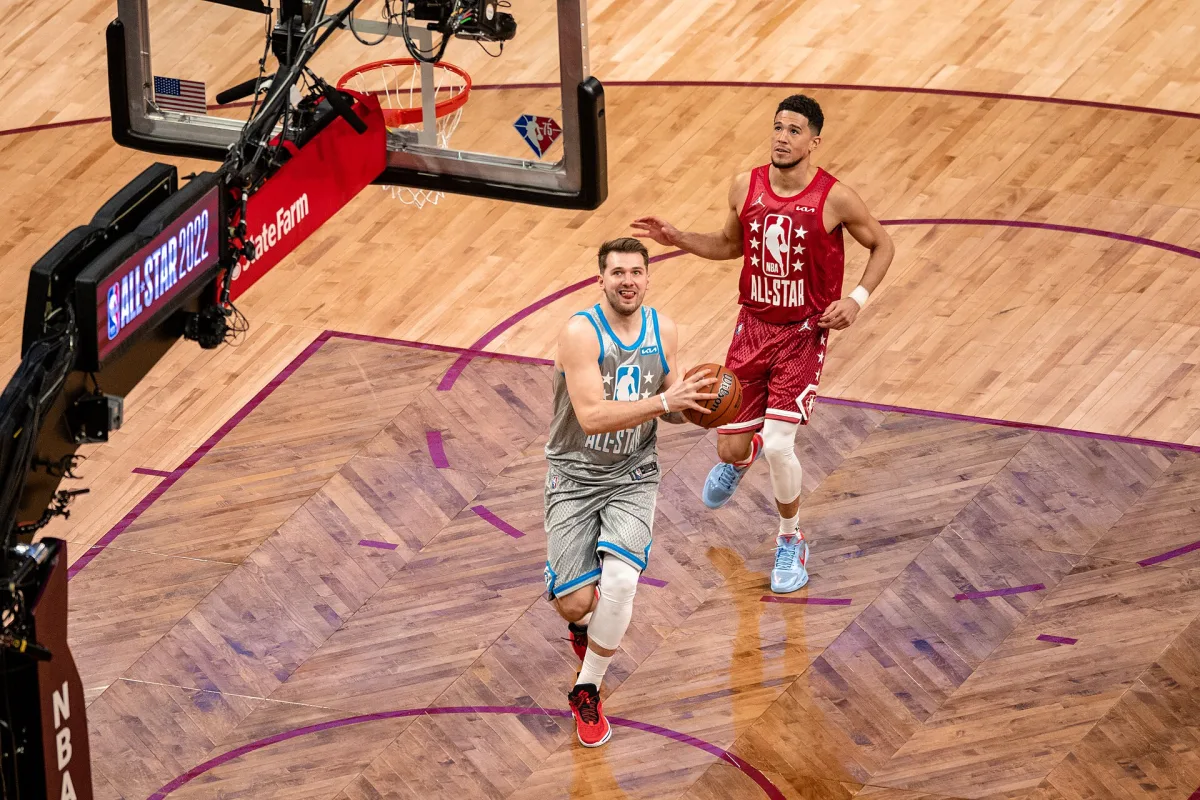
Photo: Erik Drost, CC BY 2.0, via Wikimedia Commons
The left-wing step-back and the shot above the rim
Luka Dončić’s left-wing step-back has become the possession everyone sees coming and still struggles to stop. Hoop Dungeon tracked an opening 11-game burst of 425 points, built largely from threes, free throws, and difficult midrange shot-making.
Victor Wembanyama’s recent viral play looked nothing like that. The Spurs center flicked a soft shot above the rim, a move he said was prompted by a painful blister, then Houston’s Steven Adams jokingly accused him of “plagiarism” because Adams had made a similar shot in 2022. [5][6]
Those plays capture the shape of this MVP argument. Dončić is winning possessions by forcing defenses to solve a known problem. Wembanyama is changing which shots offenses and defenses believe are available in the first place.
The choice, for now, is Wembanyama by a narrow margin. Dončić has the more overwhelming offensive résumé through the opening weeks, but Wembanyama’s scoring, rim protection, and Spurs success create the fuller MVP case.
Wembanyama vs. Dončić, category by category
| Criteria | Victor Wembanyama | Luka Dončić | Edge |
|---|---|---|---|
| Scoring pressure | Can score from unusual release points and above the rim, but has had efficiency swings. [[11]](https://www.theguardian.com/sport/2026/nov/20/victor-wembanyama-spurs-nba-mvp-finals-redemption "Victor Wembanyama has turned his NBA finals humiliation into a revenge tour for the ages | Victor Wembanyama | The Guard")[12] |
| Playmaking and offensive control | Creates matchup problems through size and range, though the available production does not establish a comparable assist case. | Averaging 7.7 assists per game and punishes help with passing reads. [[7]](https://hoopcorner.com/nba/player/1629029-luka-doncic "Luka Dončić Stats 2026-27: Averages, Career & Similar Players | Hoop Corner") |
| Defensive impact | Elite rim deterrence is central to his value, even as analysts debate the scale of his total defensive influence. | Improved engagement has been noted, but defense is not the foundation of his case. | Wembanyama |
| Efficiency and advanced value | Leads the NBA with a 37.1 PER. [13] | Sixth in PER at 27.2 as of November 23. [[4]](https://statrankings.com/nba/players/advanced-efficiency/player-efficiency-rating "Player Efficiency Rating | NBA Player Stats") |
| Team-case fit | Spurs opened 13-3 and had a 12-game winning streak before losing to Detroit on November 17. [[11]](https://www.theguardian.com/sport/2026/nov/20/victor-wembanyama-spurs-nba-mvp-finals-redemption "Victor Wembanyama has turned his NBA finals humiliation into a revenge tour for the ages | Victor Wembanyama | The Guard") |
| Sustainability concerns | Shot selection and game-to-game efficiency remain the main questions. [[11]](https://www.theguardian.com/sport/2026/nov/20/victor-wembanyama-spurs-nba-mvp-finals-redemption "Victor Wembanyama has turned his NBA finals humiliation into a revenge tour for the ages | Victor Wembanyama | The Guard")[12] |
| MVP path | Best two-way candidate if San Antonio remains near the conference leaders. | Best offensive candidate if Los Angeles turns his production into top-seed-level results. | Close |
1. Scoring pressure
Dončić owns this category because his volume is already at a level MVP voters cannot ignore. Hoop Corner lists him at 37.2 points per game through 15 appearances, alongside five games of 40 or more points. [7]
The 52-point game against Utah was part of a broader run, not a one-night eruption. Dončić also became the second player after Elgin Baylor to post four straight games with at least 40 points, five rebounds, and five assists. [15]
What separates his scoring from a standard high-usage season is where the pressure begins. Hoop Dungeon noted that opponents know the step-back is coming, but the defender still has to guard the drive, absorb the shoulder, and account for the pass.
That puts a defense in a bad sequence. If it switches, Dončić can shoot over a smaller player or drag a big into space. If it traps, he has the size and patience to find the release valve.
Wembanyama does not need to match 37 points per game to remain in this debate. His scoring pressure comes from angles that few players can replicate, including shots released high enough that conventional contests no longer change the attempt.
Still, Wembanyama’s scoring case has a more visible limitation. The Guardian reported a season opener in which he made one of 13 field-goal attempts, while Le Monde noted that his 50-point game came with heavy shot volume. [11][12]
That does not make Wembanyama inefficient as a player. It means the MVP case cannot assume every spectacular scoring night carries the same offensive value as Dončić producing elite volume with steady command of the ball.
2. Playmaking and offensive control
Dončić has the clearer advantage as a creator for teammates. His 7.7 assists per game understate some of his offensive control because an assist only records the final pass, not the rotation he forces before it. [7]
A loaded-up defense against Dončić often has to make two decisions. The first defender contains the ball, then the second defender chooses whether to leave a shooter, a cutter, or a rolling big.
That is why his scoring and passing cannot be separated cleanly. When a defense commits two bodies early, Dončić turns the possession into a four-on-three behind the pressure, and Los Angeles gets a simpler decision on the weak side.
Wembanyama’s offensive role is different. He can initiate, screen, pop, roll, and finish over help, giving San Antonio lineup flexibility that many high-scoring guards cannot provide from the same spot.
But the available numbers do not support treating him as equal to Dončić in conventional high-volume creation. Dončić begins more possessions with the ball and is better equipped to dictate the location and timing of the final shot.
3. Defensive impact
This is where Wembanyama makes up the offensive ground, then moves ahead. A great interior defender does not only block shots, he changes which shots opponents are willing to attempt and where they start their offense.
Wembanyama’s length can shrink the paint without a teammate fully abandoning a shooter. Guards see him waiting near the rim, floaters become higher, layups become kickouts, and cutters may stop before reaching the restricted area.
CBS Sports has noted debate over the total extent of Wembanyama’s defensive influence, which is fair. Blocks alone can overstate defense, especially if a player chases plays and leaves a rotation behind him. [3]
Even with that qualification, his defensive ceiling changes the comparison. Dončić can compete physically, use his frame against wings, and make better reads than his reputation sometimes allows, but he cannot reshape an opponent’s rim geometry.
The best argument for Dončić is that an offense led by him can be historically good enough to outweigh that difference. The best argument for Wembanyama is that he gives you an offensive star and a defensive system in one player.
4. Efficiency and advanced value
PER is not an MVP formula. It is a box-score metric designed to summarize per-minute production, and it does not fully capture defensive positioning, screening, lineup context, or the difficulty of individual shot creation.
It does, however, show how far Wembanyama has separated from the field in the current sample. He leads the league at 37.1 PER, while StatRankings listed Dončić sixth at 27.2 as of November 23. [13][4]
RealGM’s Week 5 list previously had Wembanyama at 36.7 and Dončić fourth at 27.8. The newer figures are slightly different, but the central finding is unchanged: Wembanyama’s per-minute statistical profile has been extraordinary.
Dončić’s efficiency case looks different because it is driven by difficult shot-making. Hoop Dungeon cited his early ability to convert contested midrange attempts, step-back threes, and free throws despite taking very few shots at the rim.
That is both a strength and a risk. A player who can make defended jumpers gives his team answers late in the clock, but a season built on unusually hot jump shooting carries more variance than one built on rim pressure.
Wembanyama has his own efficiency concern. If he settles for difficult jumpers early in possessions or turns a 50-point night into an excessive-volume exercise, he gives opponents the lower-value shots they want him to take. [12]
5. Team success and the MVP ballot
The NBA does not publish a fixed formula assigning a percentage of MVP value to individual production and team record. The award is voted on by 100 global media members, with ballots scored 10-7-5-3-1 from first through fifth. [1][2]
Team success still shapes the conversation. Historical voting has repeatedly favored superstars whose teams finish near the top of their conference, and Shai Gilgeous-Alexander’s recent MVP case came with Oklahoma City’s elite team performance. [3]
That puts Wembanyama in a strong early position. San Antonio started 13-3 and won 12 straight before Detroit ended the streak on November 17, giving the Spurs the sort of record that validates a young star’s individual surge. [11]
For Dončić, the route is straightforward. Keep the scoring near the league lead, retain the playmaking advantage, and push the Lakers into a record that feels commensurate with an MVP-level offense.
A middle-seed Lakers finish would not erase Dončić’s case, especially if his scoring remains this far ahead of the league. It would make the voting harder because Wembanyama can point to individual dominance without surrendering the team-success argument.
6. Availability and what can derail each case
Both players must clear the NBA’s 65-game threshold to be eligible for major regular-season awards. The rule requires at least 20 minutes in each qualifying game, with limited exceptions for certain injury situations. [1][2]
That is not a minor administrative footnote in a race built around early-season production. Fifteen outstanding games from Dončić or a dominant opening month from Wembanyama establishes a standard, but it does not satisfy the availability requirement.
Wembanyama’s immediate risk is less about a current injury report than the demands of his role. He is asked to score, protect the rim, clean the glass, and cover ground that many centers never have to cover.
Dončić’s risk is statistical regression. His early scoring is built on an unusually high degree of difficult-shot conversion, and the Lakers need enough team wins to prevent voters from framing his season as individual brilliance detached from standings.
The Kobe Bryant comparisons around Dončić deserve care, too. Kendrick Perkins has called him the closest current young player to Bryant, while Dončić has spoken about Bryant’s influence, but those are style and mentality comparisons, not a completed legacy judgment. [9][16]
Who each option suits
Pick Wembanyama if you value the player who can influence both ends of a possession. His case suits readers who see MVP as the award for the league’s most complete force, especially when that player anchors a winning defense and carries major offensive responsibility.
Pick Dončić if you prioritize offensive burden and late-clock problem solving. His case suits readers who believe creating a top offense through extreme usage, elite scoring volume, and passing against loaded coverages is the hardest job in basketball.
We would pick Wembanyama today, narrowly. The 37.1 PER lead, the Spurs’ 13-3 opening, and the defensive value give him the stronger total case, even with legitimate questions about shot selection and consistency. [13][11]
Dončić is close enough that this is not a settled race. If his 37.2-point pace becomes a season-long scoring title and the Lakers pair it with top-tier team success, the argument can swing quickly in his direction. [7]
Frequently Asked Questions
Who has the stronger MVP case between Victor Wembanyama and Luka Dončić?
Victor Wembanyama holds a narrow edge for MVP due to his league-leading Player Efficiency Rating (PER) of 37.1 and two-way impact, which provides a broader possession-by-possession value. Luka Dončić has a stronger pure scoring case with 37.2 points per game and exceptional playmaking, but Wembanyama’s combined scoring, defense, and Spurs’ team success give him a fuller MVP argument at this point.
What are the key stats comparing Wembanyama and Dončić for MVP?
Wembanyama leads the NBA with a 37.1 PER, highlighting his efficiency and overall impact. Dončić averages 37.2 points and 7.7 assists per game through 15 games, showcasing his scoring and playmaking dominance. Defensively, Wembanyama provides elite rim protection, while Dončić’s defense is improving but not a primary factor in his MVP case.
How do team performances affect Wembanyama and Dončić's MVP chances?
Team success is an important factor for MVP consideration. The Spurs started strong at 13-3 with a 12-game winning streak, which supports Wembanyama’s case if sustained. Dončić’s MVP chances improve significantly if the Lakers finish near the top of the Western Conference, as voters historically favor elite players on elite teams.
What are the strengths and weaknesses of Wembanyama and Dončić in MVP debate?
Wembanyama’s strengths include his two-way influence, efficiency, and unique scoring ability, but his shot selection and game-to-game efficiency raise sustainability questions. Dončić excels in scoring volume and playmaking but faces potential regression due to his extreme jump-shooting percentages and lower rim scoring volume. Defensively, Wembanyama has the advantage.
Which player leads in advanced metrics like PER for MVP consideration?
Victor Wembanyama leads the NBA in Player Efficiency Rating with a 37.1 mark, while Luka Dončić ranks sixth with a 27.2 PER as of late November 2026. This metric underscores Wembanyama’s superior efficiency and overall value on a possession-by-possession basis.
How we researched this
This article was assembled from 1 video source, 3 published articles, 16 cited references.
Nothing here is based on hands-on testing. Where a figure or finding appears, it belongs to the source cited beside it, and the writing says so rather than implying otherwise. Every source is listed below so you can check it.
Sources
What The Entire NBA REALLY Thinks About Luka Dončić's Dominance…, Hoop Dungeon
NBA PER Week 5: Luka Doncic Drops To Fourth, Nikola Jokic Moves Into Top-5, RealGM
“Unrealistic”: NBA Champion Loses His Mind Over Victor Wembanyama’s New Move That Was Accused of ‘Plagiarism’, Yahoo Sports
Victor Wembanyama can lose the MVP race to Luka Doncic despite being better, says 3x NBA champ, Yahoo Sports
How NBA Awards Are Voted: MVP, 65-Game Rule (2026-27) | Hermes
NBA MVP voting results: Shai Gilgeous-Alexander goes back-to-back, Jokić edges Wemby - CBS Sports
Luka Dončić Stats 2026-27: Averages, Career & Similar Players | Hoop Corner
El increíble comienzo de temporada de Luka Doncic: 308 puntos en ocho partidos
Pour Victor Wembanyama, la nouvelle approche du seuil emblématique des 50 points
Lakers’ Luka Doncic Responds to Kobe Bryant Mentality Comparison
Watch Victor Wembanyama vs Luka Doncic MVP Debate on Youtube
Related Articles

Luka Doncic MVP Season and Media Perception Analysis
Explore Luka Doncic's MVP-caliber 2026-27 season and how media outlets perceive his MVP candidacy and team context.
San Antonio Spurs' 18-0 Game Start vs Warriors Analysis
Explore the Spurs' historic 18-0 start in their win over the Warriors, highlighting key players and game strategies.
Lakers vs Heat Game Highlights and Key Matchups Analysis
Explore Lakers vs Heat game highlights and key matchups, including Luka Doncic's performance and Lakers' top offensive and defensive strategies.

Stephen Curry Ankle Breaker on Luka Doncic Explained
Detailed analysis of Stephen Curry's ankle breaker on Luka Doncic and its impact on the Warriors' comeback win over the Lakers.