Darius Acuff Jr. Rookie Season Analysis: A Polarizing Start
Explore Darius Acuff Jr.'s rookie season analysis, usage rate, scoring, and playmaking in Sacramento's 2026-27 NBA campaign.
Darius Acuff Jr.’s Rookie Season Is Polarizing Because Sacramento Has Made Him the Whole Test
The numbers made Acuff a debate immediately
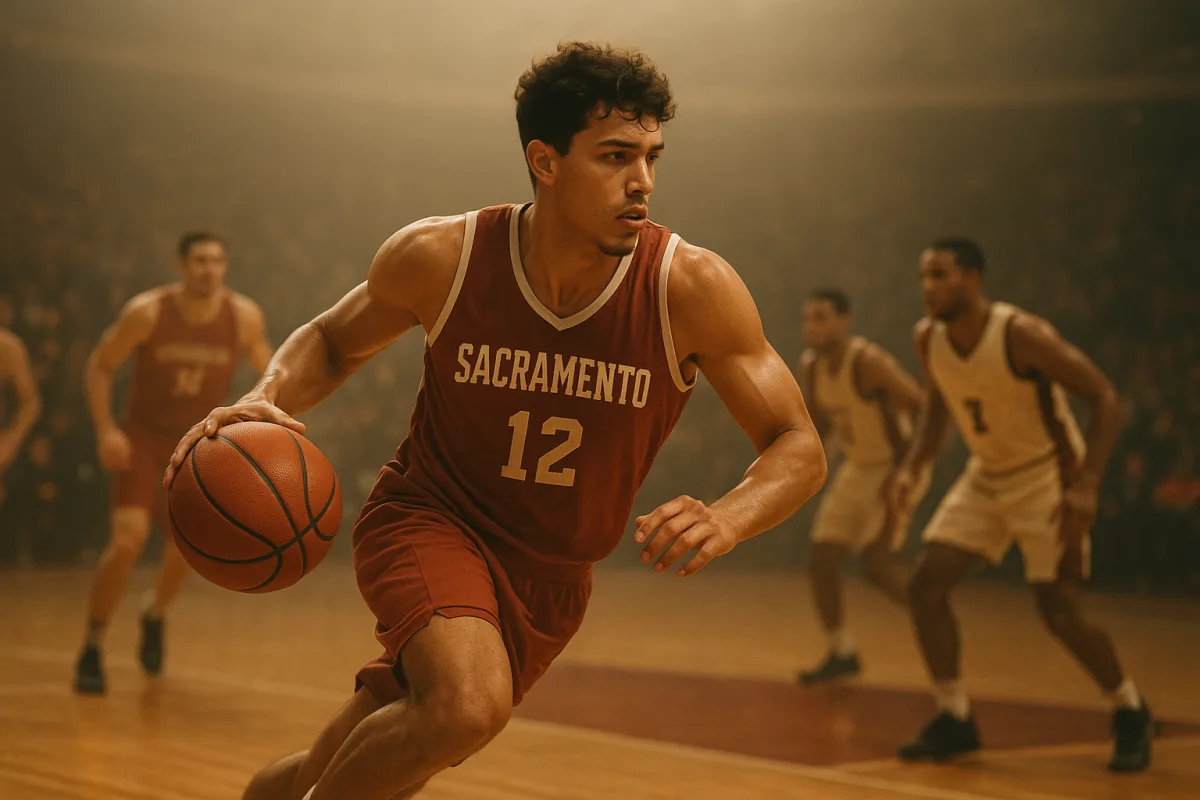
By Nov. 5, Darius Acuff Jr. had started six or seven games for Sacramento, depending on the lineup database’s update point, while logging roughly 36.5 minutes a night. The Kings have put a 20-year-old point guard at the center of nearly every offensive possession. [5]
That has created the first major rookie trend of the 2026-27 season: people are not debating whether Acuff has the ball. They are debating whether Sacramento has given him too much of it, too soon.
StatMuse listed Acuff with a 31.6% usage rate, a figure that placed him unusually high for a rookie. Usage rate estimates the share of team possessions a player ends with a field-goal attempt, free-throw trip, or turnover while he is on the floor. [2]
CBS Sports reported that Acuff ranked eighth in league-wide usage through his first eight games, behind established high-volume stars such as Luka Dončić, Anthony Edwards, Victor Wembanyama, Shai Gilgeous-Alexander, and Stephen Curry. Caleb Wilson was the only other rookie within the top 40.
That is why the reaction has been so sharp. Rookie guards usually get criticized for forcing shots, but Acuff’s situation is different because Sacramento has built its early offense around his forcing function.
He is averaging 26.1 points per game, a scoring number that naturally draws attention to every difficult pull-up, late-clock drive, and contested layup. But his shooting splits are 39.6% from the field and 32.2% from 3-point range as of Nov. 5. [1]
Those percentages are not a minor detail. A player can create a high volume of offense and still leave possessions on the table if too many of his attempts end in contested twos or off-balance threes.
His shot volume reflects roster construction as much as personality
A.M. Hoops framed Acuff as the league’s “most hated rookie,” pointing to his early field-goal volume and to Sacramento veterans wanting a more connected offense. The channel’s evidence captures why the discourse has spread, even if it cannot establish a locker-room consensus.
The more concrete explanation is Sacramento’s roster. CBS Sports reported that the Kings lack a conventional backup point guard, while Ben Simmons suffered a torn Achilles days before the season, removing a projected ball-handler from the rotation.
When Acuff sits, Malik Monk has had to operate as the de facto point guard. Monk can create shots, but asking him to run every half-court possession changes both his role and the shots available to the rest of the lineup.
CBS Sports also reported that Acuff has taken only 23 catch-and-shoot attempts among his first 189 shots, according to Synergy. That tells you his volume is coming mostly from self-created possessions, not from standing open on the weak side.
This is a critical distinction in evaluating his efficiency. Catch-and-shoot looks generally begin with an advantage already created by someone else, while Acuff is regularly being asked to create the advantage himself against a set defense.
At Arkansas, Acuff made 60 of 120 catch-and-shoot attempts, or 50%, according to CBS Sports. His college season overall was efficient: 22.9 points per game on 48.6% field-goal shooting and 44.5% from 3-point range across 33 games. [1]
The NBA transition has stripped away some of those clean looks. He is now handling more possessions, facing longer defenders, and working within a Sacramento offense that has not consistently generated easy second-side actions.
That does not excuse every shot. It explains why a rookie who shot 44.5% from deep in college has opened at 32.2% from NBA range. [1]
The passing is the evidence against the pure gunner label
The loudest criticism of Acuff is built around attempts. The strongest counterargument is found in his playmaking volume and in the kinds of passes he is attempting after drawing the first defender.
CBS Sports reported that Acuff is averaging seven assists per game, ranking 12th in the league at the time of publication. NBA tracking data also put him at 12.4 potential assists per game, 11th league-wide.
An assist records a made basket after a player’s pass. A potential assist records a pass that leads to a shot opportunity, whether the teammate converts it or misses. The gap between those figures matters for a rookie on a struggling offense.
Against the Lakers, Acuff finished with 22 points and 12 assists, according to CBS Sports. Tracking data credited him with 17 potential assists, meaning five created teammate shots did not become assists because the attempts failed.
CBS Sports highlighted a possession in which Acuff fell while delivering a cross-court pass to Monk for an open 3-pointer. Monk missed, leaving Acuff without a box-score reward for identifying the help defense and finding the open side.
That kind of film is why we would not call Acuff a one-dimensional scorer. He sees the low man, can throw lobs, and appears willing to move the ball when the defense commits two defenders to him.
A.M. Hoops also pointed to Acuff’s 30-point, 10-assist performance early in the season, placing him with LeBron James, Stephon Marbury, and Luka Dončić as teenage players to reach that combination. The individual milestone is real, but it should not be used to settle the larger evaluation.
The better read is that Acuff has shown high-level passing ambition within a high-turnover, high-difficulty role. His next developmental step is recognizing when the first available pass creates a better possession than his own late-clock shot.
The Sabonis issue is about touches, not blame
The pressure around Acuff has increased because Sacramento still employs veterans Zach LaVine and Domantas Sabonis. CBS Sports put LaVine’s usage rate at 25.6% and Sabonis’ at 15.7%, a major drop for a center who previously operated as Sacramento’s offensive hub.
Sabonis publicly said the Kings needed more ball movement and fewer one-pass pick-and-roll shots, as A.M. Hoops noted. The comment aligns with what you would expect from a playmaking big whose influence depends on receiving the ball at the elbow, nail, or short roll.
That is not proof that Sabonis was targeting Acuff personally. There is no public data set measuring veteran reactions to high-usage rookies, and no reported evidence establishes a broader player revolt inside Sacramento.
Still, the basketball tension is easy to see. If Acuff attacks early in the clock, Sabonis may never receive the touch that activates his screening, handoff, and passing strengths.
The Kings can solve part of that with sequencing. Start possessions through Sabonis at the elbow, run Acuff off a handoff or empty-corner pick-and-roll, then let the rookie attack a defense already shifted by the first action.
That setup would not take the ball from Acuff. It would give him more possessions in motion, with a tilted defense, instead of repeatedly asking him to beat a defender from a static high screen.
Defense is where the optimistic case has its largest hole
The pre-draft assessments from NBA Draft Scouting and Sports Illustrated agreed on Acuff’s biggest weakness: defense. Both scouting reports raised concerns about his on-ball resistance, lateral quickness, off-ball awareness, and inconsistent rebounding effort. [3] [7]
Those concerns have followed him into Sacramento. CBS Sports described Acuff as not a strong defender and suggested that becoming net-neutral over a full career would represent a meaningful developmental result.
Net-neutral means the player does not materially hurt or help a defense relative to typical lineups and matchups. For an offense-first 6-foot-2 guard, reaching that level would allow his scoring and passing to drive his total value.
Sacramento general manager Scott Perry has acknowledged Acuff’s defensive limitations while expressing confidence that he can improve, according to the Kings’ official coverage. [6] Perry’s public patience makes sense because Acuff’s offensive role leaves little energy margin for a rookie.
But workload does not remove the issue. If Acuff is hunted in pick-and-roll, loses shooters on the weak side, or fails to finish possessions with rebounds, Sacramento has to compensate with size and range around him.
Keegan Murray fits that need as the roster’s clearest 3-and-D wing, but CBS Sports reported that Murray is sidelined with an ankle injury. Without that defensive cover, the Kings have fewer clean ways to protect Acuff from larger attacking guards.
Sacramento’s 1-6 record sharpens every criticism
The Kings are 1-6 with Acuff starting, according to Basketball-Reference’s starting-lineup data. [5] That record is why a 26-point scorer can still become a polarizing rookie within two weeks.
Fans watching losses do not separate every missed shot from the larger possession problem. A contested Acuff pull-up, a Sabonis touch that never arrives, and a defensive breakdown all feel like part of the same failed sequence.
The available evidence is thin on direct causation. Seven starts cannot tell you whether Acuff’s high usage is causing Sacramento’s losing record, whether the weak roster is forcing his usage, or whether both things are true at once.
We lean toward the second explanation. The Kings have asked their youngest rotation player to carry a star-level creation burden because the roster lacks another dependable organizer and has not consistently supplied shooting and defensive cover.
That does not mean Acuff should keep taking 23 or 24 shots every night without adjustment. It means the team should evaluate which of those shots came after a failed possession and which came before the offense had a chance to involve its best secondary creators.
What the Kings should learn from this season
Acuff’s rookie year is becoming polarizing because it is a live experiment in role size. Sacramento is testing whether a small guard with advanced creation instincts can survive immediate star usage before the roster around him resembles a coherent long-term build.
CBS Sports reported that Sacramento is likely looking toward the 2027 offseason for a more complete rebuild, with LaVine and DeAndre Ayton coming off the books this summer. The front office’s short-term job is to gather information, not to pretend the current roster is finished.
For Acuff, the information Sacramento needs is specific. Can he improve his shot selection when Sabonis initiates? Can he defend well enough when flanked by bigger wings? Can he maintain his passing aggression without drifting into high-risk reads?
For you watching this debate, do not let the scoring record or the shooting percentage settle it alone. Acuff’s value will be determined by whether he learns to turn a heavy burden into a more efficient shared offense.
The Kings should keep giving him reps, but change the context of those reps. We would prioritize lineups with Murray, Sabonis, and at least one additional shooter, then measure whether Acuff’s rim attempts, potential assists, and defensive workload improve together.
Frequently Asked Questions
Why is Darius Acuff Jr. considered a polarizing rookie?
Darius Acuff Jr. is polarizing because Sacramento has given him an unusually high offensive role for a 20-year-old rookie, with a 31.6% usage rate. His scoring is impressive at 26.1 points per game, but his shooting efficiency is low (39.6% FG, 32.2% 3P), leading to debate over whether he is a future star or inefficient. Fans and analysts are split on whether his high volume of difficult shots is justified.
How does Darius Acuff Jr.'s usage rate compare to other rookies?
Acuff’s usage rate of 31.6% ranks him eighth in the entire NBA through his first eight games, placing him among established stars rather than typical rookies. He is one of the highest-usage rookies in recent history, with only Caleb Wilson also appearing in the top 40 usage leaders. This level of offensive responsibility is rare for a rookie.
What are the strengths and weaknesses of Darius Acuff Jr.'s rookie season?
Acuff shows strong scoring and playmaking ability, averaging 26.1 points and seven assists per game, with a willingness to create offense for himself and teammates. However, his shooting efficiency has dropped significantly from college, and he struggles defensively, with noted weaknesses in on-ball defense, lateral quickness, and defensive awareness. His high usage has not yet translated into team wins.
How has Sacramento Kings' roster affected Darius Acuff Jr.'s performance?
The Kings’ roster construction has forced Acuff into a heavy offensive load because they lack a conventional backup point guard, especially after Ben Simmons’ Achilles injury. This has required Acuff to create most of his own shots rather than benefit from catch-and-shoot opportunities, increasing the difficulty of his offensive tasks and impacting his efficiency.
What is Darius Acuff Jr.'s impact on the Kings' offense in 2026-27?
Acuff is the focal point of Sacramento’s offense, handling nearly every possession and averaging high scoring and assist numbers. Despite this, the Kings have struggled with a 1-6 record in games he has started, indicating that his individual contributions have not yet led to team success. The Kings need to develop complementary pieces to reduce the burden on Acuff and improve overall offensive cohesion.
How we researched this
This article was assembled from 1 video source, 1 published article, 7 cited references.
Nothing here is based on hands-on testing. Where a figure or finding appears, it belongs to the source cited beside it, and the writing says so rather than implying otherwise. Every source is listed below so you can check it.
Sources
The Most Hated Rookie in the NBA, A.M. Hoops
Darius Acuff Jr. isn't a perfect rookie, but he may be just what the Kings need right now, CBS Sports NBA
https://www.nba-draft-scouting.com/post/darius-acuff-2026-nba-draft-scouting-report-projection
Rookie PG Acuff Says He's Playing 'Terrible' Despite Kings' 4-0 Start
2026-27 Sacramento Kings Starting Lineups | Basketball-Reference.com
Darius Acuff Jr. News, Updates & Latest Videos | Sacramento Kings
Watch Darius Acuff Jr. as a Polarizing Rookie on Youtube
Related Articles
Yaxel Lendeborg Rookie Breakout and Impact on Warriors
Explore Yaxel Lendeborg's rookie breakout and how he's impacting the Golden State Warriors' offense and team dynamics in 2026.
NBA Rookies 2026-27 Impact and Rising Stars Analysis
Explore the NBA rookies' impact and rising stars in the 2026-27 season with detailed role and performance analysis.
Philadelphia 76ers Early Season Performance and Player
Analyze the Philadelphia 76ers' early season performance and player roles, focusing on Maxey, Brown, James, and team offensive strategies.
New York Knicks 2026-27 Roster Moves and Season Preview
Explore the New York Knicks 2026-27 roster moves, preseason analysis, and key player updates including Brunson’s MVP case and Towns’ contract.