
Jalen Brown Jayson Tatum Beef: Media Coverage and Reality
Explore the truth behind the Jalen Brown Jayson Tatum beef and how media coverage shaped the narrative between these former Celtics teammates.
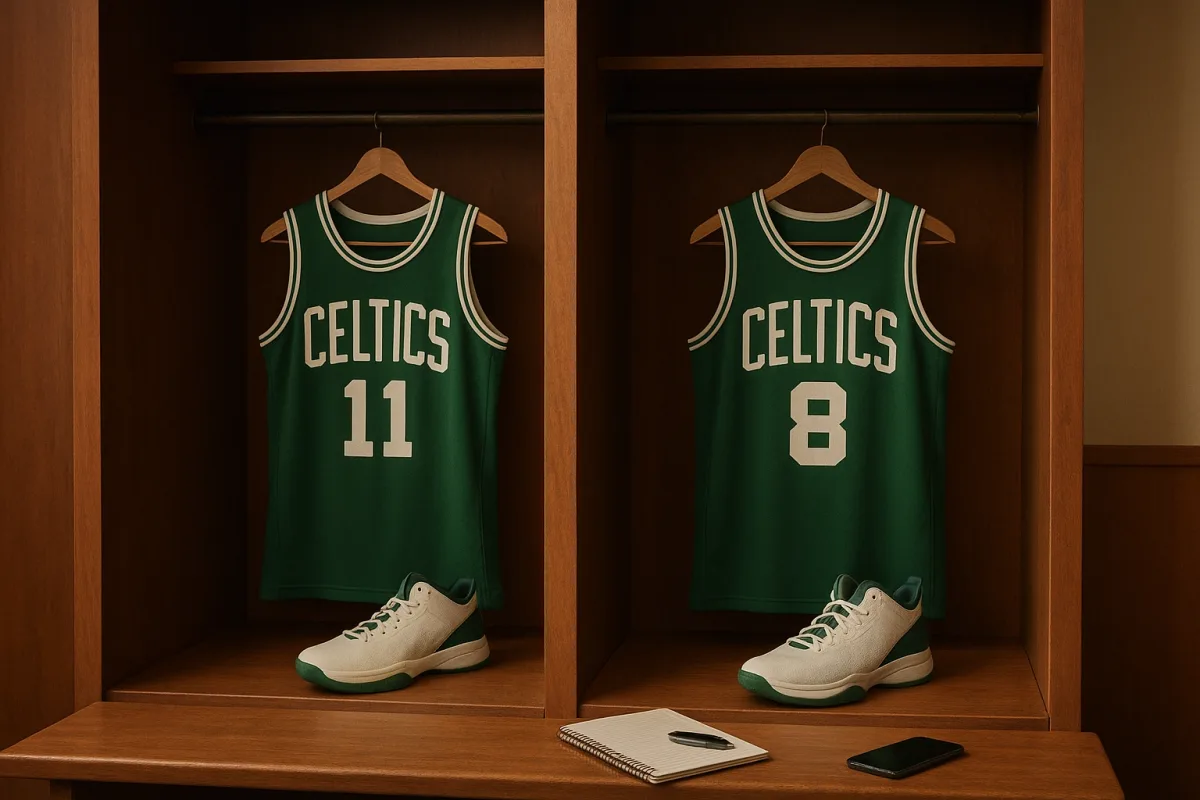
The “beef” story is built from an information gap
The central mistake in the Jayson Tatum-Jaylen Brown coverage is treating incomplete information as proof of conflict. There is a gap between what each player has publicly said, and modern NBA coverage tends to fill that gap with the most clickable explanation.
That is not unusual. A star trade creates a clean narrative structure: former teammates, a championship history, separate Eastern Conference teams, then a social-media response that can be read as a challenge. The problem is that narrative structure is not evidence.
Boston Celtics forward Jayson Tatum provided the key public detail when asked about Brown’s response to his trade-reaction video. As reposted by Chaz NBA, Tatum said he held no animosity, beef, or ill will toward his longtime teammate.
Tatum also said he called and texted Brown after the trade, while acknowledging that people process major changes differently. That is more precise than saying everything is fine, but it is also substantially different from reporting a feud. [5]
Philadelphia 76ers wing Jaylen Brown had already supplied the other side of the information gap. At his August introductory press conference, Brown said he and Tatum had “not really” spoken since the trade, while still expressing respect for him. [8]
Those statements can coexist without contradiction. Tatum can have reached out, Brown can have received the outreach, and the two can still have not had the full conversation that either player considers meaningful.
That distinction matters. “We have not really spoken” measures the state of communication. It does not measure resentment, dislike, betrayal, or a demand to be traded. Media coverage often collapses all five ideas into one.
What the cap emoji actually tells us
Brown’s “cap” emoji under Tatum’s account of being caught off guard by the trade is the piece of evidence doing most of the work. It is a public signal that Brown did not accept Tatum’s version of that particular moment. [5]
It is not, by itself, a scouting report on their relationship. On tape, one possession cannot establish a player’s defensive habits without context: matchup, score, coverage call, help position, and what happened before the clip began.
The same principle applies here. An emoji has almost no explanatory detail. It does not tell readers whether Brown thought Tatum knew more than he said, objected to the presentation of the reaction, or simply found the claim hard to believe.
That ambiguity is exactly why it travels. A detailed public statement can narrow the possibilities. A one-word response, or in this case a one-symbol response, leaves enough open space for every outlet and fan account to project a preferred theory.
Brown later said there was “no beef,” while adding the playful, deliberately imprecise line about “a little lamb chops and some gravy.” That is not a declaration that nothing changed. It is an admission that a trade can leave some competitive or emotional residue. [9]
The correct reading is not that Brown and Tatum are secretly at war. It is that both have publicly denied a major rift while neither has described a complete post-trade reconciliation.
That is a less dramatic answer, but it fits the evidence. The relationship appears complicated because a decade-long partnership ended through a management decision, and the players have not publicly unpacked every part of that transition.
The coverage mechanism: how a minor signal becomes a major story
In basketball terms, this is a coverage problem. The initial action is simple: Tatum says he was surprised, Brown responds with “cap.” The defense then overhelps toward the apparent tension, leaving the actual facts unattended.
First, a social-media exchange establishes a possible conflict. Second, commentators attach older stories about role hierarchy, Finals pressure, and contract status. Third, every new answer is assessed for body language and subtext rather than its literal content.
By the time Tatum is asked whether fans should “get popcorn” for the first Celtics-76ers meeting, the framing has already changed. The question assumes that unresolved communication must produce a personal basketball confrontation. [5]
Tatum rejected that framing directly. He said the matchup was not a boxing match and pushed back on comparisons to famous NBA feuds, specifically arguing that this was not a Shaq-and-Kobe situation. [5]
That does not mean reporters should ignore Brown’s emoji or the lack of a full conversation. Those are relevant facts. It means they need to be assigned their actual weight, rather than becoming a substitute for reporting.
A clean way to evaluate the story is to separate evidence into three levels. Level one is verified transaction information. Level two is direct public comment. Level three is interpretation of tone, timing, social posts, and silence.
The July transaction belongs in level one. The Boston Globe reported that Boston traded Brown to Philadelphia for veteran forward Paul George and multiple future draft picks, after Celtics management initiated trade discussions. [2]
That reporting is important because it corrects the least supported version of the story: that Brown forced his way out of Boston. Brown’s camp denied that he demanded a trade, and reporting on the transaction indicates the front office drove the move. [2]
Tatum’s comments, Brown’s introductory-press-conference answer, and Brown’s later “no beef” line belong in level two. They are limited, but they are still direct evidence from the people involved. [5][8][9]
The “cap” emoji, commentary about Tatum’s disappointment, and theories about who stopped communicating belong in level three. They can suggest questions worth asking. They cannot answer those questions on their own.
Why the old Celtics narrative keeps returning
The Tatum-Brown partnership was vulnerable to this framing long before the 2026 trade. When two elite wings share a team, especially one with title expectations, every late-clock possession can be treated as a referendum on hierarchy.
That is rarely how high-level offenses work. A final shot may belong to the player who receives the ball, but the outcome often comes from the earlier actions: a screen angle, a weak-side cut, a mismatch hunt, or a defender choosing to tag help.
The Celtics’ best versions did not require one player to vanish so the other could thrive. Their value was that opponents could not comfortably load up on either wing without creating an advantage elsewhere.
Brown addressed the broader dynamic in earlier comments about people trying to break up successful duos. Celtics coach Joe Mazzulla also described media portrayals of tension as unfair during the 2024 championship run. [3]
The pattern became especially visible in the 2024 Finals. Dallas Mavericks coach Jason Kidd publicly praised Brown in a way that was widely interpreted as an effort to introduce a hierarchy question around Tatum and the Celtics. [1]
That was not a mysterious psychological tactic. It was a standard attempt to change the conversation around an opponent. If Boston began debating internal status rather than making the next correct rotation or next extra pass, Dallas gained something without changing its scheme.
Boston’s players did not take the bait in that series. The Celtics won the championship, a result that should complicate, rather than erase, the premise that their partnership was inherently unstable. [1][3]
Their shared record also matters more than the online shorthand. As former NBA players Blake Griffin, Dirk Nowitzki, Steve Nash, and Udonis Haslem noted in commentary reposted by Chaz NBA, the pair made two Finals, won the 2024 title, and repeatedly led deep playoff runs together.
None of that proves the relationship is presently seamless. It does establish a baseline: the burden of proof should be high before recasting a historically productive partnership as an ongoing personal feud.
What actually changes when they meet on the court
The first Celtics-76ers game after Brown’s trade will naturally carry extra attention. But the meaningful evidence will be in the matchup decisions, not in pregame glances, bench reactions, or whether either player scores the first basket.
For Boston, the lineup change is concrete. Brown’s departure removed a powerful two-way wing who could take difficult perimeter assignments while also attacking mismatches. Paul George brings different veteran skills, but not a one-for-one replication of Brown’s driving pressure. [2][7]
For Philadelphia, Brown adds another physical wing scorer beside its established stars. The question is not whether Brown wants to embarrass Tatum. The question is which defender takes the primary assignment, where help comes from, and whether that help opens clean catch-and-shoot looks.
If Tatum guards Brown for meaningful stretches, that is not proof of hostility. It may simply be the most sensible coverage, depending on Boston’s personnel, screen-navigation options, and the 76ers’ preferred actions.
Likewise, if Boston uses switches to keep Tatum out of repeated Brown actions, that is not avoidance. It could be an effort to preserve matchups against Philadelphia’s other creators or prevent Brown from using a favorable cross-match.
The game will also not settle the relationship question. One regular-season matchup can show who won a possession battle, who handled a particular coverage better, and whether either team found a lineup advantage. It cannot reveal private feelings.
That limitation is worth stating because competitive intensity is normal evidence in NBA basketball. Brown and Tatum should play hard against one another. A hard closeout, a physical box-out, or a pointed celebration is not automatically interpersonal evidence.
The better standard for reading the story
There is a legitimate story here, just not the one suggested by “beef” headlines. Two players who entered the league together, won a championship together, and spent nearly a decade building Boston’s identity are now on competing teams.
A management-led trade separated them. Brown disputed Tatum’s account of surprise. Tatum said he reached out and wants a conversation, while Brown has indicated that substantial communication has not happened. [2][5][8]
That is enough to describe a relationship in transition. It is not enough to claim a confirmed falling-out, and no verified reporting establishes that Brown requested his way out of Boston or that either player has declared the other an enemy. [2]
The film-room version of this story is straightforward: do not grade the possession before the action develops. The evidence shows some friction, a communication gap, and an obvious competitive edge. It does not show the feud that the loudest framing requires.
Frequently Asked Questions
Is there really a beef between Jaylen Brown and Jayson Tatum?
The evidence does not support a confirmed personal feud or "beef" between Brown and Tatum. Both players have publicly denied significant animosity, though they acknowledge some unresolved communication and emotional complexity following Brown’s trade. The situation is better described as an information gap rather than a clear conflict.
What did Jayson Tatum say about his relationship with Jaylen Brown?
Jayson Tatum stated he holds no animosity or ill will toward Jaylen Brown and emphasized that people process major changes differently. He also mentioned that he reached out to Brown by call and text after the trade, indicating an attempt at communication despite the players not having a full conversation yet.
How did media coverage influence the Brown-Tatum feud narrative?
Media coverage often filled incomplete information with speculative conflict, framing minor social-media exchanges as evidence of a feud. This coverage tends to emphasize body language and subtext over literal statements, amplifying or fabricating tension that the players themselves have denied. Coaches and former teammates have also criticized these portrayals as unfair.
Did Jaylen Brown demand a trade from the Celtics?
No verified evidence shows that Jaylen Brown demanded a trade. Multiple sources confirm that the Celtics front office initiated trade talks and shopped Brown to several teams before completing the trade with Philadelphia. Brown himself never requested the trade; it was a management-driven decision.
What does Jaylen Brown's 'cap' emoji mean in relation to Jayson Tatum?
Brown’s “cap” emoji was a public response disputing Tatum’s account of being caught off guard by the trade. However, it does not provide clear insight into their overall relationship and should not be interpreted as proof of dislike. The emoji signals disagreement with one detail but does not establish a broader personal conflict.
How we researched this
This article was assembled from 2 video sources, 5 published articles, 9 cited references.
Nothing here is based on hands-on testing. Where a figure or finding appears, it belongs to the source cited beside it, and the writing says so rather than implying otherwise. Every source is listed below so you can check it.
Sources
Blake, Dirk, Steve & UD speak on Jayson Tatum and Jaylen Brown "beef" — Chaz NBA
Jayson Tatum on "beef" with Jaylen Brown "This ain't no f**king Shaq and Kobe" — Chaz NBA
Jaylen Brown's camp shuts down report that he demanded a trade out of Boston: It's '10,000% a lie' — Yahoo Sports
Did Jaylen Brown Ask Out of Boston? Celtics Insider Revisits Trade Claim — Heavy.com
Did Jaylen Brown ‘demand' trade from C's? Scal clarifies comments — NBC Boston
Mavericks vs Heat Preview and Injury Report: Early game on NBA TV — Mavs Moneyball
Diving deeper into Cavs 127-125 overtime win over Timberwolves — SB Nation
Mavericks' plan to stop Celtics in NBA Finals: Get them to fight among themselves
Is there a Jayson Tatum/Jaylen Brown beef? Tatum doesn't think so. - NBC Sports
Did The Jaylen Brown Trade Actually Hurt The Celtics? Here's What The Numbers Say
Celtics roster reset: Depth chart, contracts and more after Jaylen Brown trade – NBC Sports Boston
New NBA Rumors on Jaylen Brown-Jayson Tatum Relationship Since Celtics-76ers Blockbuster Trade
De Jaylen Brown con Boston a LeBron con Los Ángeles: Los reencuentros más esperados en la NBA
Watch Jalen Brown and Jayson Tatum Celtics 'Beef' Media Coverage on Youtube
Also from the sources
Related Articles
Philadelphia 76ers Early Season Performance and Player
Analyze the Philadelphia 76ers' early season performance and player roles, focusing on Maxey, Brown, James, and team offensive strategies.
LeBron James 76ers Title Contention and Team Dynamics
Explore LeBron James' impact on the 76ers and their realistic title contention prospects for the 2026-27 NBA season.
Philadelphia 76ers Preseason Struggles and Player Dynamics
Analyze Philadelphia 76ers preseason struggles, key player performances, and evolving roster dynamics including Embiid, James, and Brown.
Sixers Trade Activity and New Era in 2026 Season
Explore the Sixers' 2026 trade activity and new era, including key roster moves and strategy shifts around Embiid, Brown, and LeBron James.