Lakers vs Heat Game Highlights and Key Matchups Analysis
Explore Lakers vs Heat game highlights and key matchups, including Luka Doncic's performance and Lakers' top offensive and defensive strategies.
The quick list
Best overall: Lakers vs. Heat, for you if you want the clearest picture of Los Angeles’ top-end offense and its emerging frontcourt balance.
Best value: Lakers vs. Clippers, for you if you want the most repeatable possession formula, turnovers, rim protection, and transition scoring.
Best for small spaces: Lakers vs. Raptors, for you if you want to see how Dončić and Reaves can operate when the defense shrinks the floor and sends extra bodies.
The choice is between ceiling and repeatability. Los Angeles looked most dangerous against Miami, but its earlier wins over Toronto and the Clippers show two different routes to the same result: create turnovers, force rotations, and make the opponent defend more than one decision.
The Lakers entered early November at 6-2, fourth in the Western Conference. [6] That record is built less on one fixed style than on personnel flexibility, especially with Dončić initiating, Reaves providing a second ball handler, and Kessler giving the group a real rim deterrent.
| Matchup | Result or defining output | Possession price | Size advantage | Offensive layout | Main trade-off |
|---|---|---|---|---|---|
| Heat at Lakers, Nov. 2 | Lakers won 138-117 | Miami paid for extra help on Dončić with open reads elsewhere | Kessler had 15 points and 15 rebounds | Dončić pick-and-roll creation, Reaves attacking tilted defenses | The Lakers still gave up 117 points |
| Raptors at Lakers, Nov. 1 | Lakers won 131-125 | Toronto’s pressure created some Lakers turnovers, but Los Angeles built a large lead | Kessler’s interior finishing and shot blocking showed up repeatedly | Toronto loaded toward Dončić, opening catches for Reaves and wings | The Raptors’ late push exposed defensive slippage |
| Lakers at Clippers, Oct. 28 | Clippers shot 35%, committed 24 turnovers | Los Angeles scored 31 points off turnovers | Kessler protected the rim behind aggressive perimeter pressure | Transition offense followed steals and deflections | Half-court execution was less central than in Miami |
Lakers vs. Heat: the best offensive version
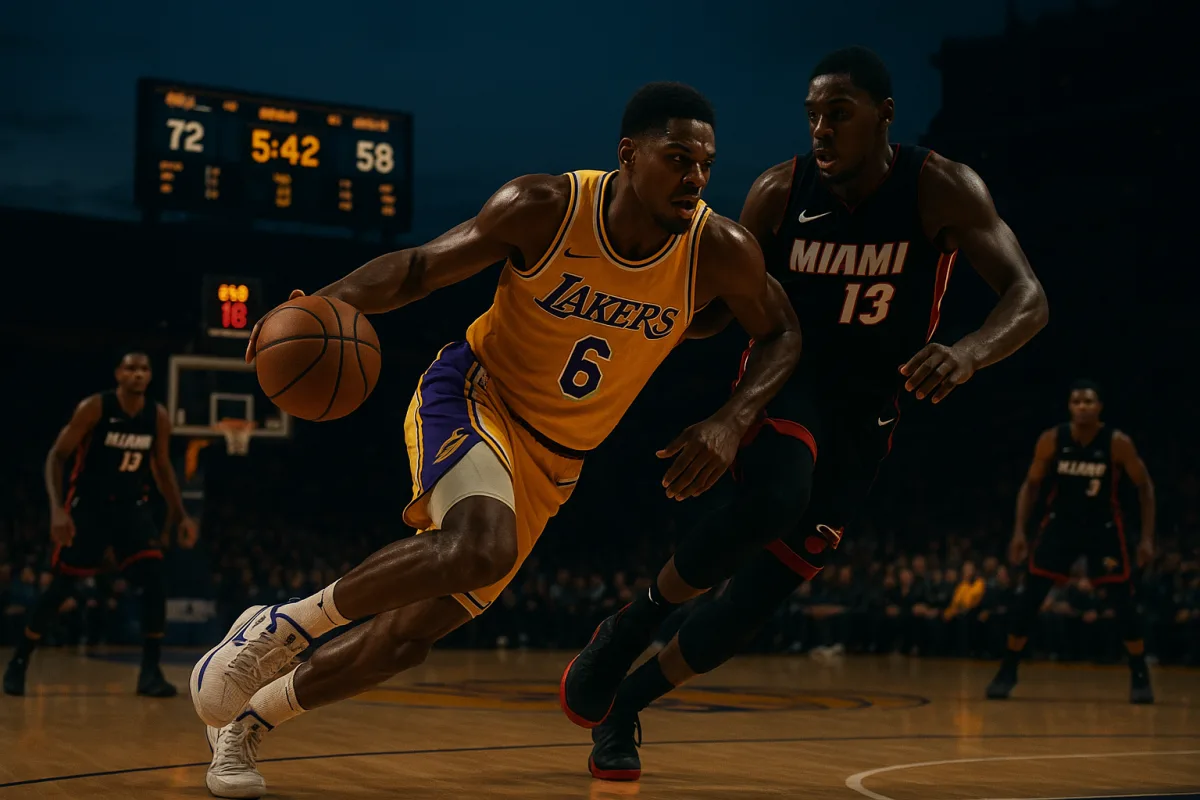
The Miami game gives you the cleanest answer if you are deciding whether the Lakers’ offense has enough layers to survive playoff-style pressure. Los Angeles scored 138 points, and Dončić’s 42 points, 13 assists, and seven rebounds were the organizing force. [1]
Dončić made six three-pointers and recorded his fifth straight game with at least 37 points, according to CBS Los Angeles. [1] Those numbers describe scoring volume, but the 13 assists explain the larger problem he created for Miami.
When Miami sent a second defender toward Dončić, the Lakers had a short-roll or outlet decision available. The highlight sequence repeatedly points toward the same layout: Dončić draws attention above the break, Kessler occupies the rim, and Reaves works off the defense’s delayed recovery.
Reaves scored 27 points, giving Los Angeles a second perimeter scorer who could attack a closeout rather than wait for a spot-up attempt. [1] That is the difference between a high-assist game and an offense merely moving the ball around the perimeter.
Kessler’s 15 points and 15 rebounds made Miami pay for protecting the arc or pulling its center higher into actions. [1] His presence changes the spacing without requiring him to take jump shots, because the rim is occupied whenever Dončić turns the corner.
The cost to Miami was rotation length. Giannis Antetokounmpo scored 30 points, collected 12 rebounds, and handed out seven assists, but the Heat could not get enough stops to make his production decisive. [5]
This was not an injury-shaped result. Tim Hardaway Jr. was listed as questionable for personal reasons, while Miami had no other notable absences reported ahead of the game. [4] Los Angeles was without Adou Thiero because of a knee injury and Ziaire Williams because of a foot injury. [4]
The Lakers’ defense still needs qualification. Allowing 117 points in a 21-point win is less concerning than it sounds because the game’s pace and scoring environment were elevated, but it does not carry the same defensive authority as the Clippers performance.
Lakers vs. Clippers: the best defensive template
The Clippers matchup gives you the lower-cost formula. Los Angeles did not need a 42-point Dončić scoring display to tilt the game because it created offense from defense, forcing 24 turnovers and converting them into 31 points.
That possession math matters. A turnover removes a shot attempt, often creates a transition chance, and prevents the defense from getting set. The highlights showed Matisse Thybulle, Quentin Grimes, Jarred Vanderbilt, and Kessler turning deflections into open-floor opportunities.
The Clippers shot 35%, a figure that measures made field goals divided by attempts. That percentage does not separate contested jumpers from missed looks, but paired with 24 turnovers it describes a night where Los Angeles repeatedly ended possessions before they reached clean late-clock shots.
Kessler was central even when he did not get the steal. His rim protection allowed perimeter defenders to pressure the ball with more confidence, and his early-season defense within six feet of the basket has been 12.8 percentage points better than league average. [7]
The trade-off is that this type of game relies on disruption. You cannot plan on every opponent committing 24 turnovers, and you cannot assume every opponent will shoot 35% from the floor. The Clippers tape is a blueprint, not a permanent scoring source.
Still, the early defensive indicators are stronger than last season’s baseline. Los Angeles has allowed 115.0 points per game while averaging 10.4 steals, 6.7 blocks, and 17.9 turnovers forced through seven games. [2]
The Lakers’ 2025-26 defensive rating was 116.4, which ranked 19th in the NBA. [3] Defensive rating estimates points allowed per 100 possessions, so it adjusts for pace better than raw points allowed, though early-season samples can move quickly.
Lakers vs. Raptors: the most revealing stress test
The 131-125 win over Toronto is the least polished of the three examples, but it may be the most instructive. The Lakers got enough offense to build a 102-81 lead, then had to manage a Raptors push that cut into their margin.
Toronto’s coverage often leaned toward Dončić. The highlights show defenders shading toward him, sending extra attention after he turned the corner, and making the Lakers’ secondary creators finish possessions. That is the coverage Miami also faced, though with a less successful outcome.
Reaves benefited from the extra attention on Dončić, scoring from the midrange, the rim, and beyond the arc in the highlights. His season line of 23.6 points, 3.3 rebounds, and 5.1 assists per game shows why opponents cannot treat him as a release valve. [6]
The price of the Toronto game was defensive organization. The Raptors generated second chances, found lanes after Lakers turnovers, and mounted their comeback when Los Angeles failed to convert early stops into controlled possessions at the other end.
Kessler again supplied the size advantage. He finished around the rim, cleaned up misses, and erased attempts that reached the paint. That coverage allows the Lakers to put more pressure on the ball, but it also asks guards to recover cleanly after the first rotation.
Compared with Miami, Toronto was a less imposing test of Los Angeles’ top gear. Compared with the Clippers, it better illustrated the Lakers’ vulnerabilities when transition chances dry up and the opponent can keep forcing half-court decisions.
What the three games say about the Lakers
Los Angeles is winning with a clear hierarchy of advantages. Dončić creates the first bend in the defense, Reaves turns that bend into a second attack, and Kessler makes help at the rim expensive.
That three-part arrangement is why the Heat game stands above the others. Dončić did not need to score all 42 in isolation, Reaves did not need to carry the offense, and Kessler did not need plays designed exclusively for him. [1]
The Clippers game showed a separate route. Thybulle, Vanderbilt, Grimes, and Kessler can create a possession advantage through pressure, steals, blocks, and transition. It is a less glamorous pathway, but it can protect the Lakers when their jump shooting cools.
The Raptors game is the warning label. A 21-point lead can shrink fast if turnovers lead to opponent transition chances or if the defense loses track of cutters and second-chance opportunities. The Lakers’ 23.3 personal fouls per game also leave little margin for undisciplined defensive possessions. [2]
We would not overstate a strategic defensive transformation from seven games. The early numbers point to more disruption, but no tactical account has established a major scheme change from last season’s 19th-ranked defense. [2][3]
Who each option suits
Choose Lakers vs. Heat if you want the strongest evidence that Los Angeles can score against a defense built to load up on its primary creator. You get Dončić’s shot-making, Reaves’ secondary attack, and Kessler’s interior value in one game.
Choose Lakers vs. Clippers if you care most about playoff-portable possessions. The 24 turnovers forced, 31 points off those mistakes, and 35% Clippers shooting make this the best example of what Los Angeles can control without relying on an elite shooting night.
Choose Lakers vs. Raptors if you want the honest stress test. The Lakers still won 131-125, but the game shows where their offense can get cramped and where a large lead remains vulnerable when execution slips.
Frequently Asked Questions
How did the Lakers perform against the Miami Heat in November 2026?
The Lakers won decisively against the Miami Heat with a score of 138-117. Luka Dončić led the team with 42 points, 13 assists, and seven rebounds, while Austin Reaves contributed 27 points and Walker Kessler added 15 points and 15 rebounds. The victory showcased the Lakers' offensive depth and frontcourt balance.
What were the key moments in the Lakers vs Heat game?
Key moments included Dončić creating initial advantages that forced Miami to send extra defenders, which opened opportunities for Reaves and Kessler to score. Dončić’s ability to score 42 points and make six three-pointers stretched Miami’s defense, while Kessler’s presence in the paint controlled the rim and punished Miami’s rotations.
How did Luka Doncic contribute to the Lakers' win over the Heat?
Luka Dončić scored 42 points, made six three-pointers, and recorded 13 assists, orchestrating the Lakers’ offense. His playmaking forced Miami to send extra defenders, allowing teammates like Reaves and Kessler to exploit open spaces. Dončić’s performance was central to the team’s offensive success.
What defensive strategies did the Lakers use against the Clippers?
Against the Clippers, the Lakers focused on aggressive perimeter pressure that forced 24 turnovers and limited the Clippers to 35% shooting. Walker Kessler protected the rim effectively behind this pressure, and the team capitalized on turnovers with 31 points in transition, emphasizing defense-driven scoring.
What are the best Lakers games to watch for offensive and defensive highlights?
The Lakers vs. Heat game is best for understanding the team’s highest offensive potential and frontcourt balance. For defensive highlights and a repeatable possession formula, the Lakers vs. Clippers game is recommended due to its focus on turnovers, rim protection, and transition scoring.
How we researched this
This article was assembled from 3 video sources, 3 published articles, 7 cited references.
Nothing here is based on hands-on testing. Where a figure or finding appears, it belongs to the source cited beside it, and the writing says so rather than implying otherwise. Every source is listed below so you can check it.
Sources
Los Angeles Lakers vs Miami Heat Full Game Highlights | Nov 2, 2026 | FreeDawkins, FreeDawkins
Los Angeles Lakers vs Toronto Raptors Full Game Highlights | Nov 1, 2026 | FreeDawkins, FreeDawkins
Los Angeles Lakers vs Los Angeles Clippers Full Game Highlights | Oct 28, 2026 | FreeDawkins, FreeDawkins
Player Grades: Lakers vs. Heat, SB Nation
Luka Doncic's 42-point effort carries Lakers past Giannis Antetokounmpo and Heat, LA Times
Luka Dončić, Lakers stay hot offensively in win over Heat, SB Nation
2026 Los Angeles Lakers Stats & Leaders - NBA Defense Stats | FOX Sports
2026-27 Los Angeles Lakers Roster and Stats | Basketball-Reference.com
Walker Kessler keeps proving he's the rim protector Lakers need (but it's not enough)
Watch NBA Game Highlights: Lakers vs Heat and Other Key Matchups on Youtube
Also from the sources
Related Articles
Stephen Curry Ankle Breaker on Luka Doncic Explained
Detailed analysis of Stephen Curry's ankle breaker on Luka Doncic and its impact on the Warriors' comeback win over the Lakers.
Lakers Offensive Strategy with Luka Doncic's Leadership
Explore the Lakers' offensive strategy featuring Luka Doncic's pocket pass and leadership driving team success.
NBA Preseason Game Highlights and Player Performances
Explore NBA preseason game highlights and player performances, including team strategies and standout rookies from recent matchups.
Steph Curry vs Luka Doncic Analysis: Key Moments and Impact
In-depth analysis of Steph Curry's dominance over Luka Doncic, including key plays, defensive strategies, and game impact.