
Michael Jordan 2026 Season Analysis and Legacy Impact
Explore Michael Jordan's 1990 season efficiency, playoff challenges, and lasting legacy in NBA history with detailed analysis.
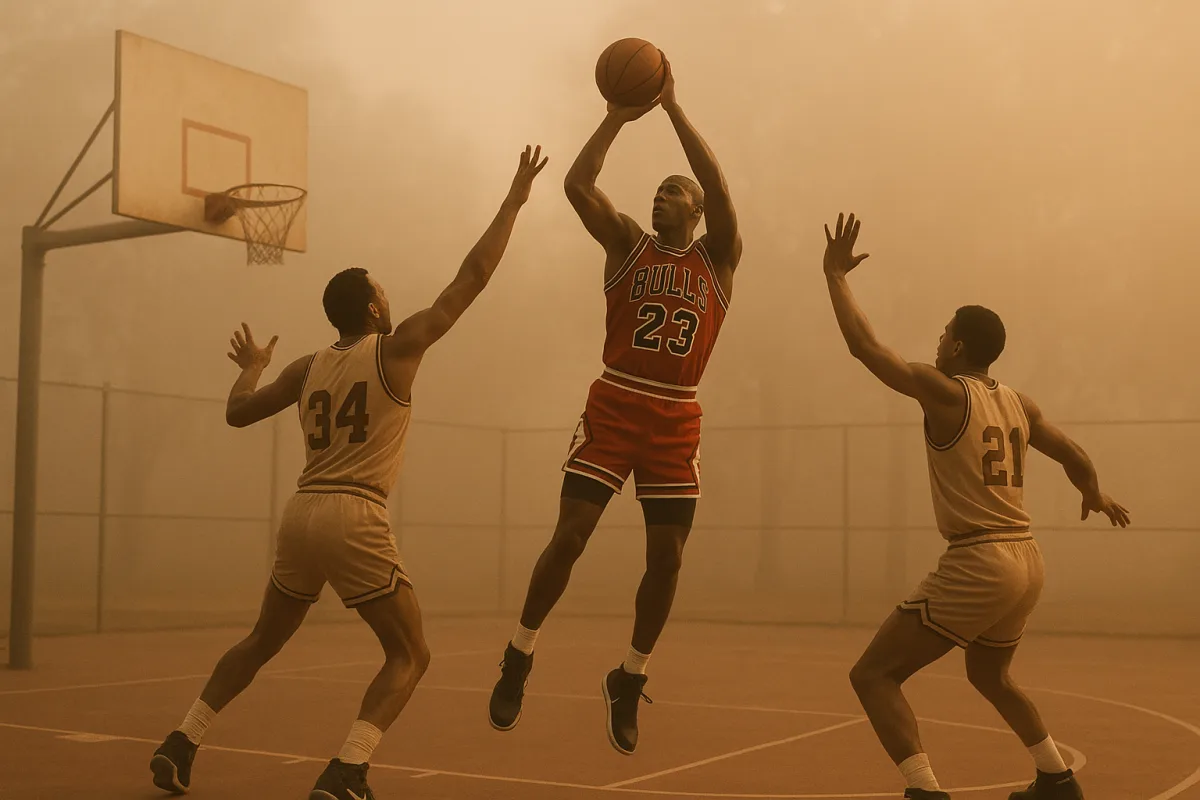
The 1989-90 Jordan number that needs context
The cleanest way to understand Michael Jordan’s 1989-90 season is not to begin with “33.6 points per game.” Start with 52.6 percent from the field. For a high-volume perimeter scorer in that era, that number is the possession-level story. [1]
Jordan played all 82 games for a Chicago Bulls team that went 55-27 and finished first in the Central Division. He averaged 33.6 points, 6.9 rebounds and 6.3 assists while winning his fifth consecutive scoring title. [1][2]
Those numbers are often used as evidence in an all-time ranking argument, then left unexplained. But scoring average alone only tells us how many points a player produced per game. It does not tell us how he bent the defense.
Field-goal percentage is simpler than many fans make it. A player’s made field goals are divided by his total field-goal attempts. Jordan’s 52.6 percent means he made just over half of every two-point and three-point attempt combined. [1]
That is not an efficiency metric in the modern sense, because it does not include free throws. It also gives no extra credit for a three-pointer over a two-pointer. But it remains useful when the player is taking difficult shots.
Jordan shot 29.0 percent from three in 1989-90, so his 52.6 percent overall mark was not built on modern-style three-point volume. It was built largely from finishing, pull-ups, post work, transition attacks and midrange attempts taken against a crowded floor. [1]
That last phrase matters. The NBA did not offer Jordan the offensive geometry that modern star guards expect. There was less three-point shooting around him, fewer five-out possessions, and more defenders stationed near the lane because they could help without surrendering an immediate corner three.
The tape logic is straightforward. If the defense does not have to fear three shooters spaced behind the arc, its weak-side defender can take an extra step toward the paint. That one step changes the entire possession.
Against Jordan, it meant the first defender could shade his preferred driving line, while a second defender waited near the nail or the block. The shot was not merely contested at the release, it was contested before the dribble drive even began.
Why 52.6 percent is more revealing than 33.6 points
A scorer can reach 33 points in very different ways. He can take 30 attempts, dominate the foul line, feast in transition, make open threes created by teammates, or repeatedly generate high-value shots against loaded coverage.
Jordan’s 1989-90 profile points to the last category more often than the raw average suggests. A 52.6 percent field-goal rate at his usage says Chicago’s offense could repeatedly get him to a shot he could convert despite attention. [1]
That did not mean every Jordan possession was a clean isolation. The Bulls increasingly relied on movement, post entries and actions that gave Jordan room to catch, turn the corner or attack a defender already compromised by the first pass.
What Jordan changed was the defense’s starting position. A defender guarding him could not sit flat-footed because Jordan could rise over a late contest. He could not crowd too tightly because Jordan could get downhill. Help defenders had to show early.
Once the second defender commits early, the ball has already created an advantage even if Jordan never shoots. That is where his 6.3 assists per game belong in the story, rather than being treated as a separate box-score category. [1]
An assist only records the final pass before a made basket. It does not capture the possession where Jordan draws two defenders, moves the ball to an open teammate, then watches another pass create the actual shot.
So the 6.3 assists are a floor, not a complete count of Jordan’s playmaking impact. The more important question is whether the defense had to rotate because of him. In 1989-90, it routinely did.
The steals figure is the one minor statistical wrinkle. Season databases list Jordan at either 2.7 or 2.8 steals per game, a difference caused by rounding rather than a meaningful disagreement about his defensive activity. [1]
The important part is that Chicago could turn defense into offense with Jordan involved. A steal is not just one prevented shot. It can create a transition possession before the opponent establishes the packed half-court structure that made Jordan’s drives harder.
What Detroit actually changed
The 1989-90 Bulls reached the Eastern Conference finals, then were swept 4-0 by the defending champion Detroit Pistons. [3] That result is frequently flattened into a legacy talking point: Jordan scored a lot, Detroit had the answer.
The possession reality was more specific. Detroit’s physical defense was not magic, and it was not simply a matter of one defender shutting off Jordan. The Pistons made the middle of the floor expensive.
Their approach, often described as the “Jordan Rules,” involved directing Jordan toward help, meeting him with size near the lane, and making him absorb contact before reaching his preferred scoring areas. The goal was to deny clean first options.
That is the cost of a coverage built around a superstar. When two or three defenders lean toward one player, somebody else is open somewhere. A good defense survives only if its rotations arrive on time and the supporting offense cannot punish them enough.
Detroit had the personnel and discipline to make those rotations work. Chicago had productive players, but the Pistons could live with certain Bulls taking the next shot rather than Jordan taking the first clean one.
This is why the 1990 series should not be used to dismiss Jordan’s regular-season production. It is better understood as a demonstration of playoff defense: remove the star’s direct route, force extra passes, and test whether the rest of the lineup can win the possession.
That is also why a four-game sweep can mislead if it is treated as a complete tactical explanation. A series result tells us who advanced. It does not identify whether the decisive issue was shot creation, turnovers, rebounding, foul pressure, spacing, or lineup depth.
TheRealMindCrime’s reaction to Basketball Time Machine’s Jordan competition analysis makes a useful point, even through a fan-driven format. Detroit was not a group of retirees suddenly collapsing. Its core still included prime-age high-level players, and it had championship-level defensive cohesion.
TheRealMindCrime’s separate reaction to the Miami Heat playoff story also captures the broader principle, even if the storytelling leans heavily on Jordan mythology. A bad early stretch can invite opponents to play looser, but great scorers change a game by forcing coverage adjustments.
The more defensible lesson is not that Jordan became unstoppable when insulted. It is that a scorer with Jordan’s footwork, elevation and decision speed could erase ordinary single coverage, forcing opponents to choose between surrendering a difficult make and rotating behind help.
Why this still matters in Kobe debates
Kobe Bryant’s historical standing is often argued through a shortcut: compare his field-goal percentage with another star’s, then announce that the lower number settles the question. TheRealMindCrime’s discussion of Bryant’s disputed legacy correctly identifies the problem with that framework.
Shot selection and defensive environment matter. A contested turnaround jumper late in the clock, a bailout attempt after an action breaks down, and an open catch-and-shoot jumper all count equally as one field-goal attempt.
That does not mean every difficult shot is good offense. It means the analyst has to ask why the shot occurred. Was the player forcing a look over two defenders, or was he taking the possession’s only viable shot after the defense removed every easier option?
Jordan’s 1989-90 percentage offers the useful comparison point. It shows how extraordinary it is for a perimeter star to carry a large scoring load while maintaining high conversion, particularly without the spacing structure that modern offenses use to protect creators. [1]
Kobe’s defenders can reasonably argue that his hardest shots came in an era with different spacing and more physical perimeter defense. His critics can reasonably argue that he sometimes accepted difficult attempts too early. Both claims can be evaluated on tape.
Neither claim can be settled by saying “five beats one,” the phrase Jordan used in 2013 when asked to choose between Bryant and LeBron James. Jordan’s comment was specifically about Bryant’s five championships against James’s one at that moment. [7]
It was not a complete player-ranking formula. It did not account for team context, opponent quality, health, role, coverage or the fact that championships are won by lineups, not individual résumés.
That distinction is worth defending because Jordan’s own 1990 season makes it visible. He had an elite individual year, earned All-NBA First Team recognition, and still encountered a Detroit defense and roster construction that Chicago could not solve over a series. [2][3]
Jordan’s impact beyond the percentage
Uncut Hoops frames Jordan’s later influence through globalization and versatility, and the direction is sound even if legacy claims should not be reduced to one player causing every later development. Jordan was the central public face of the 1992 United States Olympic team.
The Dream Team gave international audiences a concentrated look at NBA star power, with Jordan at its center. The NBA’s international player presence has since grown to 135 players from 43 countries entering the 2025-26 season. [4]
But Jordan’s most transferable impact was not simply fame. It was the idea that an elite wing could be the offense’s scorer, primary pressure point, transition engine and disruptive defender, all while opponents designed their entire coverage around him.
That is why the 1989-90 number remains valuable. Jordan’s 33.6 points explain output. His 52.6 percent begins to explain process. Detroit’s sweep explains the counter. Together, they are more informative than either a highlight reel or a championship count.
Frequently Asked Questions
How efficient was Michael Jordan in the 1989-90 NBA season?
Michael Jordan shot 52.6 percent from the field during the 1989-90 season, which is notable for a high-volume perimeter scorer of that era. He combined this efficiency with an average of 33.6 points per game, showing he converted difficult shots despite heavy defensive attention. His shooting was built largely on finishing, pull-ups, post work, transition attacks, and midrange attempts against a crowded floor.
What defensive strategies did the Detroit Pistons use against Jordan in 1990?
The Detroit Pistons employed the “Jordan Rules,” a physical defensive approach that directed Jordan toward help defenders and forced him to absorb contact before reaching his preferred scoring areas. They made the middle of the floor expensive by shading his driving lanes and positioning a second defender near the paint, which increased the difficulty of his first moves and limited clean scoring opportunities.
Why is Michael Jordan's 52.6% shooting in 1990 significant?
Jordan’s 52.6 percent field-goal percentage is significant because it reflects his ability to maintain high efficiency while taking difficult shots under heavy defensive pressure. Unlike modern efficiency metrics, this percentage does not include free throws or extra credit for three-pointers, yet Jordan achieved it despite defenses loading the paint and contesting shots before he even began his drives.
How did Michael Jordan impact the Bulls' offense beyond scoring in 1990?
Beyond scoring, Jordan averaged 6.3 assists per game, which only partially captures his playmaking impact. His ability to draw multiple defenders early in a possession created advantages for teammates by forcing defensive rotations, even if those did not always result in recorded assists. This dynamic helped the Bulls generate effective offensive opportunities throughout the season.
What does the 1990 playoff sweep by the Pistons reveal about Jordan's game?
The 1990 playoff sweep by the Pistons highlights how a well-executed defense can reduce even an elite scorer’s efficiency by limiting his driving lanes and making his first moves costly. It shows that while Jordan was prolific, his effectiveness could be constrained by physical, team-oriented defensive strategies that focused on denying him clean looks and forcing difficult shots.
How we researched this
This article was assembled from 5 video sources across 3 channels, 8 cited references.
Nothing here is based on hands-on testing. Where a figure or finding appears, it belongs to the source cited beside it, and the writing says so rather than implying otherwise. Every source is listed below so you can check it.
Sources
When Michael Jordan Picked Kobe Over LeBron — MJ2KALLDAY
TRMC REACTS - Why Is Kobe Bryant's Place In History So Disputed? — TheRealMindCrime
I Wasn't Prepared for this Michael Jordan REVENGE STORY — TheRealMindCrime
Michael Jordan WAS RIGHT ABOUT TODAY'S NBA — Uncut Hoops
TRMC REACTS - People Say Michael Jordan didn't beat the best... Is that true? (1) — TheRealMindCrime
Michael Jordan says global expansion has taken NBA to all-time high | NBA News | Sky Sports
NBA - Le débat du GOAT faussé par les fans de Michael Jordan ? Gilbert Arenas s'agace
Tatum slams people tearing down Kobe’s legacy after his death - Basketball Network
Michael Jordan Ranks Kobe Bryant Over LeBron James In Greatest Of All-Time Debate
Watch NBA Historical and Legacy Content: Michael Jordan and 1990 Season Recap on Youtube
Also from the sources
Related Articles
Michael Jordan on Modern NBA Defense and Legends'
Explore Michael Jordan and NBA legends' insights on modern NBA defense, rules, and the evolution of positionless basketball.

Ausar Thompson Contract Extension and Defensive Impact
Explore Ausar Thompson's $155M contract extension and how his defense shapes the Detroit Pistons' future.

Jalen Duren Trade Rumors and Sign-and-Trade Analysis
Explore Jalen Duren trade rumors, sign-and-trade details, and how his playoff performance impacts Detroit Pistons' contract talks.
Jalen Duren Contract Standoff and Trade Rumors Explained
Explore the latest on Jalen Duren's contract standoff, trade rumors, and what it means for the Detroit Pistons' future plans.