
Michael Jordan on Modern NBA Defense and Legends'
Explore Michael Jordan and NBA legends' insights on modern NBA defense, rules, and the evolution of positionless basketball.
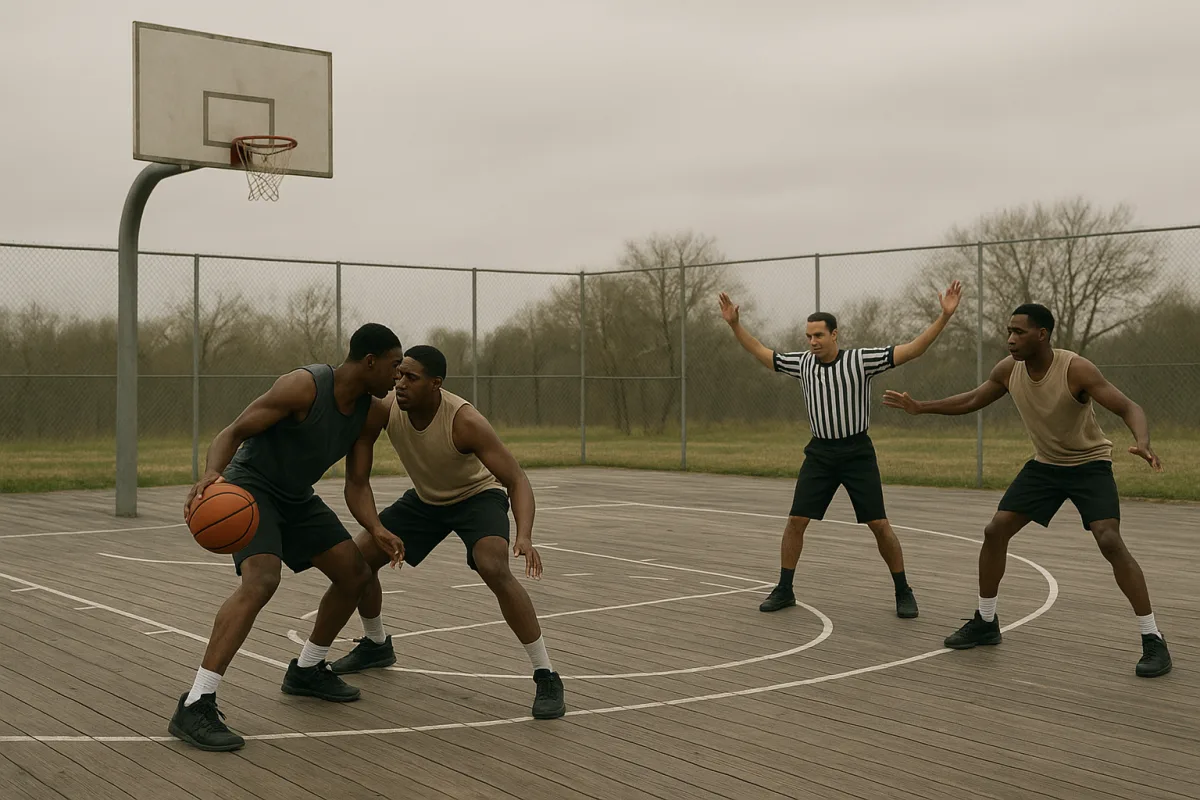
Modern NBA “Softness” Is Really a Conversation About Defensive Geometry
The word “soft” hides the real argument
The loudest legend-versus-modern-NBA argument usually begins with contact. Former players remember cutters being bumped off routes, post entries being denied with forearms, and drivers meeting a second body near the rim.
That memory is not imaginary. In Uncut Hoops’ compilation of former-player comments, the recurring complaint is that today’s defenders cannot make an offensive player “pay a price” for moving through the lane.
But “the league is soft” is not a scouting report. It does not tell us whether a defender was beaten by first-step speed, screened out of the play, late on a rotation, or prohibited from using contact.
The useful question is narrower: what does a tighter interpretation of holding, pushing, and impeding change about the geometry of a possession? That is where modern scoring, player comparisons, and many old-school critiques meet.
Freedom of movement changes the defender’s first job
The NBA’s current rules do permit defenders to establish legal guarding position and use limited forearm or leg positioning in the Lower Defensive Box. They do not permit a defender to hold, push, dislodge, or impede an opponent with unnatural body positions or extended limbs. [7]
That distinction matters most before the shot, not at the moment of the shot. A defender who cannot redirect a cutter early may be forced to chase him for the next two seconds.
Imagine a wing setting a pindown screen for a shooter. The defender’s old instinct might be to bump the cutter before the screen, grab a jersey briefly, or ride the shooter’s hip through the route.
Under freedom-of-movement enforcement, those actions can become fouls if they alter the cutter’s path or balance. The defender must instead beat the route with footwork, anticipation, and a legal angle around the screen.
That sounds like a small adjustment. It is not. Arriving half a step late changes whether the big defender can stay attached to the roller, whether the low man must tag, and whether the corner shooter is open.
Modern offense is built around forcing precisely those half-steps. The best teams do not need a defender to be helpless. They need the defense to make one early choice that compromises the next rotation.
The same principle applies on drives. If a perimeter defender cannot use an extended arm or body check to slow a ballhandler’s line, the help defender has to engage earlier and farther from the rim.
Once help comes early, the offense has a read. The driver can finish before the rotation, dump the ball to a big, kick to the corner, or swing the ball to attack a closing defender.
That is why “you cannot touch anybody” is too broad to explain modern offense. Defenders can still contest, wall up, switch, peel switch, trap, ice a side pick-and-roll, and load extra bodies toward a scorer.
What they cannot reliably do is solve a coverage mistake with an illegal grab or a late displacement. The rules make defensive organization more valuable, because individual recovery has less room for error.
A pick-and-roll is a chain, not a one-on-one contest
Take a high pick-and-roll with a shooting guard, a screening center, two corner shooters, and a weak-side wing. Five offensive players are involved even if only two touch the ball.
The on-ball defender has to choose whether to chase over the screen, slip under it, switch, or send the ballhandler toward a sideline. The screener’s defender determines whether to drop, hedge, switch, or blitz.
If the big drops, the ballhandler may gain a pull-up jumper. If the big steps up, the roller can sprint into open space. If weak-side help tags that roller, a corner or wing shooter becomes available.
Freedom-of-movement rules affect the first defender’s ability to stay connected through the screen. They also affect whether the screener can illegally hold the defender, which officials are supposed to police in the other direction.
That is the cost of any coverage. A drop protects the rim but concedes certain pull-ups. Switching removes the immediate advantage but risks a small defender against a big player. Blitzing forces a pass but opens four-on-three basketball.
The outcome depends on personnel. A slow-footed center may have to drop deeper. A mobile center can show higher. A guard with strength can fight over screens. A long wing can switch onto a ballhandler without conceding immediate separation.
This is why modern players are asked to be more complete. They must dribble, pass, shoot, make quick reads, and defend different positions because every coverage is trying to locate the weakest skill on the floor.
Michael Jordan made that point in his 2003 All-Star Weekend press conference, replayed by TheRealMindCrime. Jordan described the game less as guard-oriented than as increasingly versatile, with multi-position players giving coaches different looks.
That forecast has aged well. The language has changed to “positionless basketball,” but the possession-level reality is the same: a defense cannot hide a limited player as easily when actions force five players to make decisions.
What a paint percentage can, and cannot, tell us
Uncut Hoops uses Shai Gilgeous-Alexander’s restricted-area efficiency alongside Shaquille O’Neal’s to argue that modern paint scoring is easier. That comparison identifies a real environment change, but the number alone cannot prove its cause.
Restricted-area percentage is simply makes divided by attempts from the area nearest the basket. It does not record whether the shot came in transition, after a switch, against a rotating rim protector, or after two defenders vacated the lane.
It also does not distinguish a thunderous post finish from a guard’s layup after a five-out drive. Both count as a make from the same location despite requiring very different defensive responses.
The right film-room question is not whether Gilgeous-Alexander’s percentage should match O’Neal’s. It is whether each player generated the same kind of rim attempt against comparable help, spacing, and legal contact conditions.
O’Neal often demanded a low-post double team before the shot even began. Gilgeous-Alexander more commonly bends a defense from the perimeter, using pace and angles until a big defender has to choose between containing him and protecting a teammate.
Neither task is automatically harder. They impose different coverage taxes. O’Neal compressed the defense toward the block, while a modern primary ballhandler can stretch it from the nail to both corners.
Playoff basketball is useful here because opponents have time to tailor coverages. Teams show more bodies early, switch more selectively, top-lock shooters, and accept difficult matchups rather than surrender the offense’s preferred first option.
That does not mean regular-season basketball is meaningless, as Uncut Hoops suggests. It means regular-season efficiency and playoff efficiency answer different questions, because the menu of defensive counters is different.
Jordan’s more valuable modern observation was global
Jordan’s 2003 comments also anticipated the international change that has reshaped matchup planning. He credited David Stern, the Dream Team, and the NBA’s global reach for giving players abroad a reason to pursue the league.
The league now has 135 international players from a record-tying 43 countries across six continents on 2025-26 opening-night rosters, according to NBA Communications. [8] Europe alone supplied 71 players, while Canada led all countries with 23. [8]
That shift matters beyond nationality. Different development systems have produced more big players comfortable making reads from the elbow, initiating offense after a rebound, or defending in space rather than operating strictly as screen setters.
Jordan said the global game would force American players to become more rounded. That is a better frame than treating international influence as a threat, because the practical result is a larger supply of players who stress old coverage assumptions.
A center who can pass over the top of a double changes the value of sending help. A 6-foot-8 creator who handles pick-and-roll changes the value of switching. The chessboard is wider.
Player comparisons fail when they become moral arguments
Jordan’s 2013 Kobe Bryant versus LeBron James answer, replayed by MJ2KALLDAY, is often reduced to “five beats one.” In context, Jordan praised LeBron’s dominance while recognizing Bryant’s five championships and extreme competitive workload.
The problem is not that championships matter. The problem is that rings are team outcomes, not a clean measure of an individual possession. They reflect roster construction, health, opponents, coaching, and dozens of matchup decisions.
The better comparison asks what each player forced. Bryant’s difficult-shot repertoire could punish a defense that switched late or allowed him to reach preferred elbow spots. James created larger-scale pressure by collapsing the paint and finding weak-side shooters.
Their styles created different coverage problems, which is why a simple count cannot settle the argument. A defense may live with a contested Bryant jumper, then discover he can make it. Against James, it may crowd the lane and concede a corner three.
BTM Basketball Time Machine’s compilation on Grant Hill provides another useful warning. Players describe the healthy Detroit forward as a large initiator who could handle, post, score, and create for teammates, then compare that template to LeBron.
That is a role comparison, not proof that Hill was identical to James or Jordan. Hill’s value was that his size and ballhandling forced defenders to decide who could guard the initial action without compromising the rest of the coverage.
The old-school critique deserves precision
Byron Scott’s complaint that the league has lost some “innocence and purity” reflects a broader concern about load management, player availability, and the commercial rhythm of the modern season. [4] That is a critique of the league experience, not necessarily of skill.
Jordan’s own recent criticism of load management focused on physical readiness and whether fans get to see stars play. ESPN reported that his concern was availability, not a broad statement about modern players’ mental toughness. [3]
There is also a counterargument worth keeping in the frame. Dan Le Batard criticized the tendency of basketball media, including discussion around Inside the NBA, to treat the current game with reflexive negativity. [5]
The tape supports neither nostalgia as a trump card nor dismissal of every old-player complaint. Modern defense is constrained differently, offenses are better spaced, and players are more versatile. None of that makes physicality, effort, or accountability irrelevant.
It means the next time someone says today’s NBA is softer, the response should be: show the possession. Identify the contact, name the coverage, and explain which defender lost the geometry before the whistle ever arrived.
Frequently Asked Questions
How does Michael Jordan view defense in the modern NBA?
Michael Jordan predicted that the evolution of basketball would be shaped by global talent and positional versatility, leading to more well-rounded players rather than a guard-oriented game. He emphasized the importance of versatility, where players must be able to dribble, pass, shoot, and defend multiple positions, reflecting the demands of modern defensive schemes. Jordan’s insight highlights that defense today requires adaptability rather than relying on physicality alone.
What changes in NBA defensive rules affect gameplay today?
Current NBA rules prohibit defenders from holding, pushing, or impeding opponents using unnatural body positions or extended limbs, though limited forearm and leg positioning within the Lower Defensive Box is allowed. These rules prevent defenders from using illegal contact to redirect or dislodge offensive players, forcing defenders to rely more on footwork, anticipation, and positioning. This leads to offenses exploiting small defensive mistakes and requires defenses to be more organized and precise.
How do NBA legends compare modern NBA to past eras?
NBA legends often recall a more physical style of defense where bumping cutters and using contact to deny post entries were common. However, modern rules restrict such contact, changing the geometry of defense and offense. Comparing players across eras by raw statistics or championships misses the more nuanced question of how each player forced defenses to adjust, reflecting different defensive constraints and styles.
What did Michael Jordan predict about the evolution of basketball?
Michael Jordan predicted that the game would become more versatile and less positionally rigid, with players expected to be multi-skilled and capable of defending multiple positions. He foresaw that global talent and positional versatility would force a more rounded style of basketball, which aligns with today’s concept of “positionless basketball.” His prediction emphasizes the strategic complexity and adaptability required in modern play.
How does defensive geometry influence modern NBA offenses?
Defensive geometry shapes how offenses create space and exploit defensive rotations. Because defenders cannot use illegal contact to slow cutters or ballhandlers, offenses force defenders into difficult choices—such as whether to chase over screens, drop to protect the rim, or switch assignments. These decisions create opportunities for pull-up jumpers, open shooters, or cutters to the basket, making modern offenses highly dependent on forcing defensive compromises through spacing and movement.
How we researched this
This article was assembled from 5 video sources across 4 channels, 9 cited references.
Nothing here is based on hands-on testing. Where a figure or finding appears, it belongs to the source cited beside it, and the writing says so rather than implying otherwise. Every source is listed below so you can check it.
Sources
NBA Legends EXPOSE WHY MODERN GAME IS SOFT — Uncut Hoops
When Michael Jordan Picked Kobe Over LeBron — MJ2KALLDAY
Michael Jordan WAS RIGHT ABOUT TODAY'S NBA — Uncut Hoops
NBA Legends on why Grant Hill had Jordan Potential — BTM Basketball Time Machine
Michael Jordan's Final ALL STAR Press Conference is WHY he's the GOAT — TheRealMindCrime
NBA rosters feature record 125 international players from 40 countries | NBA.com
Michael Jordan criticizes load management in current NBA - ESPN
Sam Smith: Today's NBA lost "innocence and purity" of past eras - Basketball Network
Dan Le Batard: ‘Inside the NBA’ Is “Super Negative” - Barrett Media
NBA Experts Debate Magic Johnson and Larry Bird Modern Era Success
Watch Michael Jordan and NBA Legends Reflect on Modern NBA on Youtube
Also from the sources
Related Articles

NBA Legends on Michael Jordan and Other Basketball Greats
NBA legends reflect on Michael Jordan and other greats, comparing legacies, Finals impact, and playing styles in basketball history.

Michael Jordan Legacy Analysis
Explore Michael Jordan legacy analysis focusing on his defensive impact and insights from NBA legends on his greatness and playoff tactics.

NBA GOAT Debate Analysis
Explore NBA GOAT debate analysis comparing Michael Jordan and LeBron James' views and evidence for their greatness.
Los Angeles Lakers Playoff Debacle: Depth, Coaching, and Defensive Woes Exposed
The Los Angeles Lakers' shocking defeat to the Minnesota Timberwolves in a five-game series revealed issues of depth, coaching decisions, defensive vulnerabilities, and failed trade attempts for a center, ultimately leading to their downfall in the playoffs.