
Minnesota Timberwolves Offseason Changes and Frontcourt
Explore Minnesota Timberwolves offseason changes and how the new frontcourt shapes their 2026 season outlook and team dynamics.
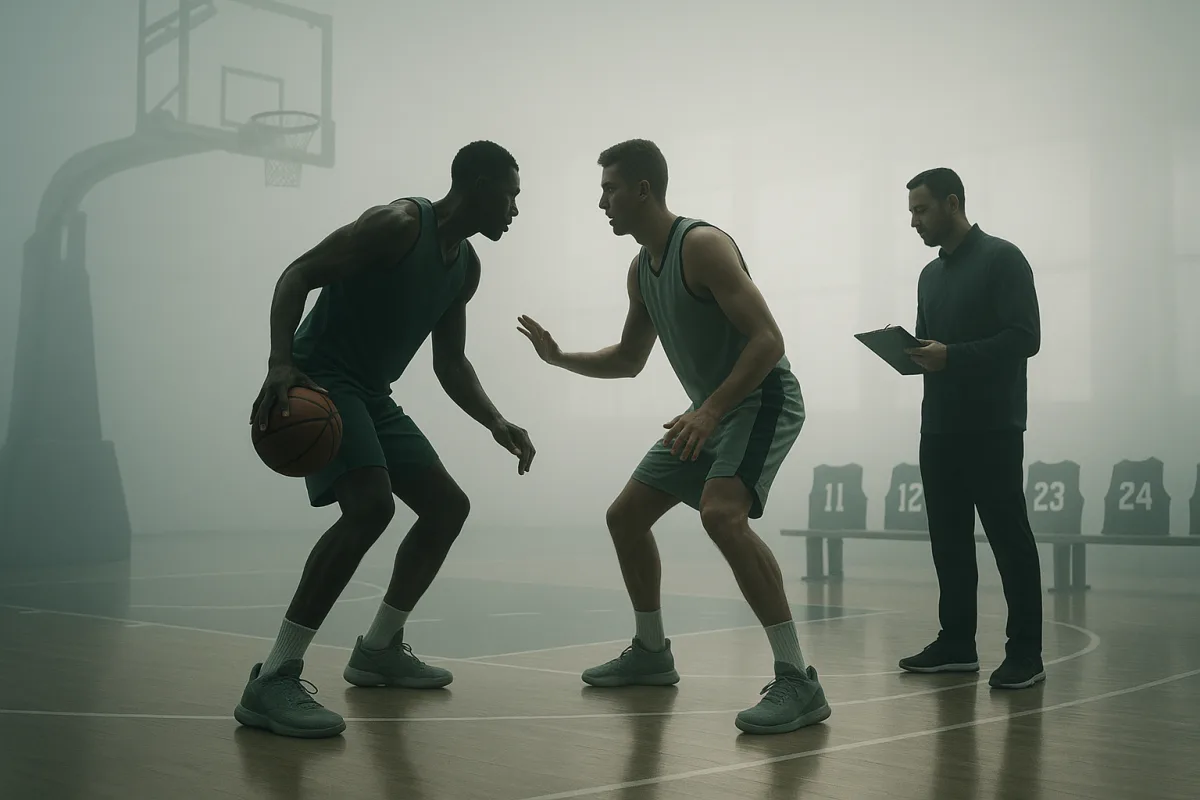
The frontcourt is now a coverage problem
The Timberwolves did not simply reshuffle their forwards. By moving on from Julius Randle and Naz Reid, Minnesota changed the number of playable answers it has when an opponent attacks Rudy Gobert’s role in a playoff series. [6]
That is the concept worth isolating: frontcourt depth is not just a count of big bodies. It is the ability to change a defensive coverage or offensive shape without surrendering the core identity of a lineup.
Gobert remains the center of Minnesota’s defense. His most valuable work is usually not a block that reaches the box score, but the possession before it, when a driver sees him stationed near the rim and turns a layup into a floater, kickout, or reset.
That kind of rim protection lets perimeter defenders press higher up the floor. Anthony Edwards, Jaden McDaniels and Minnesota’s other wings can chase over screens or crowd ball-handlers because they know a large, experienced center is behind them.
The cost is that Gobert is not a perimeter shooter. When he is on offense, Minnesota typically needs enough shooting, cutting and secondary playmaking around him to prevent opponents from placing a second defender near the paint.
That was easier when Minnesota could toggle between different frontcourt looks. A roster with Randle and Reid offered more size, scoring and, in Reid’s case, a credible shooting threat from the big-man spots.
The current group is thinner. Kuminga brings athleticism and downhill force, Lyles brings a more conventional stretch-forward skill set, and young center Joan Beringer offers energy and length. But those players do not solve the same problems in the same way.
Why Kuminga-Gobert changes the geometry
The Kuminga-Gobert pairing is not automatically doomed by spacing. Plenty of winning teams have played a non-shooting center beside a forward whose shooting is merely adequate. The question is what Minnesota asks Kuminga to do when Gobert occupies the lane.
Kuminga has made 33.2 percent of his career three-point attempts, a figure that describes conversion rate, not willingness or defensive reputation. Opponents will decide how tightly to guard him based on both elements. [13]
If a defense helps off Kuminga in the corner, the immediate issue is not simply that Minnesota gets an open three. It is that Gobert’s defender can crowd the restricted area while still being close enough to recover.
That can erase the cleanest version of an Edwards drive. Rather than attacking one primary defender with Gobert’s screen creating separation, Edwards may see a low man already planted in the lane and a second helper ready to rotate.
A functioning Kuminga-Gobert possession therefore needs more movement than a conventional spread pick-and-roll. Kuminga cannot merely stand in a corner awaiting a pass. He has to cut behind ball-watching defenders, screen, sprint in transition and attack tilted defenses.
That is where the fit has a plausible path. Gobert’s value as a screener pulls his defender into the action, while Kuminga can attack gaps created after the first rotation. The goal is not to make Kuminga a stationary shooter.
Still, cuts are not an all-purpose spacing substitute. A cut works when defenders lose sight of the cutter, when a ball-handler can make the pass on time, and when the occupied paint has a usable lane. Those conditions are matchup-dependent.
Minnesota also cannot assume Kuminga will solve its playmaking shortages himself. His career rate of 3.6 assists per 36 minutes suggests he has not yet been a high-volume connective passer, the type who consistently converts the advantage created by Edwards or Gobert into the next advantage. [13]
That distinction matters. A scorer can punish a closeout, but a connector keeps the offense alive after the defense rotates. Minnesota needs both functions, particularly if opponents crowd Edwards above the break and dare other players to make quick decisions.
Lyles is a structural counter, not a headline addition
Trey Lyles’ one-year, $3,876,529 minimum-salary agreement looks modest next to Kuminga’s arrival, but it may be the cleaner answer to the lineup problem. The contract is a low-cost commitment, not a declaration that he must start. [3][11]
Lyles suits the minutes when Minnesota needs a forward whose defender must honor the perimeter. With Gobert screening and rolling, even a forward standing beyond the arc can make the paint meaningfully less crowded than it is in a two-non-shooter alignment.
That does not mean Lyles replicates Reid. Reid’s departure removed a player who could score in several different ways and change the game with his own offensive creation. Lyles’ value is more likely to come through fit and decision simplicity.
There is a tactical benefit in that simplicity. A lineup does not need every player to create a shot. It does need players to understand whether their job on a possession is to space, screen, cut, switch or help.
Minnesota can use Lyles to make Kuminga’s role more specific. Rather than asking both forwards to share ambiguous space around Gobert, the Wolves can put Lyles above the break or in the corner and free Kuminga to cut and run.
The reverse lineup is also important. If Minnesota plays Kuminga without Gobert, it can unlock more open-floor possessions and give Kuminga a clearer runway to the rim. But that version asks who protects the basket and rebounds against playoff-caliber size.
That is the trade-off at the center of this roster. Bigger lineups can preserve rim protection but risk offensive congestion. Smaller or more shooting-oriented groups can improve the attack but may ask too much of McDaniels, Edwards or Kuminga defensively.
Beringer has to learn the cost of aggression
That brings the discussion to Joan Beringer, the 19-year-old center who played 40 regular-season games as a rookie. He averaged 3.9 points, 2.3 rebounds and 0.7 blocks in 7.9 minutes per game. [4][5]
Those averages should not be inflated into proof that Beringer is ready for 20 playoff minutes. A block rate in limited action can show real rim-protection instincts, but it does not tell readers whether he can call coverages, avoid fouls, or defend multiple actions.
What Minnesota needs from Beringer is more specific than “development.” The Wolves need him to remain playable after the first screen, the second drive and the weak-side rotation, without leaving his assignment in pursuit of every possible block.
That is a common young-center problem. A rookie sees the ball enter the paint and races toward it, but the offense has designed the possession around that impulse. The dump-off pass, baseline cutter or corner shooter is waiting behind the first contest.
Beringer’s 66.3 percent field-goal shooting should be read carefully, too. It reflects efficiency close to the rim in a limited role, not evidence that Minnesota can run offense through him or use him as a spacing solution. [4][5]
His route to usefulness is narrower and more valuable: screen hard, dive to the rim, rebound, protect the paint and execute the team’s intended coverage. Gobert’s presence gives him a daily model for the positional details that rarely appear in highlights.
But depth becomes fragile quickly when the backup center is still learning those details. An injury, foul-heavy game or matchup that forces Gobert into a different coverage could turn Beringer from developmental reserve into a required answer.
The Kuminga contract shapes the decision
Minnesota signed Kuminga to a two-year, $12.4 million deal with a player option in the second season, an important detail beyond the annual $6.2 million average. [2][3]
A player option gives Kuminga the ability to re-enter free agency after one productive season. That can align his incentives with Minnesota’s, because a strong year requires helping a good team win, but it can also make role clarity essential.
The Wolves do not need Kuminga to win a nightly scoring contest with Edwards. They need him to make Minnesota’s best five-man groups more difficult to scheme against, especially when the opponent traps Edwards or overloads the paint against Gobert.
That likely means accepting some possessions where his most useful action produces no shot attempt. A hard baseline cut can force a rotation. A weak-side box-out can preserve a stop. A correctly timed switch can keep Gobert near the rim.
Those are not secondary details. They determine whether a high-talent frontcourt survives postseason scouting. Opponents will repeatedly attack the same weak points until a team proves it can counter, rather than waiting for individual shot-making to rescue possessions.
Be careful with the “new era” commentary
A Hoop Dungeon video framed Minnesota’s possible new era around reactions attributed to former NBA players, including excitement about an Edwards-LaMelo Ball pairing and concern about a crowded hierarchy. That premise should be treated cautiously.
The available reporting supporting Minnesota’s actual offseason centers on Kuminga, Lyles, Beringer and the frontcourt departures, not a verified Ball acquisition. There is also no substantiated public record of NBA legends offering detailed analysis of this specific post-offseason roster balance.
That does not make the underlying basketball question uninteresting. It simply means the useful evidence is on the court: can Kuminga defend off the ball, can Lyles preserve spacing, and can Beringer survive the minutes Gobert cannot play?
The Timberwolves’ ceiling will be determined less by the number of recognizable athletes on the roster than by whether those three answers fit together possession by possession.
Frequently Asked Questions
What are the key offseason changes for the Minnesota Timberwolves?
The Timberwolves moved on from Julius Randle and Naz Reid, changing their frontcourt composition significantly. They signed Jonathan Kuminga to a two-year, $12.4 million contract with a player option and Trey Lyles to a one-year minimum deal. These moves reflect a shift toward a different frontcourt dynamic centered on Rudy Gobert and Kuminga.
How will the Kuminga-Gobert frontcourt impact the Timberwolves?
The Kuminga-Gobert pairing creates spacing and defensive communication challenges because Gobert is a non-shooting center and Kuminga’s three-point shooting is inconsistent at 33.2%. Kuminga must be more active off the ball, cutting and attacking gaps rather than standing as a stationary shooter. This frontcourt combination requires more movement and coordination to maintain offensive flow and spacing.
What role does Trey Lyles play in the Timberwolves' new lineup?
Trey Lyles serves as a structural counter and a lineup-release valve rather than a primary scorer. His skill set as a stretch forward helps relieve pressure when Gobert and Kuminga compress the half court. Lyles’ one-year minimum contract reflects a modest but important role in providing flexibility and depth.
How does the Timberwolves' frontcourt depth affect their defense?
The Timberwolves’ frontcourt depth is thin, which limits their ability to change defensive coverage without compromising their core identity. Rudy Gobert remains the defensive anchor, allowing perimeter defenders to press higher, but the lack of interchangeable frontcourt options reduces Minnesota’s flexibility in managing foul trouble or injuries.
What challenges does Joan Beringer face in the Timberwolves rotation?
Joan Beringer’s development has become a rotation necessity due to limited frontcourt depth and reliance on Gobert as the only established interior anchor. Beringer must contribute consistently despite limited minutes, and his growth is crucial to providing energy and length off the bench while minimizing risks related to foul trouble or injury.
How we researched this
This article was assembled from 1 video source, 6 published articles, 13 cited references.
Nothing here is based on hands-on testing. Where a figure or finding appears, it belongs to the source cited beside it, and the writing says so rather than implying otherwise. Every source is listed below so you can check it.
Sources
What NBA Legends ACTUALLY Think About The Timberwolves New Era — Hoop Dungeon
Wolves Counting On Joan Beringer To Fill Rotation Role — RealGM
Warriors Waive Elias Ralph — RealGM
Timberwolves Waive Stephen Thompson — RealGM
Hawks Waive Will Baker — RealGM
Timberwolves Sign Stephen Thompson To Camp Contract; Waive Jules Bernard — RealGM
Joan Beringer Stats, Height, Weight, Position, Draft Status and more | Basketball-Reference.com
Timberwolves' lack of frontcourt depth remains a clear concern
Timberwolves' biggest mistake so far in 2026 NBA free agency
The Biggest Thing Holding the Timberwolves Back for 2026-27 Season
The Mechanics of the NBA Exhibit 10 Contract: How Training Camp Invites Actually Work | Factlen
Pros and Cons of the Timberwolves' Kuminga-Gobert Frontcourt
Watch Minnesota Timberwolves Offseason Changes and New Era Outlook on Youtube
Related Articles
NBA 2026 Offseason Analysis: Key Moves and Team Strategies
Explore the NBA 2026 offseason analysis with insights on major trades, signings, and team-building strategies shaping the upcoming season.
NBA Offseason Team Building Strategies for 2026-27 Season
Explore NBA offseason team building strategies in 2026 and how moves shape Bulls and Timberwolves' 2026-27 outlooks.

NBA 2026 Offseason Team Moves and Surprises Explained
Explore key NBA 2026 offseason team moves and surprises, analyzing trades, strategies, and impacts on team depth and championship chances.
Jonathan Kuminga Team Choice and Trade Controversy Explained
Explore Jonathan Kuminga's team choice, contract details, and trade controversy in the NBA, including Minnesota vs Lakers offers and career impact.