
NBA Offseason Team Building Strategies for 2026-27 Season
Explore NBA offseason team building strategies in 2026 and how moves shape Bulls and Timberwolves' 2026-27 outlooks.
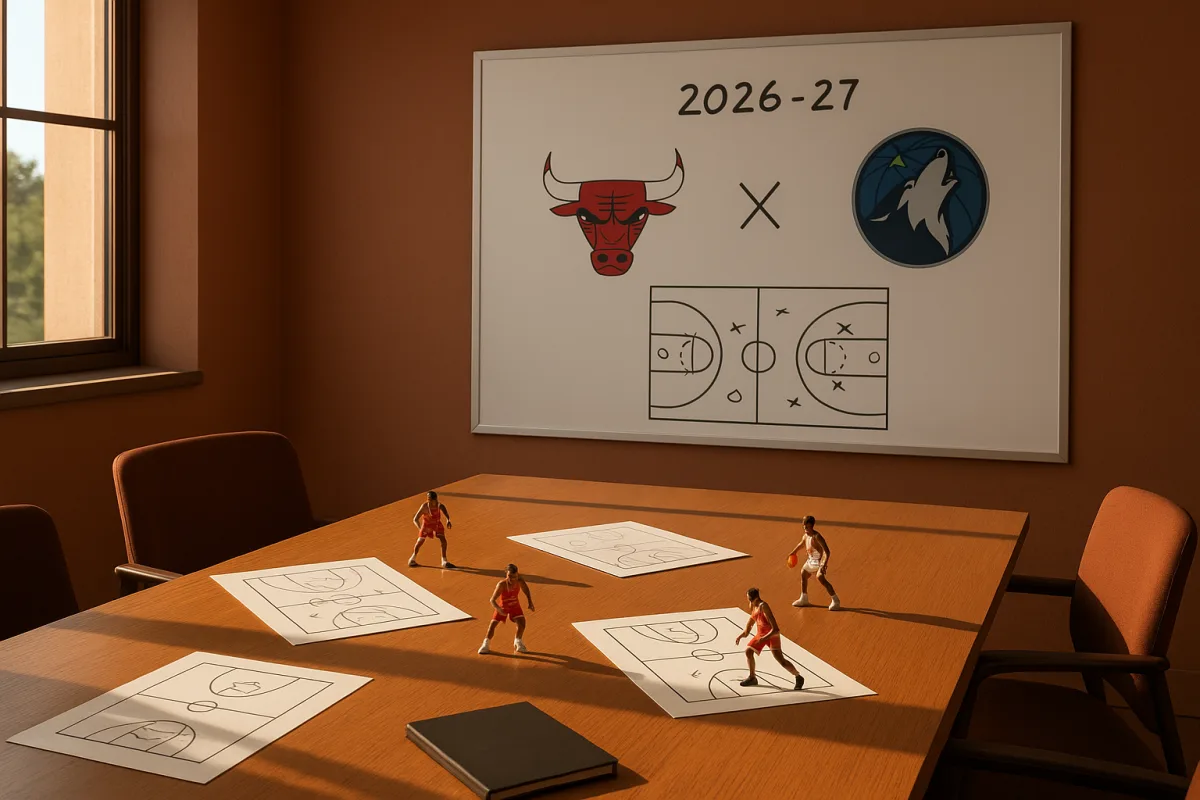
The decision: Chicago’s balanced reset over Minnesota’s volatile ceiling
The choice is the Chicago Bulls’ quieter roster construction over the Minnesota Timberwolves’ larger swing for LaMelo Ball. That is not a claim that Chicago will finish above Minnesota. Minnesota should be better immediately if its best lineup coheres.
It is a judgment about offseason process. Chicago added answers at center, on the wing and in the draft without making every offensive possession dependent on one player changing his habits or remaining healthy.
Minnesota’s move is more understandable than its skeptics allow. The Athletic reported that the Timberwolves wanted a faster, more athletic identity after a sixth-seed season and a second-round loss to San Antonio, replacing some of their size-and-muscle approach.
But a trade can be both compelling and costly. NBA.com reported that Minnesota acquired Ball and Josh Green in the four-team transaction officially announced July 10, while moving Julius Randle and Naz Reid in deals connected to Brooklyn and Charlotte. [2]
The price matters because it changes the margin for error. The independent reporting behind that transaction identifies Minnesota’s outgoing 2033 unprotected first-rounder, swaps in 2028, 2029 and 2030, plus second-round picks in 2029, 2032 and 2033.
Chicago’s moves carry uncertainty too, particularly because the fourth overall selection Caleb Wilson remains a rookie rather than an established connector. Still, the Bulls did not need Wilson to become an immediate star for the offseason to make structural sense.
Hoops Reference framed Chicago as a team improving on the margins, and that is the useful lens. The point is not whether every incoming player has an optimistic projection, it is whether each one repairs a recognizable possession-level weakness.
Criterion one: What problem does each move solve?
Minnesota solved a real initiation problem. Anthony Edwards is an elite difficult-shot scorer, but placing a true passing threat beside him can stop opponents from loading up before Edwards reaches the nail or turns the corner.
Ball’s value is not simply assists. His best possessions create an early advantage, a hit-ahead pass before the defense is matched, a skip pass behind a low man, or a lob that forces the rim protector to choose.
That matters next to Rudy Gobert. A conventional pick-and-roll can allow defenders to sit on Edwards’ driving lane and tag Gobert late. A passer willing to throw the ball early can force the tag before help is set.
Chicago’s problem was different. A rebuilding group with Josh Giddey and Matas Buzelis needed clearer role definition around them, especially after its frontcourt lost Nikola Vucevic before this offseason, as Hoops Reference noted.
Claxton supplies vertical spacing and rim deterrence, two functions that are linked. A center who can finish above the rim keeps the weak-side big near the paint, while his defensive mobility offers more cover for perimeter breakdowns.
Powell addresses another issue, the possession that starts poorly and needs somebody to score without a pristine play call. He is not a primary organizer, but a credible movement shooter and downhill scorer changes how tightly defenses can shade Chicago’s young ball handlers.
Wilson is the long-term bet. Hoops Reference highlighted his defensive activity, driving force and a more promising summer-league jumper than his college role had revealed. That remains developmental evidence, not a guarantee of three-level scoring.
Criterion two: How does the lineup fit hold up?
Minnesota’s closing five has obvious athletic force: Ball, Edwards, Jaden McDaniels, Kuminga and Gobert. It can switch selectively on the wing, pressure the rim in transition and create mismatches before a defense organizes.
The complication is not that multiple good players are inherently a problem. It is that Ball, Edwards and Kuminga all want possessions with room to probe, while Gobert’s screen-and-roll utility requires intentional timing around them.
The Athletic noted that Ball and Edwards both posted usage rates above 30 last season. Usage rate measures the share of team possessions a player ends through a shot attempt, free throws or a turnover while on court. It does not measure creation quality.
That distinction is central. Minnesota does not need every player to use less possession volume in the abstract. It needs Ball to start actions earlier, Edwards to attack second-side gaps and Kuminga to cut, defend and rebound when he is not the featured scorer.
Chicago has less star power, but its fit is easier to diagram. Giddey can work as a large initiator, Powell can occupy attention off movement, Buzelis can attack tilted defenses, and Claxton can be a screen-and-dive target.
The concern is half-court creation against a playoff defense that switches or goes under. Claxton does not solve a cramped floor by himself, and Wilson should not be asked to solve it immediately. Chicago’s ceiling depends on improvement from its returning young creators.
Criterion three: What is the cost and what flexibility remains?
Minnesota’s cost is concrete in draft control, even if the exact financial terms of the Ball trade were not publicly disclosed. The team sent multiple premium future assets to Charlotte, a price that makes this more than a low-risk stylistic experiment.
The Timberwolves also sent the 2026 No. 28 first-round pick and No. 33 second-round pick to Brooklyn, receiving No. 33 back in the trade structure, according to NBA.com’s transaction report. [2] That is not fatal, but it thins the replenishment pipeline.
Chicago’s Claxton deal is the rare confirmed financial figure available here. Basketball-Reference lists his agreement at four years and $44,090,911, while the broader terms described in the supplied research say it covers the 2026-28 seasons. [7]
Those descriptions do not perfectly align on duration, so the responsible reading is that Chicago committed meaningful but not star-level money, while the public record supplied here does not cleanly resolve every contract detail. Powell’s terms were not disclosed. [8]
Chicago also has a useful low-cost stabilizer in Tre Jones. The Bulls’ 2025 extension was three years and $24 million, an $8 million annual cap hit, according to Basketball-Reference. [7] That does not make Jones a star, it makes the roster less desperate for one.
Criterion four: Which path survives its downside case?
Minnesota’s downside is not simply Ball missing games. It is a healthy version of the roster producing attractive transition clips but struggling to decide whose turn it is in the final six seconds of a tied playoff possession.
Randle’s departure may open touches for McDaniels, as The Athletic reported, and that is a legitimate benefit. Yet the Wolves have replaced one high-usage forward dynamic with a more complicated multi-creator environment, not removed the underlying tension.
Chicago’s downside is more ordinary. Claxton may not regain his best defensive impact, Powell may be more useful as a scorer than as an organizer, and Wilson may need time. That can leave the Bulls in the middle rather than on a fast track.
But ordinary downside has value. If Chicago is merely decent, it still has a younger framework, a real rim-running center and less evidence of having mortgaged future choices. The plan can be adjusted without needing a franchise-saving outcome.
| Criterion | Chicago Bulls: Claxton, Powell and Wilson | Minnesota Timberwolves: Ball-led revamp |
|---|---|---|
| Primary problem addressed | Adds rim protection, vertical finishing, shooting gravity and developmental upside | Adds a high-level passer and pace source beside Edwards |
| Offensive fit | Cleaner role separation, but limited proven playoff creation | Higher ceiling, but more overlap among Ball, Edwards and Kuminga |
| Defensive fit | Claxton can anchor more flexible coverages, Wilson offers projected activity | Gobert and McDaniels remain elite defensive pillars, Kuminga must fully commit |
| Asset and financial cost | Claxton’s reported $44,090,911 deal is the clearest disclosed commitment [[7]](https://www.basketball-reference.com/contracts/CHI.html?utm_source=openai "Chicago Bulls Team Payroll | Basketball-Reference.com") |
| Downside case | A respectable but creation-limited young team | A costly, talented roster that cannot organize its late-game offense |
| 2026-27 outlook | A plausible underrated success, likely still a step below contention | A contender-level ceiling, with greater risk attached |
| Verdict | Better offseason process | Better all-in bet only for a team prioritizing immediate contention |
The context: why flexibility should decide close calls
The Golden State Warriors are the contrast case for Minnesota and Chicago. NBC Bay Area’s reporting on the Warriors’ quiet offseason underscores how little room a capped veteran team has when the core is expensive and aging. [5]
The research brief identifies Stephen Curry at $62.6 million and Jimmy Butler at $56.8 million, with Golden State also holding the 11th pick without turning it into a meaningful roster upgrade. The issue is not merely a lack of transactions.
It is the absence of a possession-changing answer around Curry, Butler and Draymond Green. A team can survive older stars if it adds speed, shooting or a second unit that changes coverage demands. Standing still makes every injury and matchup more punitive.
The Los Angeles Clippers illustrate an even harsher form of lost flexibility. The Associated Press reported that the league fined the franchise $30 million and suspended owner Steve Ballmer for one year after finding salary-cap circumvention involving Kawhi Leonard-related endorsement arrangements. [1]
The Clippers also forfeited five first-round picks from 2029 through 2033, while Leonard was fined $700,000 and his business manager received a five-year ban, according to the independent reporting and contemporaneous coverage. [1] This is a roster-building penalty, not mere reputational damage.
That enforcement matters when judging aggressive teams. Minnesota’s draft sacrifice is voluntary and basketball-motivated. The Clippers’ loss of picks is punitive. But both examples show why future picks are not abstract spreadsheet assets, they are the currency of recovery.
Who each option suits
Choose the Chicago Bulls’ approach for a front office that needs to improve its lineup without pretending it has already found a No. 1 option. Claxton, Powell and Wilson make sense for a team valuing optionality, coverage versatility and gradual development.
Choose Minnesota’s approach for a team that believes it already has its championship-level scorer in Edwards and cannot wait for incremental progress. Ball raises the possible level of the offense, especially if he embraces quicker decisions and Edwards thrives off the ball.
Minnesota is the better bet to matter in the 2027 playoffs. Chicago is the better bet to look back on its summer without needing every optimistic assumption to hold. In an offseason of extreme outcomes, that is an underrated form of success.
Frequently Asked Questions
What are the key team building strategies used by NBA teams in the 2026 offseason?
NBA teams in 2026 employed different strategies ranging from incremental resets to high-risk gambles. The Chicago Bulls focused on addressing multiple lineup needs—rim protection, veteran scoring, and developmental upside—without relying on a single star. In contrast, the Minnesota Timberwolves made a major trade to acquire LaMelo Ball, aiming for a faster, more athletic identity but sacrificing significant future draft capital. Overall, teams balanced immediate roster fit with long-term flexibility.
How did the Chicago Bulls and Minnesota Timberwolves approach the 2026 offseason differently?
The Bulls opted for a balanced, incremental approach by acquiring Nic Claxton, signing Norman Powell, and drafting Caleb Wilson to fill specific roster gaps without making the offense dependent on one player. The Timberwolves, meanwhile, made a high-variance trade to bring in LaMelo Ball and Josh Green, sacrificing multiple future first-round picks for a potentially transformative but riskier offensive dynamic. Chicago’s moves focused on structural improvements, while Minnesota’s centered on raising their immediate ceiling.
What are the risks and benefits of NBA offseason trades involving draft picks in 2026?
Trades involving draft picks carry the benefit of immediate roster upgrades but come with the risk of reduced future flexibility. For example, Minnesota’s acquisition of LaMelo Ball required giving up multiple future first-round picks and second-round picks, which limits their ability to build through the draft long term. This raises the margin for error, as the success of such trades depends heavily on player health and fit. Conversely, teams like Chicago preserved more draft control while improving specific roster needs.
How do offseason moves affect NBA team flexibility and roster fit for 2026-27?
Offseason moves can either enhance or constrain a team’s flexibility depending on the assets exchanged. Minnesota’s trade for Ball improved their immediate lineup but reduced future draft options, limiting long-term maneuverability. Chicago’s acquisitions improved role clarity and addressed positional needs without overcommitting to one player, maintaining more optionality. Additionally, teams like Golden State faced constraints due to salary cap and aging cores, while the Clippers’ cap circumvention penalties severely limited their flexibility.
Which NBA teams showed the most balanced roster construction in the 2026 offseason?
The Chicago Bulls demonstrated the most balanced roster construction by adding Nic Claxton for rim protection, Norman Powell for veteran scoring, and Caleb Wilson as a developmental prospect. Their approach avoided dependence on a single star and focused on repairing specific possession-level weaknesses. This contrasts with Minnesota’s more volatile roster centered around LaMelo Ball, which offers higher upside but greater risk.
How we researched this
This article was assembled from 2 video sources, 2 published articles, 11 cited references.
Nothing here is based on hands-on testing. Where a figure or finding appears, it belongs to the source cited beside it, and the writing says so rather than implying otherwise. Every source is listed below so you can check it.
Sources
5 NBA Teams That Will Regret EVERYTHING They Did This Offseason — Hoops Reference
5 NBA Teams That Sneakily Had INCREDIBLE Offseasons — Hoops Reference
Timberwolves' roster revamp brings a lot of variables. Will they find success? — The Athletic NBA
For Clippers fans, NBA's cap circumvention punishment an all-too-familiar shame — The Athletic NBA
NBA suspends Clippers owner Ballmer, fines team $30M, Kawhi Leonard $700K in cap circumvention case
Warriors’ lack of NBA offseason moves shown by jarring graphic – NBC Bay Area
Grading Every Chicago Bulls Move In 2026 NBA Free Agency - Fadeaway World
Watch NBA Offseason Moves and Team Outlooks for 2026-27 on Youtube
Also from the sources
Related Articles
NBA 2026 Offseason Analysis: Key Moves and Team Strategies
Explore the NBA 2026 offseason analysis with insights on major trades, signings, and team-building strategies shaping the upcoming season.
Washington Wizards Roster Outlook and New Era Analysis
Explore the Washington Wizards roster outlook and new era, focusing on Trae Young, Anthony Davis, and defensive challenges for 2026-27.
NBA 2026 Offseason Team Moves and Surprises Explained
Explore key NBA 2026 offseason team moves and surprises, analyzing trades, strategies, and impacts on team depth and championship chances.
Minnesota Timberwolves Offseason Changes and Frontcourt
Explore Minnesota Timberwolves offseason changes and how the new frontcourt shapes their 2026 season outlook and team dynamics.