
NBA Legends' Perspectives on Today's Game and Players
Explore NBA legends' insights on how past skills and coaching translate to today's game and players across eras.
NBA Legends’ Perspectives on Today’s Game: What Actually Translates Across Eras
The quick list
Best overall: The Mike Brown and New York Knicks case, for readers deciding whether adaptability and lineup flexibility matter more than a coach’s résumé scars.
Best for era translation: The Julius Erving case from Mr Sports, for readers evaluating which old-school wing skills genuinely gain value in modern spacing.
Best value in an unpopular read: The Muggsy Bogues case from BTM Basketball Time Machine, for readers who want a reminder that size is a constraint, not the entire scouting report.
Best for roster-context analysis: The Washington Wizards case from Hoop Dungeon, for readers deciding whether star names solve a franchise’s structural problems.
The useful question is not whether past legends could “play today.” Nearly every great player says he would, and confidence is part of what made him great. The real question is what happens to a player’s possessions when the court, rules, defensive geometry and developmental infrastructure change.
That requires separating a player’s portable skills from the parts of his game that belonged to his environment. It also requires resisting a common mistake in legend debates: treating an impressive archival clip as evidence of a complete modern offensive profile.
The four examples supplied here operate at different scales. Julius Erving is the star-wing translation question. Muggsy Bogues is the physical-outlier question. Mike Brown’s Knicks are the coaching-and-lineup question. Washington is the franchise-context question.
Comparison table
| Option | Core basketball question | Size or scale | Concrete number | Main upside | Main trade-off |
|---|---|---|---|---|---|
| Mike Brown’s New York Knicks | Can coaching flexibility change a championship roster? | Nine-man contribution cited by Walt Frazier | Knicks listed at +800 by Fanatics | More lineup options and fresher players | A title does not guarantee the same playoff matchup advantages next year |
| Julius Erving’s 1970s-80s game | Would an elite slashing wing benefit from modern space? | Listed at 6-foot-7 in the Mr Sports framing | Three ABA MVPs referenced | Rim pressure, hang time and transition finishing travel | Three-point range and defensive schemes cannot be assumed |
| Muggsy Bogues’ NBA profile | How much can skill compensate for extreme lack of size? | 5-foot-3 | Shortest active player is 5-foot-7 Yuki Kawamura | Full-court pressure, low dribble and tempo creation | Modern switching and size hunting remain severe obstacles [7] |
| Washington Wizards rebuild | Do star acquisitions fix organizational instability? | A.J. Dybantsa is a 6-foot-9 rookie-wing type in the Hoop Dungeon framing | Wizards won 17 games in the cited discussion | Potential defensive cover behind a small lead guard | Recent acquisitions and departures undercut continuity [1][8] |
There is no price in the consumer sense here, but there is a cost in possessions. A coach pays for switching with rebounding or size. A small guard pays for offensive creation with defensive targeting. A slashing wing pays for a non-shooting profile if defenders can load the paint.
That is the layout of this discussion. The “size” column is literal for Bogues and Erving, but it also means roster size for New York and organizational scale for Washington. The trade-offs are not side notes. They are the analysis.
Best overall: Mike Brown’s Knicks and the value of adaptable structure
The Hoop Dungeon account frames Mike Brown as a coach who had been fired four times before guiding New York to a title. That is true as a résumé line, but it is incomplete as an evaluation. Firings are events, not a coverage scheme.
NBA.com noted that Brown had been part of five championship runs after New York’s title, including four championships as an assistant coach. [6] His later work also included the 2023 Coach of the Year award with Sacramento. [10]
The significant detail in the Knicks discussion is not simply that Brown used more players. It is that the team could alter who closed games, who initiated offense and which defensive matchups it accepted without treating the opening lineup as sacred.
Walt Frazier’s praise in Hoop Dungeon focused on perseverance, character and a group rather than a two-man star vehicle. He specifically described nine Knicks as thriving, while tying the group’s cohesion to the Villanova connections among Jalen Brunson, Josh Hart and Mikal Bridges.
That is a usable basketball point. A team with several credible decision-makers can survive when an opponent removes its first option. The lineup’s layout changes from “stop Brunson” to “which connector do we help off, and can we still get back?”
The source’s claim that New York finished fourth in offense and seventh in defense is the kind of regular-season ranking that needs context. Rankings describe where a team finished, not why it won. A seven-game series asks whether a team can generate good shots after opponents know its first two actions.
New York’s current market view supports the idea that this was not merely a one-month heater. NBC Sports placed the Knicks alongside San Antonio and Oklahoma City in its title-contender tier for 2026-27. [2] Fanatics installed New York at +800, while DraftKings listed +900, a small difference that still reflects contender status rather than a fringe bet. [3][9]
The trade-off is simple: depth does not remove the need for top-end shot creation. It gives that creation more favorable conditions. Brunson still has to beat the first defender, but a flexible rotation can reduce the number of possessions where he must beat the first defender and the help behind him.
Best for era translation: Julius Erving’s game gains space, not automatic shooting
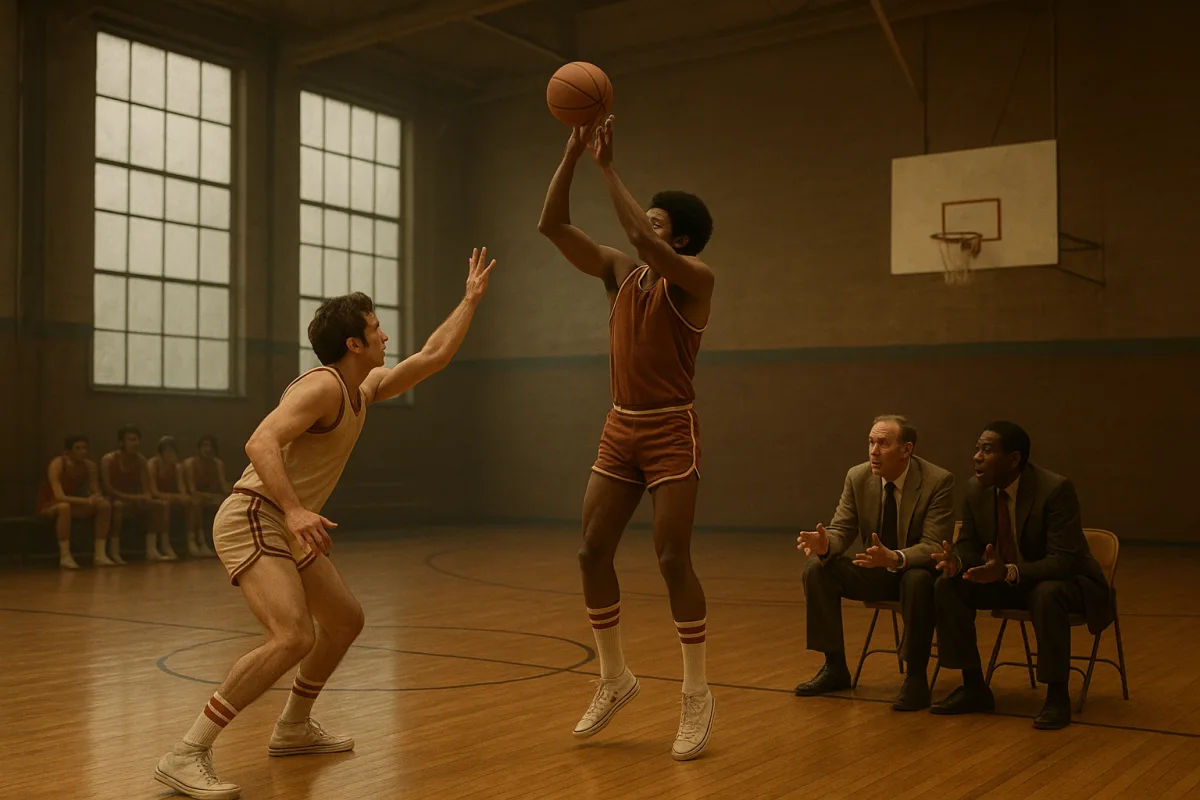
The Mr Sports treatment of Julius Erving makes the strongest possible visual case. It shows a 6-foot-7 forward attacking the rim with one-hand gathers, midair adjustments and an unusual capacity to change direction after leaving the floor.
Those are not nostalgia traits. A wing who can beat the first line, maintain the ball away from rim protectors and finish from awkward angles has value in any era. Modern offenses still spend enormous effort trying to manufacture that exact advantage.
The relevant comparison is not Erving versus Stephen Curry. It is Erving versus the current transition and second-side wing. Give a high-level slasher more corner spacing, fewer bodies parked in the paint and clearer transition lanes, and his rim attacks become easier to launch.
But “more space” is not the same as “an easy modern superstar.” The three-point line arrived in the NBA during Erving’s career, and the modern league asks wings to make more decisions against rotating defenses than a highlight package can capture.
The independent research brief correctly urges caution here. Erving’s prime crossed the ABA and NBA, two leagues with different media exposure, competition structures and statistical records. Rule changes, expansion, hand-checking restrictions and contemporary tracking data make a clean translation impossible.
Erving himself, in the Mr Sports excerpt, points to an overlooked part of the record: ABA statistics often disappear from mainstream “first to” discussions. That does not settle where he would rank today, but it does warn against evaluating him through incomplete NBA-only history.
The more defensible claim is that Erving’s athletic tools would scale upward in a spaced floor. The less defensible claim is that he would automatically become a high-volume three-point shooter. Those are separate projections, and the tape only strongly supports the first.
Best value in an unpopular read: Muggsy Bogues was a coverage problem
The BTM Basketball Time Machine compilation is valuable because the former players do not praise Muggsy Bogues in vague terms. Grant Hill describes adjusting Detroit’s offensive alignment simply to keep Bogues away from the main ballhandling action.
That is a film-room compliment. It means Bogues changed the first pass before the offense began. If a larger initiator is reluctant to dribble near a defender, the defense has already reduced the offense’s available menu.
Bogues’ listed 5-foot-3 height matters because it makes the achievement unusual, not because it tells the whole story. The players in BTM Basketball Time Machine repeatedly mention speed, strength, 94-foot pressure and a low center of gravity.
Greg Anthony’s account is particularly revealing. He said he would advance the ball to John Starks rather than bring it up himself against Bogues. That is not a box-score steal, but it is a turnover-risk adjustment created before any turnover happened.
Still, Bogues should not become evidence that height no longer matters. The shortest active NBA player is 5-foot-7 Yuki Kawamura, and players below 5-foot-5 remain essentially absent from the modern league. [7][11]
Today’s defenses would still target a 5-foot-3 player through post seals, screening actions and switches. Bogues’ strength helped him resist some of that, but the modern game’s broader floor and five-out formations would create new complications.
The lesson is not that every undersized guard deserves an NBA role. It is that height is not a complete defensive measurement. Pressure at the point of attack, hand strength, recovery speed and anticipation determine whether a small defender actually damages possessions.
Best for roster-context analysis: Washington’s names do not erase its structure
The Hoop Dungeon Wizards discussion starts with a familiar temptation: put Trae Young, Anthony Davis, Alex Sarr and No. 1 pick A.J. Dybantsa in the same sentence, then leap directly to the playoff bracket.
The independent reporting makes that forecast untenable. High-profile deals involving Young in January 2026 and Davis in February 2026 did not produce Wizards appearances, because both players were injured and subsequently traded. Washington’s hoped-for core did not become a functioning lineup.
That correction matters more than an optimistic roster graphic. A lineup only changes coverage if it plays together. Davis beside Sarr could, in theory, erase mistakes behind a small guard, but theory cannot supply availability or continuity.
DeMarcus Cousins’ point in the Hoop Dungeon segment remains sound in the abstract. If a team has a defensively vulnerable smaller guard, adding rim protection and long wings can change the math of its coverage behind the ball.
But the Wizards have paid a steep organizational price for treating talent accumulation as a substitute for stability. Reporting on the franchise’s recent history identifies a pattern in which notable additions, including Spencer Dinwiddie, Kyle Kuzma and Kentavious Caldwell-Pope, did not create durable long-term growth. [8]
Dybantsa does represent a different timeline. Axios identifies him as an NBA rookie as of October 2026, despite years as a professional before reaching the league. [1] That experience may ease the transition, but it does not make a rookie immune to NBA decision-making demands.
Who each option suits
Mike Brown’s Knicks suit the reader who wants to understand why championship coaching is often about surviving the second and third counter, not inventing a clever opening play. Their value is lineup flexibility, role acceptance and multiple ballhandling pathways.
Julius Erving suits the reader who wants a disciplined historical projection. His case supports the idea that elite rim pressure translates, especially for a big wing, while leaving legitimate uncertainty about shooting volume, defensive responsibilities and league-specific context.
Muggsy Bogues suits the reader who is tired of height being treated as scouting analysis. His career shows how pressure can reshape possessions, but also why exceptional skill, strength and competitive processing are prerequisites rather than inspirational extras.
Washington suits the reader evaluating young teams through more than talent names. A defensive back line and a creative lead guard can fit on a whiteboard. The harder question is whether the franchise can keep its best players available, connected and improving together.
Frequently Asked Questions
How do NBA legends view the skills of today's players?
The article does not provide direct quotes or perspectives from NBA legends on today’s players. Instead, it focuses on analyzing which skills and player attributes from past eras translate effectively to the modern NBA environment.
What aspects of past NBA players' games translate to the modern NBA?
Skills such as rim pressure, hang time, and transition finishing, exemplified by Julius Erving’s slashing wing play, translate well to today’s game. However, other elements like three-point shooting volume and defensive schemes from past eras do not automatically carry over due to changes in spacing and rules.
Can coaching adaptability impact NBA team success today?
Yes. Mike Brown’s success with the New York Knicks, despite previous firings, highlights how coaching flexibility and the ability to use diverse lineups can lead to championships. His career shows that adaptability and experience across roles contribute significantly to team success.
How do size and skill trade-offs affect NBA players across eras?
Size remains a critical factor; for example, Muggsy Bogues demonstrated that elite ball pressure and processing can offset small stature, but no player under 5-foot-5 currently thrives in the NBA. Smaller players face challenges such as defensive targeting and physical demands, indicating size constraints persist despite skill.
Do star acquisitions fix franchise instability according to NBA legends?
The Washington Wizards’ recent history suggests that acquiring star players does not automatically resolve franchise instability. Despite high-profile trades and signings, the team has struggled to develop or retain talent, reinforcing the idea that organizational issues extend beyond star acquisitions.
How we researched this
This article was assembled from 4 video sources across 3 channels, 11 cited references.
Nothing here is based on hands-on testing. Where a figure or finding appears, it belongs to the source cited beside it, and the writing says so rather than implying otherwise. Every source is listed below so you can check it.
Sources
NBA Legends and Players Explain How the 2026 Knicks BROKE The NBA — Hoop Dungeon
NBA Legends on why 5FT3 Muggsy Bogues was a Beast! — BTM Basketball Time Machine
NBA Legends And Players Explain Why Dr. J Would Destroy Today’s NBA — Mr Sports
What NBA Legends ACTUALLY Think About The Wizards New Era — Hoop Dungeon
Mike Brown now has been part of 5 NBA championship runs. The Knicks got this one right | NBA.com
Mike Brown, de los Sacramento Kings, es el Coach del Año en la NBA
Watch NBA Legends' Perspectives on Today's Game and Players on Youtube
Also from the sources
Related Articles
Michael Jordan on Modern NBA Defense and Legends'
Explore Michael Jordan and NBA legends' insights on modern NBA defense, rules, and the evolution of positionless basketball.
NBA Legends on Michael Jordan and Other Basketball Greats
NBA legends reflect on Michael Jordan and other greats, comparing legacies, Finals impact, and playing styles in basketball history.
Los Angeles Lakers Playoff Debacle: Depth, Coaching, and Defensive Woes Exposed
The Los Angeles Lakers' shocking defeat to the Minnesota Timberwolves in a five-game series revealed issues of depth, coaching decisions, defensive vulnerabilities, and failed trade attempts for a center, ultimately leading to their downfall in the playoffs.
BullBull: The Rise, Challenges, and NBA Potential
Explore BullBull's basketball journey from highly touted prospect to NBA underdog, facing challenges with injuries and work ethic. Will he break out as a top-tier center?