
NBA Player Performance Surprises and Struggles in 2026-27 Season
Explore NBA player performance surprises and struggles, focusing on Mikal Bridges' regression and Rudy Gobert's offensive issues this season.
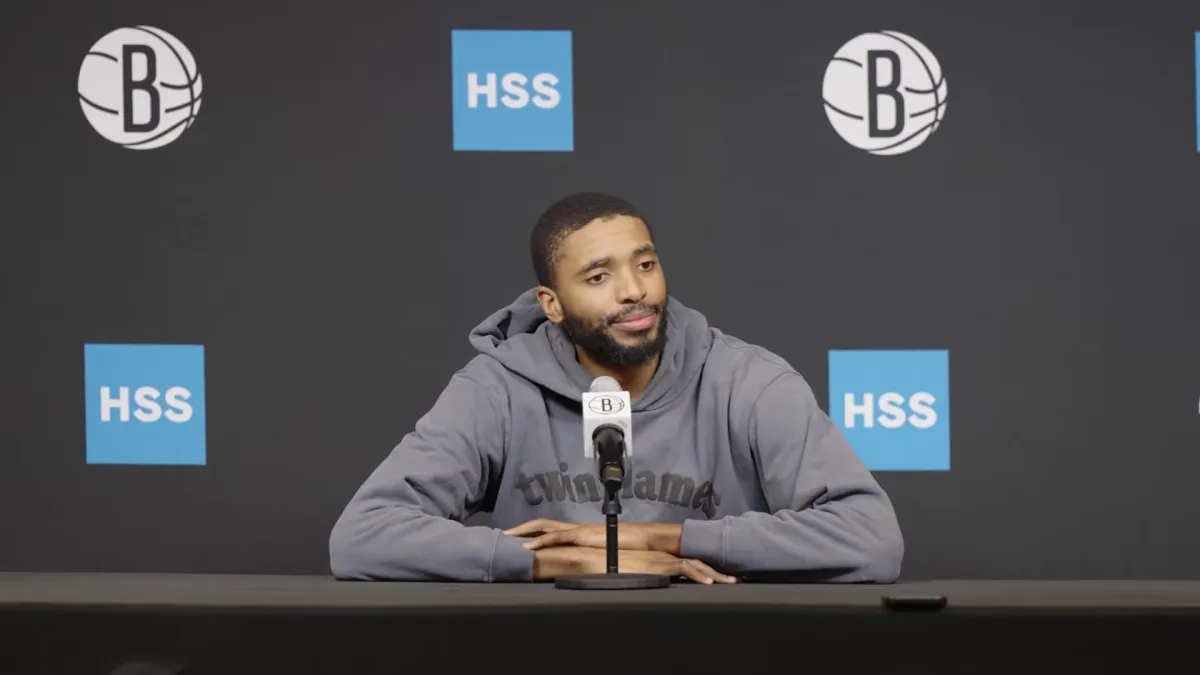
Photo: YES Network, CC BY 3.0, via Wikimedia Commons
The choice: prioritize Bridges’ production, not Gobert drama
Mikal Bridges caught the inbound at the top of the key with 3.2 seconds left against Portland, dribbled left, and buried the game-winner. It was the kind of shot that can change a week in New York.
CBS Sports rightly urged caution after that moment. Bridges scored 12 points in the 97-96 win, and the Knicks still lost his 28 minutes by six points, the worst plus-minus on the roster that night. [7]
Still, the shot put two season-long surprises side by side. Bridges’ decline is visible in his minutes, shot-making, and place in late-game lineups. Rudy Gobert’s offensive downturn is also visible, but the larger claim, that he is driving Minnesota’s locker room apart, has not been verified.
So the head-to-head choice is straightforward: which issue should concern you more right now, Bridges’ regression in New York or Gobert’s alleged chemistry problem in Minnesota? We pick Bridges’ regression, because it has an established on-court cost and identifiable paths toward improvement.
| Criteria | Option A: Mikal Bridges’ regression | Option B: Rudy Gobert locker-room tensions |
|---|---|---|
| Evidence quality | Supported by minutes, shooting, scoring, and lineup results | Recent conflict claims lack credible confirmation |
| Measured on-court cost | Major decline in scoring efficiency and playing time | Poor scoring is documented, but team-friction impact is unmeasured |
| Known explanation | Left ankle sprain, reduced role, and competition for minutes | No verified internal dispute or established cause |
| Path to improvement | Restore movement shooting, defend, and rebuild minutes gradually | Improve finishing and screen-roll timing, but chemistry claims remain speculative |
| Where it falls down | One hot stretch or clutch shot cannot erase the season sample | Treating rumor as fact can misread a team that may be dealing with basketball fit |
| Our choice | The more concrete concern, and the more actionable one | Monitor the offense, not the unverified drama |
1. Evidence quality: Bridges’ slump has a real statistical shape
Bridges has gone from a high-minute complementary wing to a player New York has had to manage carefully. Through 17 games, he is averaging 7.8 points in 26.4 minutes, down from 14.4 points in 32.8 minutes last season. [6]
The efficiency decline is sharper than the raw scoring drop. Bridges’ field-goal percentage has fallen from 49.0% to 40.3%, while his three-point percentage has declined from 37.1% to 31.7%. [6]
His true shooting percentage is down from 58.7% to 48.4%. True shooting measures scoring efficiency by accounting for two-pointers, threes, and free throws, so it captures more than a cold jumper. [6]
That is why this is not only a usage problem. Fewer minutes naturally reduce scoring totals, but Bridges has also converted possessions less efficiently when he is on the floor. The Knicks have felt both parts of the decline.
CBS Sports reported that New York was minus-five points per 100 possessions in Bridges’ minutes entering the Portland game, while it was plus-17.8 per 100 with him off the court. [7] Those numbers are noisy early, but they explain why his fourth-quarter role has become less secure.
Gobert’s measurable issue is different. The Minnesota center is averaging 7.6 points and 10.6 rebounds in 28.8 minutes, while shooting 44.0% from the field and 44.4% at the foul line. [1]
Those are poor finishing numbers for a center whose offense is normally built around screens, dives, putbacks, and dunks. But the most viral Gobert claim, that he is below 30% on layups, cannot be verified through standard publicly available season reports.
That leaves a gap between Gobert’s offensive struggles and the claims made around them. Mike Korzemba’s video presents clips of teammates appearing frustrated, but clips cannot establish an ongoing locker-room dynamic without reporting from people around the team.
Fadeaway World reported that Gobert was “not meshing” with LaMelo Ball and suggested a Minnesota exit could be increasingly likely. [2] No reputable reporting has confirmed a current Gobert-Ball conflict, a broader team fracture, or a demand for a trade.
2. Measured cost: New York is losing a rotation function
The Knicks did not acquire Bridges merely to add another scorer. They traded for a 6-foot-6 wing who could take difficult perimeter assignments, make quick decisions next to Jalen Brunson, and punish defenses when they loaded up on New York’s primary creators.
The cost was enormous. The NBA announced that New York sent Brooklyn Bojan Bogdanovic, Mamadi Diakite, Shake Milton, four unprotected first-round picks, a protected first-round pick, a 2028 pick swap, and a 2025 second-round selection in the Bridges trade. [3]
That transaction makes every cold stretch louder, but the basic basketball concern is fair. A lineup with Brunson needs Bridges to make defenses pay for helping off the wing, attacking scrambled closeouts, or switching smaller guards onto him.
When Bridges shoots 31.7% from three, those possessions change. Help defenders can stunt at Brunson, recover more comfortably to Bridges, and reduce the space New York’s guards need to reach the paint. [6]
The reduced minutes also matter. Bridges had two recent games in which he played 17 minutes, and he logged only two points against Cleveland on Nov. 12. [7] That is a sign that the coaching staff has been willing to shrink his role when the game requires it.
Gobert’s offensive limitations create a different cost. If a center cannot finish cleanly on rolls or convert deep catches, opponents can direct more attention toward Minnesota’s ball handlers without paying the usual lob or dunk penalty.
But Minnesota’s problem should be framed as a possession problem first. A missed roll, a strip in traffic, or a rushed touch shot can derail an offense. It does not automatically tell you what Gobert’s teammates think of him.
The documented conflict in Gobert’s recent history came in 2023, when Minnesota suspended him after he struck teammate Kyle Anderson during a timeout. Sports Illustrated reported the suspension at the time. [9] That incident is real, but it is not evidence of a current crisis.
3. Known explanation: Bridges has a clearer route back
Hoop Dungeon’s account of Bridges’ career gets one central point right: his 26.1-point burst after arriving in Brooklyn was an extraordinary 27-game stretch, not proof that he had become a full-time No. 1 creator.
Bridges averaged 19.6 points on 43.6% shooting in the following full Brooklyn season, showing the difference between exploiting a new opportunity and carrying a defense’s full attention for 82 games. His best role has usually included advantages created by others.
New York does not need him to become Brunson. It needs him to operate as the second or third decision-maker on a possession, attacking tilted defenses after Brunson, Karl-Anthony Towns, or another initiator has drawn the first rotation.
There is also a documented physical qualifier. Bridges entered the season after dealing with a left ankle sprain suffered in Brooklyn training camp, and his reduced minutes have coincided with an uneven start. [7]
That does not excuse a 48.4% true shooting mark. It does, however, give New York a reasonable explanation for diminished burst, unstable footwork on jumpers, and a slower return to the defensive activity that earns Bridges late-game trust.
Bridges has also taken ownership publicly. He said he needed to be better, a basic response but one that fits a player whose recovery depends on regaining rhythm, not reinventing his game. [8]
Gobert’s route back is narrower but still visible. Minnesota needs more reliable screen-and-roll possessions: firm screens, a direct dive, two hands on the catch, and finishes before the low man can rotate across the lane.
The Timberwolves do not need to run offense through Gobert post-ups or difficult touch shots. His value rises when he limits his offensive job to high-efficiency actions and preserves possessions with offensive rebounds, screens, and rim pressure.
What Minnesota cannot do is diagnose an unreported personal dispute as the reason for missed shots. A faster offense, unfamiliar spacing, or a declining finishing stretch may be part of the basketball explanation, but none confirms the claimed tension.
4. Where each option falls down
The case against Bridges can become too absolute. The Knicks were minus-50 in his minutes over their first three games, but CBS Sports noted they had been roughly neutral in his minutes since then. [7]
That does not turn a poor opening month into a success. It does show how quickly early-season plus-minus can be distorted by a few bad games, specific lineup combinations, and the small number of possessions available so far.
Likewise, one buzzer-beater cannot restore Bridges’ value by itself. The Portland shot was a confidence moment, not a statistical reset. New York still needs several weeks of competent shooting, defensive engagement, and dependable off-ball movement.
The Gobert tension narrative falls down at a more basic level. It asks you to infer private relationships from old incidents, clipped reactions, and reports that have not been corroborated by established NBA reporters or the Timberwolves themselves.
Minnesota can have a real Gobert issue without having a Gobert locker-room issue. His 44.0% field-goal mark is enough to demand attention, especially for a starting center. [1] The unsupported drama adds heat without adding clarity.
Who each option suits
Option A, prioritizing Bridges’ regression, suits you if you want to evaluate what is currently changing a contender’s rotation. The minutes, efficiency, and spacing concerns are all present in the games, and New York has a clear incentive to solve them.
We would start by treating Bridges as a connector again. Let him defend, run in transition, cut behind ball pressure, and take catch-and-shoot threes before asking him to manufacture difficult mid-range offense against a set defense.
Option B, prioritizing Gobert’s rumored tensions, suits you only if you are monitoring Minnesota for possible developments beyond the court. Keep watching his finishing and his screen-roll chemistry, but do not turn unverified reports into a verdict on the locker room.
Gobert’s offense may remain Minnesota’s larger playoff vulnerability. Bridges’ regression is still the more concrete current concern, because it is already reducing a high-cost wing’s impact in the possessions New York needs him to win.
Frequently Asked Questions
What are the biggest NBA player performance surprises this season?
Mikal Bridges’ early-season regression stands out as a major surprise, with a significant drop in scoring, shooting efficiency, and minutes for the New York Knicks. Rudy Gobert’s offensive struggles are also notable, but rumors of locker-room conflicts have not been verified by credible sources.
Why is Mikal Bridges struggling in the 2026-27 NBA season?
Bridges’ decline is linked to a left ankle sprain, reduced playing time, and increased competition for minutes in New York’s rotation. His shooting percentages and true shooting efficiency have fallen sharply, which has affected his scoring and overall impact on the court.
Are Rudy Gobert's locker-room issues affecting his performance?
There is no credible evidence confirming ongoing locker-room tensions involving Rudy Gobert with the Minnesota Timberwolves. While Gobert’s offensive numbers are down, reports of internal conflicts remain unsubstantiated by reliable reporting.
How do injuries impact NBA player performance early in the season?
Injuries like Bridges’ left ankle sprain can reduce a player’s mobility, shooting efficiency, and minutes played, leading to a measurable decline in performance. Managing these injuries carefully is key to a gradual recovery and restoring a player’s role in the rotation.
What measurable effects do player regressions have on NBA teams?
Player regressions can lead to decreased scoring efficiency and fewer minutes, which disrupts team rotations and on-court chemistry. For example, the Knicks have experienced a net negative impact during Bridges’ minutes, highlighting how individual declines can affect overall team performance.
How we researched this
This article was assembled from 2 video sources across 2 channels, 1 published article, 9 cited references.
Nothing here is based on hands-on testing. Where a figure or finding appears, it belongs to the source cited beside it, and the writing says so rather than implying otherwise. Every source is listed below so you can check it.
Sources
We've Never Seen A Player Drive His Teammates Crazy Like This, Mike Korzemba
We've Never Seen A Superstar Regress Like Mikal Bridges…, Hoop Dungeon
In a New York minute: Did Mikal Bridges just turn his season around with one shot?, CBS Sports NBA
Rudy Gobert Season Averages 2026-27 | Minnesota Timberwolves
Mikal Bridges, New York Knicks, SG - Fantasy Basketball News, Stats - CBS Sports
Mikal Bridges Takes Ownership of Struggles: 'I Just Got to Be Better' - The Express Gazette
Watch NBA Player Performance Surprises and Struggles on Youtube
Also from the sources
Related Articles

NBA Early Season Player and Team Evaluations: November 2026
Get NBA early season player and team evaluations including MVP, rookies, and surprise teams after the first month of the 2026-27 season.
Philadelphia 76ers Early Season Performance and Player Dynamics
Analyze the Philadelphia 76ers' early season performance and player roles, focusing on Maxey, Brown, James, and team offensive strategies.
Minnesota Timberwolves Internal Struggles Despite Strong Record
Explore the Minnesota Timberwolves' internal struggles, Rudy Gobert's role, and team dynamics despite a strong 2026-27 record.
Early NBA Season Surprises and Team Performances 2026-27
Explore early NBA season surprises and team performances with analysis of breakout players, injuries, and what to watch next in 2026-27.