
NBA Small Guards Evaluation: Skills and Youth Talent Trends
Explore NBA small guards evaluation, scouting trends, and youth talent development for undersized guards in modern basketball.
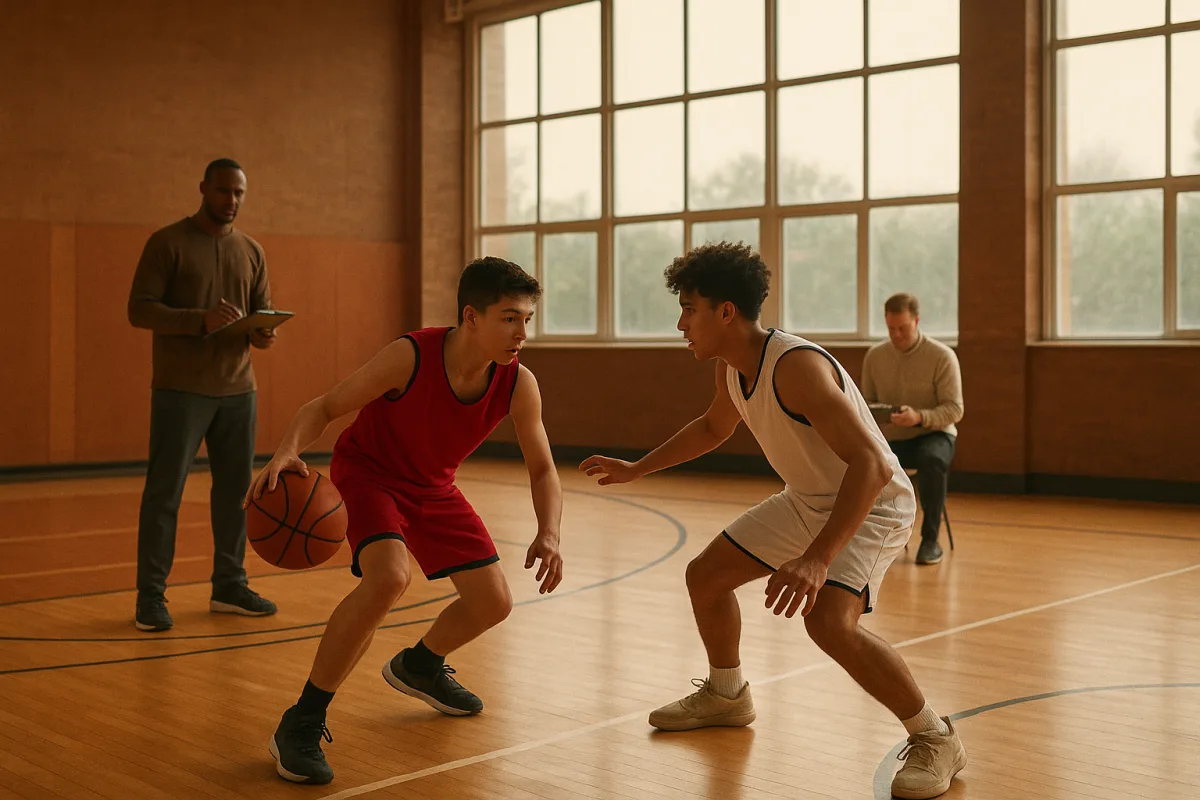
The shift is toward functional guard play, not simply shorter players
The emerging trend is straightforward: undersized guards are receiving more serious evaluation when they can bend a defense with the ball, make rapid decisions, and survive the actions opponents will target. Height still matters. It is no longer the whole first sentence.
That distinction is visible across independent scouting and combine coverage. HoopBrief’s guide to guard evaluation emphasizes processing, pick-and-roll command, defensive competitiveness and the ability to create useful advantages, while Sports Illustrated’s examination of the 2027 small-guard class treats size as a context for evaluating skills rather than an automatic disqualifier. [3][7]
The NBA Draft Combine has not redesigned itself around small guards. NBA.com’s 2026 combine hub still presents a broad evaluation environment, while reporting from NBC Sports and Yahoo Sports focused heavily on measurements, wingspans and athletic testing among the leading prospects. [1][5][6]
That matters because the new openness has limits. A 6-foot guard is not being evaluated as though he carries a 6-foot-8 forward’s margin for error. The question is whether his offensive creation and defensive mobility create enough value to offset the lineup constraints.
In practical terms, scouts are less interested in whether a small guard can make a difficult isolation jumper once. They are asking whether he can produce a good shot after the defense has loaded up, then avoid becoming the weak link on the next possession.
What the Ballislife tape actually shows
Ballislife’s 2-on-2 feature on newcomers D1 and Caleb is a useful snapshot of why small guards can generate attention outside the formal prospect-ranking apparatus. The game is built around close coverage, limited space and an immediate need to create an advantage.
The most interesting parts are not the commentators’ superlatives. They are the possessions where the smaller ballhandlers have to navigate a defender stationed near the point of attack, a teammate in the passing lane, and almost no empty-side room to build speed.
Ballislife’s commentators describe D1 as quick and crafty with a live dribble, while Caleb is introduced as a smaller guard with burst and a pull-up game. Those are observations from a filmed competitive setting, not standardized measurements or scouting grades. [1]
The tape also provides the necessary counterweight. Both sides settle for rushed perimeter attempts early, and the on-court coaching repeatedly directs the players to clear a side, move the ball, cut behind ball watching and avoid turning every possession into a one-on-one audition.
That coaching is more revealing than a sequence of step-backs. In a 2-on-2 setting, a compact guard can create a first edge with pace or change of direction. The next question is whether he recognizes the help defender early enough to convert that edge into a layup, pass or relocation three.
A particularly useful instruction in the Ballislife game is to play through the player with the favorable matchup, then make the secondary defender choose. That is the foundation of scalable guard offense, not merely an attractive dribble sequence.
The film also shows why some small guards can look dominant in loose settings but face tougher translation questions. If the ballhandler’s teammate stands too close, the defender can help without paying a cost. If the ballhandler keeps the dribble alive too long, the defense recovers.
Those are not size-specific errors, but smaller guards have less room to absorb them. A bigger creator can sometimes finish through the late rotation or pass over it. A smaller creator often has to win the possession one beat sooner.
Do not confuse a content combine with the NBA Draft Combine
The language around the Ballislife event requires care. Its “combine” is a branded basketball setting, not the 2026 NBA Draft Combine in Chicago. NBA.com lists 73 participants for the official event held May 10 through 17. [1]
There are no verified official Draft Combine measurements, lane-agility times, vertical-leap results or defensive ratings publicly available for the Ballislife player identified as D1. Claims that he has tested like an NBA prospect would go beyond the evidence. [1][5]
The same caution applies to Caleb. The Ballislife feature identifies a player only as Caleb, while official coverage includes North Carolina forward Caleb Wilson, listed at 6-foot-8 and reported with a 34.5-inch standing vertical. They should not be treated as the same player. [5][6]
That distinction is important because online prospect discourse often merges a compelling clip, a familiar first name and a combine label into a false résumé. The evidence supports saying Ballislife found an intriguing small guard in a competitive run. It does not support assigning him an NBA-combine profile.
Nor should viewers infer verified defensive impact from the game. Defensive ratings, defensive efficiency and defensive box plus-minus are not combine measurements. Defensive evaluation in this environment remains qualitative, built from tape, longer game samples and how a player handles actual actions. [1][3]
Why the small-guard conversation is happening now
The first driver is offensive role compression. More teams want their guards to initiate offense, attack a tilted floor, shoot off the catch, and make the next pass without needing a play call to rescue the possession.
That has expanded the value of a player who can change directions in traffic and force help. HoopBrief’s guard-evaluation framework stresses pick-and-roll decisions, shooting versatility and the ability to read coverages, all traits that can travel even when a prospect lacks ideal size. [3]
The second driver is that modern defenses expose stationary players. A small guard who cannot fight over a screen, contain the ball for a beat, rotate down to tag, or recover to a shooter gives opponents a clean target.
Combine drill coverage reflects that pressure. Lane-agility testing measures timed change of direction, while scouting evaluation still extends beyond stopwatch results to defensive switchability, lateral movement and the speed with which a guard processes the next action. [1][2][3]
The third driver is visible NBA precedent. Sports Illustrated’s small-guard analysis points to the changing perception of undersized creators, with Jalen Brunson’s high-level play serving as an obvious example of how strength, pacing and decision-making can outweigh a modest listed height. [7]
But precedent is not a guarantee. Brunson is not evidence that every small scorer will translate. His case is evidence that a compact guard can thrive when he owns angles, controls tempo, absorbs contact, punishes switches and consistently makes the defense commit.
That is the unpopular but useful read on the trend: the league has not lowered the standard for small guards. In many ways, it has made their standard more exacting. They must prove enough on-ball value to justify the defensive geometry they create.
The broader youth class still has size at the top
The 2026 combine’s most visible prospects underline that point. NBA.com, NBC Sports and Yahoo Sports all covered a group led by larger prospects such as BYU’s AJ Dybantsa, Kansas guard Darryn Peterson, Duke forward Cameron Boozer, North Carolina’s Caleb Wilson and Houston guard Kingston Flemings. [1][5][6]
Those names do not undermine the small-guard trend. They define its competitive environment. A smaller creator is competing for a role against bigger handlers who may offer comparable passing, more finishing reach and greater flexibility in defensive matchups.
The reported vertical benchmarks tell a similar story. Leading prospects reached jumps in roughly the 40.5- to 45.5-inch range, which reinforces how much physical explosion exists at the top of the board. [4][5]
A small guard therefore cannot make athleticism his only case. He needs a clearer possession-based identity: perhaps he is the best pull-up shooter, the most reliable screen navigator, the quickest advantage creator, or the guard who turns pressure into organized offense.
The Ballislife game offers a modest example. Caleb’s pull-up comfort from the middle of the floor appears meaningful because defenders cannot simply concede that space. The unanswered question is whether the three-point shot, passing reads and defensive possession work rise to the same level.
For D1, the attraction is the live dribble and ability to get downhill. Yet the film also makes clear that a live dribble only matters if it produces something before the defense can load the paint and force a bailout attempt.
What to build if you are planning a youth guard project
A player-development project should begin with the possessions a small guard is most likely to see. Start with 2-on-2 and 3-on-3 work that requires a ball screen, a low man, a tagger and a shooter in the opposite corner.
The objective is not to rack up makes. Track whether the guard creates two feet in the paint, forces a second defender to engage, identifies the help on time, and makes a pass that improves the teammate’s shot quality.
Film should separate creation from conversion. A missed open corner three can still follow a correct read. A made contested pull-up can still be poor process if the guard ignored an open roller or attacked into a loaded side.
Defensively, train the actions that determine whether coaches can keep the player on the floor. That means screen navigation, rear-view contests, early switches, low-man rotations and the ability to recover after helping one pass away.
The NBA combine context supports that approach. Timed agility and vertical testing can provide a useful athletic baseline, but guard evaluation remains tied to mobility, defensive viability and decision-making under pressure. [1][2][3]
A useful public profile should therefore include full possessions, not only edited highlights. Include clips of a guard rejecting a screen, making the low-man read, spacing after giving up the ball, fighting over a pick and defending without reaching.
That is also the responsible way to interpret exciting youth footage. The Ballislife run can identify traits worth following, especially Caleb’s shot creation and D1’s change-of-pace handle. It cannot answer the larger questions that a season of organized basketball must answer.
The emerging market for small guards is real because evaluators increasingly understand how skill creates advantages. The path remains narrow because NBA lineups still demand answers at both ends. For a young player, that is not discouraging news. It is a specific development plan.
Frequently Asked Questions
What skills do NBA scouts look for in small guards?
Scouts prioritize live-dribble creation, pick-and-roll processing, and defensive mobility over height alone. They look for guards who can make rapid decisions, create useful advantages, and show a defensive plan that prevents opponents from exploiting matchups. Scoring flair is not enough; possessions should include paint touches, early reads against help defense, and catch-and-shoot value.
How are small guards evaluated differently in the NBA draft?
Small guards are evaluated with more emphasis on their offensive creation and defensive mobility to offset lineup size constraints. Height remains important but is considered in context rather than as an automatic disqualifier. Scouts focus on whether a small guard can consistently produce good shots under pressure and avoid being a defensive liability, rather than isolated scoring ability.
What makes a small guard valuable in modern NBA play?
A small guard’s value comes from their ability to bend defenses with pace, quick decision-making, and effective pick-and-roll play. They must convert initial advantages into layups, passes, or open shots while maintaining defensive competitiveness. Their skill in forcing defensive rotations and making secondary defenders choose is key to scalable guard offense.
How can youth basketball players develop as effective small guards?
Youth players should train and film decision-making in constrained, competitive game situations rather than only practicing handle packages or highlight moves. Development should focus on repeatable possession value, including early reads, passing, and defensive awareness. Practicing under pressure and in tight spaces helps build the necessary skills for modern guard play.
What are the challenges small guards face in the NBA?
Small guards have less margin for error and must win possessions one beat sooner than bigger creators. They face tougher translation from loose, informal play to structured NBA defenses that exploit size mismatches. While the NBA is increasingly open to undersized guards, these players must consistently offset physical disadvantages with superior decision-making and defensive effort.
How we researched this
This article was assembled from 1 video source, 7 cited references.
Nothing here is based on hands-on testing. Where a figure or finding appears, it belongs to the source cited beside it, and the writing says so rather than implying otherwise. Every source is listed below so you can check it.
Sources
We May Have Found The MOST EXCITING New Small Guard... — Ballislife
2026 AWS NBA Draft Combine Data Hub: Everything you need to know | NBA.com
2026 NBA Draft Combine: Measurements of star players, notes on standout performances - NBC Sports
2026 NBA draft combine: The top measurements, including wingspans - Yahoo Sports
Watch Exciting New NBA Small Guards and Youth Basketball Talent on Youtube
Related Articles
Rising NBA Talent: Evaluating and Developing Young Players
Explore how rising NBA talent is evaluated and developed, focusing on skills, roles, and growth beyond stats and height.
NBA 1v1 Combines: Formats and Player Showcase Insights
Explore NBA 1v1 combines and player showcases, comparing formats and what they reveal about player skills and scouting value.
NBA Legends' Perspectives on Today's Game and Players
Explore NBA legends' insights on how past skills and coaching translate to today's game and players across eras.

Ben Simmons NBA Comeback
Explore Ben Simmons NBA comeback, his role with Sacramento Kings, contract details, and challenges ahead for the 2026-27 season.