
Rising NBA Talent: Evaluating and Developing Young Players
Explore how rising NBA talent is evaluated and developed, focusing on skills, roles, and growth beyond stats and height.
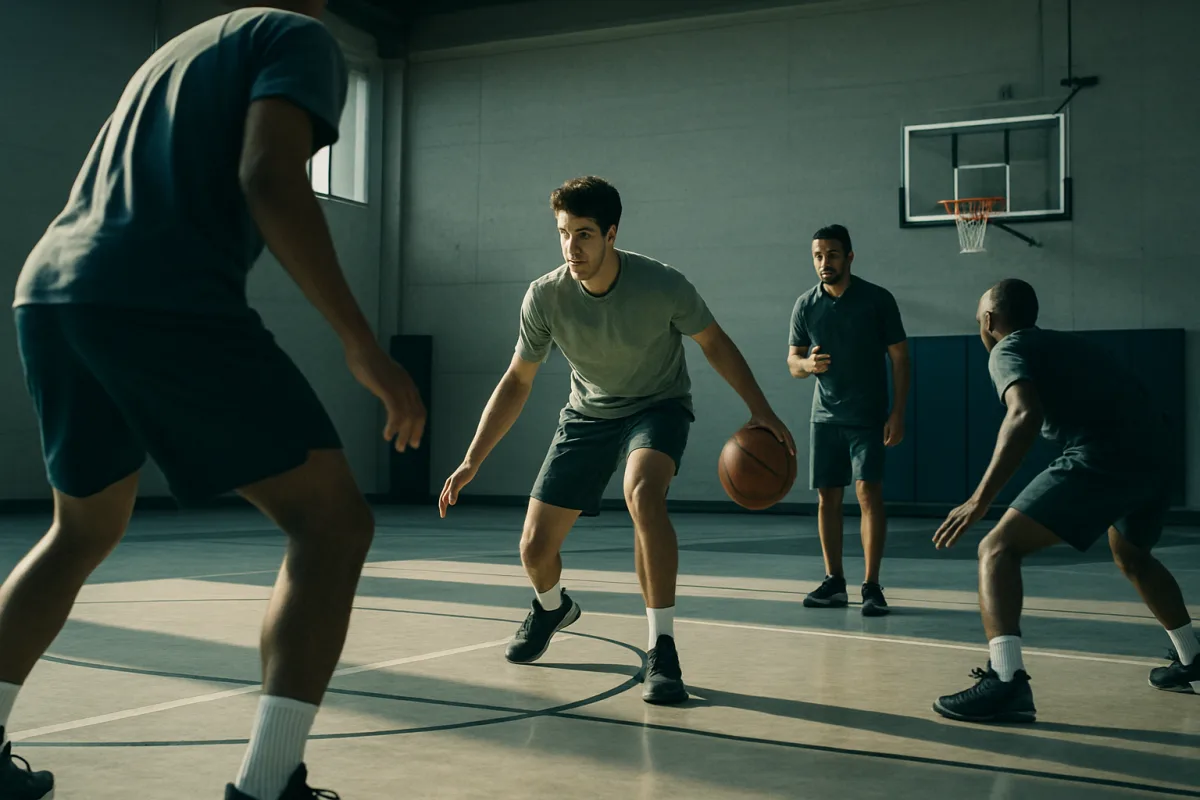
Start by separating highlights from repeatable possessions
The first problem with evaluating rising talent is that the most available evidence is often the least useful. A 92-point high school game, a deep pull-up or a full-court pass can identify unusual confidence and touch, but it cannot answer whether a player can survive NBA defensive structure.
LaMelo Ball’s famous high school scoring explosion is a useful example. Hoop Dungeon recounts that he attempted 61 shots and scored 41 fourth-quarter points in the game, but the more important scouting question is what the environment allowed: transition, early offense and freedom without possession-by-possession consequences.
That does not make the tape worthless. It tells you Ball had unusual shot range, open-floor vision and a willingness to process the floor aggressively. It also tells you a scout needed to keep watching, especially in half-court possessions where bad angles and premature pull-ups are punished.
When studying a young guard, chart four things before looking at points per game. Watch whether he creates an advantage, recognizes the help defender, delivers the next pass on time, and can make a basic defensive rotation after his shot misses.
A prospect who scores 25 through contested pull-ups may be less portable than one who scores 16 by attacking a tilted defense, relocating after a pass and making the low-man defender choose. The first player may have more visible talent. The second may fit more NBA lineups.
Judge the development environment, not just the label
The next trap is assuming there is one correct path. College, the G League, overseas leagues, prep academies and professional development programs ask different questions of a player. None automatically provides a better answer without examining the role and competition.
Ball’s route was unusually fragmented. Hoop Dungeon traces his move from Chino Hills to Lithuania, then the family-created Junior Basketball Association, Spire Institute and Australia. The important lesson is not to imitate that sequence, it is to identify what each stop did and did not test.
His short Lithuanian stint exposed him to older professionals and smaller margins for error. His Junior Basketball Association numbers were enormous, but the competition did not settle his NBA projection. Returning to recognizable prep competition and then playing professionally in Australia supplied more useful evaluation context.
That is the practical framework for any prospect with a nontraditional résumé. Ask whether the player faced adult physicality, whether he had to defend in a system, whether his decisions were constrained by a shot clock, and whether coaches trusted him when the game slowed down.
The Pro Skills Basketball development guide makes the broader point that players develop at different rates and through different routes. [5] That should make readers less eager to call a 19-year-old finished, but it should not erase the need to distinguish production from translatable responsibility.
With giant prospects, watch the body before projecting the ceiling
A 7-foot-6 high school player will draw attention before he touches the ball. That is inevitable. It is also why the first evaluation job is to remove height from the center of the conversation and ask what happens once opponents force the player to move laterally.
All Hail Cullen’s profile of Australian prospect JK Mach shows the practical burden around extreme height. Mach describes custom clothing, shoe problems, difficulty fitting in vehicles and an eight-foot bed arranged by Orangeville Prep, while also describing constant stretching as central to his daily routine.
Those details matter because development is not limited to skill workouts. Recovery, travel comfort, footwear, knee maintenance and access to adequate training equipment all affect how many quality repetitions a very tall teenager can accumulate over a season.
Mach also described a rapid growth period from roughly 7-foot to 7-foot-3 between grades nine and 11, plus Osgood-Schlatter-related knee pain. That is not a diagnosis or forecast for his future, but it is a reminder that physical maturation can disrupt coordination and availability.
There is no credible transition-rate dataset for 7-foot-6 prospects specifically. The available general baseline is already severe: roughly 3.6 percent of high school boys reach an NCAA roster, about 1.1 percent reach Division I, and only around 1 percent of NCAA players are drafted by NBA teams. [5]
So do not ask whether Mach is “too tall to fail.” Ask whether he can change directions twice in one possession, cover a ball screen without immediately conceding a drive, establish deep position early, and make short-roll reads when defenses collapse.
A giant center who only finishes at the rim can still have value, but his lineup usefulness narrows if he cannot defend space or pass out of pressure. A giant center who screens, re-screens, tags rollers and keeps the ball moving gives a coach more ways to protect him.
Translate the box score into a role
Once a player reaches the NBA, the next challenge is mistaking a good stat line for complete development. Ball’s 2025-26 season is a case where availability itself changed the analysis. He played 74 games and averaged 20.1 points, 4.8 rebounds and 7.1 assists. [2]
Those figures describe volume, but not the possessions. The more meaningful development evidence is that Ball had enough game availability to stack decision-making reps, including a 38-point, 13-rebound, 13-assist triple-double against Washington on Oct. 26. [3]
His post-accident response also matters only in that context. After a two-car accident in Charlotte on March 12, 2026, Ball played the following day and posted 11 points, seven rebounds and seven assists, suggesting no lengthy interruption followed. [4]
The stronger tape question is whether Ball can reduce the possessions that end with a difficult early-clock jumper while preserving the passing aggression that bends defenses. That balance is more important than arguing whether his creativity is inherently good or bad.
His 30 points and 10 assists in Charlotte’s 127-126 Play-In win over Miami offered a more useful test than a random regular-season outburst. [4] In a one-game environment, the defense is organized, matchups tighten and every live-ball turnover has a larger cost.
Read the Minnesota trade through lineup mechanics
Minnesota’s June 2026 acquisition of Ball and Josh Green from Charlotte, in a four-team deal that sent Naz Reid and future draft assets out, is not merely a talent consolidation. [12] It changes who initiates offense, who spaces the weak side and who must cover for whom defensively.
The Athletic reported that both Ball and Anthony Edwards had usage rates above 30 last season. [3] That is not automatically a conflict. Usage rate estimates the share of team possessions a player ends through a shot attempt, turnover or trip to the foul line while on court, not ball dominance alone.
The concern comes when both guards want to begin possessions from the same place. Minnesota can reduce that overlap by using Ball in high pick-and-roll, placing Edwards as a weak-side cutter or movement shooter, then flipping the action so Edwards attacks against a rotating defense.
Rudy Gobert is the immediate beneficiary if Ball consistently hits the lob window after drawing the low man. Jaden McDaniels can benefit too, because less self-created burden should mean more catches against a bent defense rather than late-clock bailouts.
Jonathan Kuminga’s arrival adds another variable. The Athletic reported that Minnesota expects him to start beside Gobert, Edwards and McDaniels. [3] That lineup has length and transition force, but it will require clear spacing rules if Kuminga and Gobert occupy the paint simultaneously.
The practical indicator to watch in preseason is not the win-loss record. Track whether Ball advances the ball, then relocates while Edwards runs the second action. If the two guards alternate rather than collaborate, Minnesota will have added talent without improving its offensive organization.
Understand what camp deals actually offer
For prospects below the lottery tier, the immediate obstacle is not talent in the abstract. It is access to a roster slot, practice reps and a role that lets a team evaluate a narrow NBA skill.
Milwaukee’s training-camp agreement with John Butler Jr. illustrates that path. Butler averaged 9.4 points, 5.7 rebounds and 1.7 blocks across 49 G League games in 2025-26, while making 36.3 percent of his threes. [6] That profile gives evaluators a concrete question: can he protect the rim without sacrificing spacing?
Charlotte’s Exhibit 10 agreement with Kobe Stewart is a different but similarly limited opportunity. Stewart averaged 7.7 points and 3.2 rebounds over 46 G League games, shooting 45.5 percent from the field. [13] The deal is an invitation to prove a role, not a guarantee of NBA salary.
Exhibit 10 contracts can lead to a two-way conversion or a G League assignment, although terms and outcomes vary by team. [7] A reader following these players should watch training-camp deployment: defensive matchups, spot-up attempts, rebounding assignments and whether coaches trust them in scrimmage closing groups.
That same principle applies to transaction blurbs. RealGM reported that Charlotte signed Kobe Stewart and waived Jarkel Joiner, while Milwaukee brought Butler into camp. Those moves matter because the waived player’s opening and the team’s two-way decisions can create development minutes that box scores cannot predict.
Follow the infrastructure around player development
Not every development story is a prospect highlight. Coaching staffs, front offices and the bottom of the roster decide whether a young player receives stable instruction or moves between systems before any skill can settle.
RealGM reported that former NBA wing Corey Brewer joined Arkansas State’s staff after player-development and assistant-coaching work with New Orleans. That is a reminder to track teachers, especially for transition players, because a development coach’s teaching can shape defensive habits more than an offseason mixtape does.
The same roster economics apply across professional basketball. RealGM reported that Ariana Andonian moved from leading the Philadelphia 76ers’ G League personnel operation to become the Los Angeles Sparks’ general manager, showing how G League evaluation experience can feed senior decision-making roles.
Finally, do not separate development from league rules. The Clippers’ cap-circumvention penalties, including a $30 million fine and the forfeiture of five first-round picks, show how aggressively the NBA can alter a franchise’s future talent pipeline. [1]
First-round picks are not just abstract assets. They are cheap rotation-player opportunities under a 2026-27 salary cap of $164.961 million, with luxury-tax and apron thresholds restricting how freely expensive teams can correct developmental mistakes. [8]
Frequently Asked Questions
How do scouts evaluate rising NBA talent beyond scoring?
Scouts focus on possessions a player can repeat against organized defense rather than isolated scoring feats. They watch if the player creates advantages, recognizes help defense, delivers timely passes, and makes basic defensive rotations after shots. This approach values decision-making and fit within NBA lineups over flashy scoring.
What factors influence the development of young NBA players?
Development depends on the environment and role a player faces, not just the league or competition level. Factors include exposure to adult physicality, defensive responsibilities, shot clock constraints, and coaching trust in game situations. Players develop at different rates and through varied paths, so distinguishing production from translatable responsibility is key.
How does height affect the development of NBA prospects?
For extremely tall players, such as those around 7-foot-6, height alone is less important than mobility, skill variety, and availability. Physical challenges like coordination disruption, injury risk, and equipment issues can limit repetitions and development. Evaluators should focus on lateral movement, defensive coverage, positioning, and passing ability rather than just size.
What role do trades play in the development of NBA players?
Trades can alter a player’s workload and team dynamics, affecting development context. For example, LaMelo Ball’s trade to Minnesota changed Anthony Edwards’ offensive role and the Timberwolves’ pick-and-roll schemes. Trades also impact roster spots and opportunities, which influence how much runway young players receive.
How can box score stats be translated into player roles?
Box score stats show volume but not the quality or context of possessions. For instance, LaMelo Ball’s averages indicate availability and decision-making reps rather than complete development. Understanding a player’s role requires looking beyond points and assists to how they influence game flow and fit within team strategies.
How we researched this
This article was assembled from 2 video sources across 2 channels, 8 published articles, 13 cited references.
Nothing here is based on hands-on testing. Where a figure or finding appears, it belongs to the source cited beside it, and the writing says so rather than implying otherwise. Every source is listed below so you can check it.
Sources
Every Season of LaMelo Ball Explained In 36 Minutes — Hoop Dungeon
Meet The World's Tallest High Schooler (7'6 JK Mach) — All Hail Cullen
Timberwolves' roster revamp brings a lot of variables. Will they find success? — The Athletic NBA
For Clippers fans, NBA's cap circumvention punishment an all-too-familiar shame — The Athletic NBA
Pablo Torre on the NBA's Clippers report and 'delight' across a year of reporting — The Athletic NBA
Corey Brewer Hired As Assistant Coach At Arkansas State — RealGM
John Konchar, Drew Eubanks Drawing Interest From Knicks — RealGM
NBA suspends Clippers owner Ballmer, fines team $30M, Kawhi Leonard $700K in cap circumvention case
LaMelo Ball 2025-26 Advanced Game Log | Basketball-Reference.com
The Journey is Unique: How Basketball Players Develop at Their Own Pace
Bucks Bring Back John Butler Jr. on a Camp Deal - NBA News | Fantasy Basketball
Wolves land LaMelo Ball in blockbuster 4-team trade with Hornets | NBA.com
Kobe Stewart Hornets Agree To Training Camp Deal - RealGM Wiretap
Watch Rising NBA Talent and Player Development on Youtube
Also from the sources
Related Articles

NBA Small Guards Evaluation: Skills and Youth Talent Trends
Explore NBA small guards evaluation, scouting trends, and youth talent development for undersized guards in modern basketball.
NBA Workout Training Insights from Top Young Players
Discover NBA workout training insights from top young players, including drills, shooting, finishing, and fatigue strategies to improve your game.

Youth Basketball Rising Stars and Rankings
Explore youth basketball rising stars and rankings with practical evaluation and training tips from grade 2 through high school.
Washington Wizards Roster Outlook and New Era Analysis
Explore the Washington Wizards roster outlook and new era, focusing on Trae Young, Anthony Davis, and defensive challenges for 2026-27.