NBA Smart Basketball Technology Testing Explained
Explore NBA smart basketball technology testing in 2026 preseason and what data it provides without impacting officiating decisions.
NBA Smart Basketball Testing Is Really a Test of What Data Can Prove
The important distinction: tracking the ball is not officiating the game
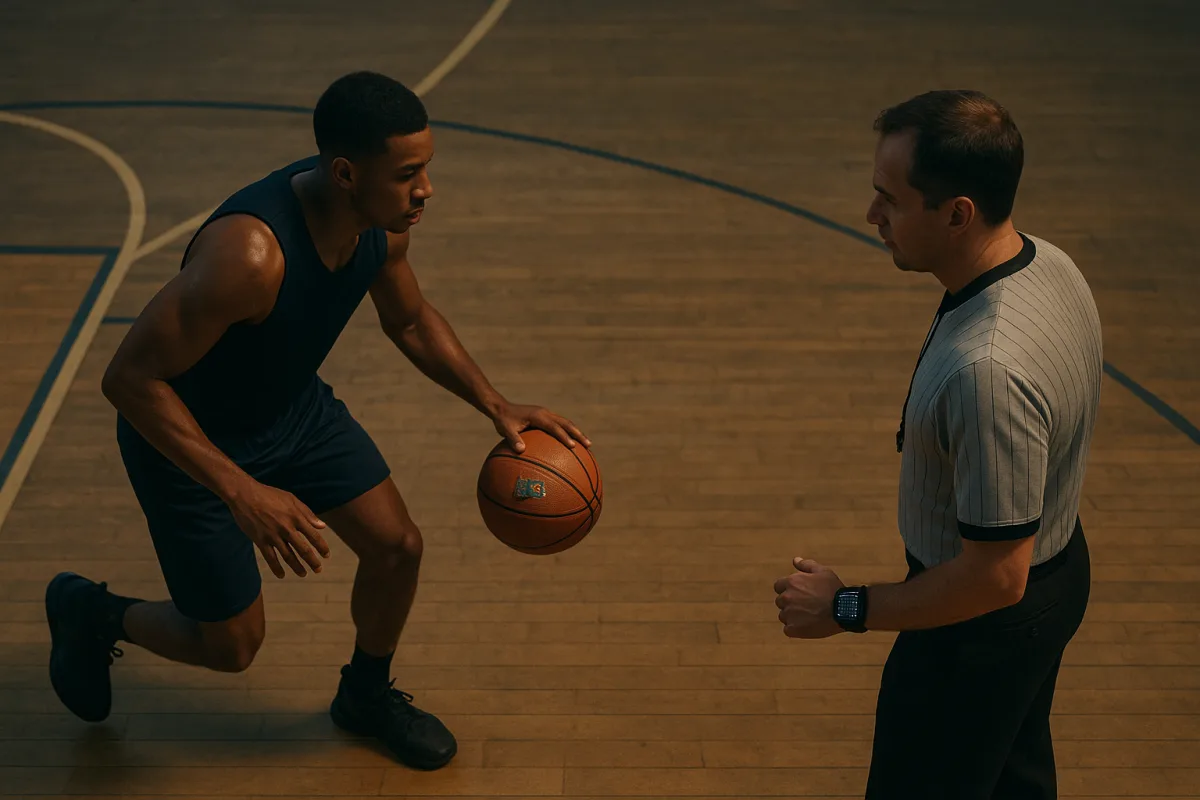
The useful way to view the NBA’s smart-basketball trial is not as a robot referee project. It is a ball-tracking experiment. The league is testing basketballs with embedded Bluetooth sensors during select 2026 preseason games, alongside wrist wearables for officials. [4]
That sounds like a small distinction, but it is the whole issue. Basketball is not scored or officiated merely by knowing where the ball was. The decisive moments on tape usually require knowing what happened around it.
Take a late-clock sideline possession. A sensor may eventually be able to log the ball’s location and movement at fine intervals. That could help establish when it crossed a boundary plane or when it left a shooter’s hand.
But a normal out-of-bounds call asks more than that. Which player touched it last? Did the defender redirect it before the ball struck the offensive player? Did the ball hit a player’s hand, wrist, knee or uniform? Was there a foul before the ball went out?
Those are not the same question. The ball can be precisely tracked and still leave the referee with the actual basketball question: who created the final legal touch? That requires video, sightlines and judgment.
The NBA’s own framing reflects that limitation. It says the smart balls and official wearables are being used for research, not for in-game officiating decisions. The trial is limited to select preseason settings, with no approved use in regular-season or playoff games. [4]
That should temper both the enthusiasm and the fear around the technology. The ball may become a richer source of data. It is not presently a replacement for the crew on the floor or the replay center.
What the sensor is testing, and what remains undisclosed
The confirmed public description is narrow: the basketball contains Bluetooth sensors, and officials are wearing wrist devices during selected preseason games. [2][4] The league has not released a detailed technical sheet explaining sensor placement, sampling rate, battery design or calibration process.
That missing detail matters because tracking is only as useful as its error tolerance. A ball that is off by a meaningful amount at the rim is not a clean answer to a goaltending, basket-interference or buzzer-beater question.
Think about the geometry of a close play. On a made three, the relevant event is not simply that the ball traveled from the wing toward the basket. The call can turn on whether the shooter’s foot touched the line, when the ball left the hand, and whether the game clock displayed zero.
A ball sensor addresses only one part of that chain, the ball’s motion. It does not locate the shooter’s feet unless the NBA adds another tracking source. It does not identify a hand release with certainty unless its measurements are validated against synchronized high-speed video.
The same problem applies at the rim. A ball’s vertical path could potentially help describe the moment it descended toward the cylinder. Yet basket interference is not a pure ball-location rule. Officials must also judge contact, the player’s relationship to the rim and whether the ball had a realistic scoring chance.
That is why “chip in the ball” should not be confused with an automated whistle. The rules are built around player actions, not merely the coordinates of an object. A sensor could become corroborating evidence, but corroboration is a different job from adjudication.
The league has not published sensor-accuracy data, performance results or the number of preseason games in the trial. It also has not identified the manufacturer or model of the officials’ wrist wearables. [3][5] Until those details emerge, no outsider can responsibly grade the system’s reliability.
The possession-level use case that makes the most sense
If there is a basketball case for this technology, it is probably not the viral one. It is not “the machine will tell us who fouled whom.” The more realistic use is building a cleaner account of ball events that already matter to coaching, replay and broadcast analysis.
Consider a pick-and-roll possession against drop coverage. On film, an analyst may chart whether the ball handler got downhill, whether the screener created a pocket pass, and whether the defense forced the ball away from the middle.
A smart ball could potentially attach precise timestamps to part of that sequence: the pass leaving the ball handler, the pocket catch, the lob trajectory or the shot release. That would not explain why the coverage failed. Tape still does that.
The tape might show the low man committing early to the roller, the weak-side wing failing to tag, or the on-ball defender dying on the screen. Sensor data would instead provide a more exact chronology of the ball’s route through those decisions.
That distinction is valuable. Basketball tracking is often strongest when it answers “when” and “where,” while possession analysis answers “why.” If a team gives up a corner three, location data can identify the pass path, but it cannot by itself tell you whether the error was poor nail help or a missed switch.
The NBA already operates in a league where teams use video, player tracking and internal analytics to study possessions. A sensor-rich ball could add another layer. It might reduce ambiguity around release timing or provide more consistent ball-flight records for research.
Still, the phrase “could add” is doing necessary work. The NBA has not said that the preseason project will feed coaching staffs, broadcasters, player-development departments or public statistical products. It has said only that the testing is experimental and research-oriented. [4]
Why the officials’ wearables should be treated separately
The officials’ wrist wearables have been announced alongside the smart balls, but they solve a different kind of problem. Public reporting has not established their model, full function or operational results. [3][5]
That means it would be a mistake to assume the wrist devices are receiving automatic call recommendations from the basketball. The NBA has not announced such a system, and the trial data do not affect officiating decisions. [4]
In practical terms, a wearable could be tested for communication, timing or workflow. Those possibilities are not confirmations, because the league has not disclosed the devices’ capabilities. The important point is that a referee wearable is not proof of automated officiating.
This is where the framing can get loose. A connected ball plus a connected wrist device sounds like a closed loop: sensor detects event, official receives verdict. But that is a theory of what connected hardware might someday enable, not the NBA’s stated 2026 use.
The actual experiment is more conservative. The league is collecting information without altering the authority structure of the game. Referees still make the calls, replay rules still govern review, and preseason testing has not created new regular-season standards. [4]
The “nobody could tell the difference” claim needs context
Eurohoops characterized the test with the line that “nobody could tell the difference.” That is encouraging in one narrow sense. A basketball with an embedded component cannot be useful if its weight, balance, bounce or feel immediately announces itself to players.
But the short Eurohoops excerpt does not provide a sample size, testing protocol, player quotations, measured bounce comparison or a definition of who “nobody” includes. It should not be treated as proof that the ball performs identically in every relevant condition.
For a player, feel is not a cosmetic concern. A guard’s handle includes how the ball returns off the floor at different speeds. A shooter reads seams and rotation. A big feels the ball on touch passes, deflections and one-hand gathers.
The same ball also has to survive game conditions. It will be dribbled, passed, kicked, slapped, squeezed on rebounds and exposed to sweat and floor contact. A credible operational assessment would need to examine durability, signal continuity and consistency across multiple balls.
No such NBA results are public at this point. The Associated Press reported no documented technical or operational problems from the trial, but the absence of reported malfunctions is not the same as a published validation study. [1]
That is not a criticism of the test. It is simply the correct standard of evidence. In basketball, a system is ready for a rules role only when its performance is known on the hardest possessions, not merely when it works in a controlled demonstration.
Cost and fan reaction are mostly unknowns, not debate points
The NBA has not disclosed a per-ball cost, licensing fee, team operating expense or projected maintenance budget for the smart-ball project. The same is true for the officials’ wearable program. [2][3]
That leaves no factual basis for claims that smart basketballs would be cheap enough for league-wide deployment, or expensive enough to be impractical. General sports-technology market forecasts do not supply an NBA-specific cost model for this program. [6]
The full cost would also be more than the ball itself. A league-wide system would require device management, data transmission, security, testing, replacement procedures, integration with timing systems and training for the people expected to use the information.
None of that means those costs would be prohibitive. It means they are undisclosed. A responsible reading of the preseason trial separates what the NBA has confirmed from what observers are projecting onto a very early test.
The fan-reaction question has a similar evidence problem. There is no NBA-published survey, season-ticket-holder poll or reliable public dataset on fan sentiment toward the technology. [4] Online discussion may be active, but it cannot be presented as a measured league-wide response.
Some fans will naturally see a chance to improve timing calls. Others will worry about more stoppages, more reviews or a game that becomes over-engineered. Those are reasonable positions, but they are forecasts of a future system, not reactions to a regular-season policy that exists today.
What evidence would justify the next step
The next useful disclosure would not be a broad promise that the technology is innovative. It would be a narrowly defined benchmark. For example: how accurately does the system timestamp a release compared with synchronized high-speed video?
The NBA would also need to establish what happens when data conflict. If optical tracking, broadcast replay and ball-sensor information point in slightly different directions, which source governs? That is not a hardware question. It is a rules and officiating question.
The cleanest path would be incremental. Use the ball data first for postgame research, quality control and possibly enhanced statistical context. Publish enough methodology for teams, players and viewers to understand what the system measures and where it can fail.
Only then does it make sense to debate an official-game role. The NBA’s present posture is appropriately narrower than the public conversation: a preseason experiment, no effect on decisions, and no announced regular-season or playoff deployment. [4]
Frequently Asked Questions
What is NBA smart basketball technology testing?
The NBA’s smart basketball technology testing involves using basketballs embedded with Bluetooth sensors and wrist wearables for officials during select 2026 preseason games. This trial is strictly for research purposes and is not intended to influence in-game officiating decisions, regular-season, or playoff games.
How does the NBA smart basketball sensor work?
The sensor-equipped basketballs track the ball’s movement and location through embedded Bluetooth technology. However, the league has not disclosed detailed technical information such as sensor placement, sampling rate, or accuracy, and the sensor only tracks the ball, not player actions or other contextual factors.
Will NBA smart basketball data affect officiating?
No, the data collected from the smart basketballs do not currently affect officiating calls or replay rulings. The NBA emphasizes that the technology is a research tool and not a replacement for human judgment in interpreting possession, contact, or legal guarding positions.
What are the limitations of NBA smart basketball sensors?
The sensors can track the ball’s position but cannot determine many critical basketball rules that depend on player interactions, such as who last touched the ball or whether a foul occurred. The technology does not capture player positioning, contact, or timing details necessary for officiating decisions, and no accuracy standards or performance data have been publicly released.
Are NBA smart basketballs used in regular season games?
No, the smart basketballs are only used in select preseason games for experimental purposes in 2026. There are no NBA regulations permitting their use in regular-season or playoff games at this time, and no public timetable has been announced for wider adoption.
How we researched this
This article was assembled from 1 video source, 2 published articles, 6 cited references.
Nothing here is based on hands-on testing. Where a figure or finding appears, it belongs to the source cited beside it, and the writing says so rather than implying otherwise. Every source is listed below so you can check it.
Sources
Nikola Jokic EXPOSED THE ADAM SILVER ERA — Uncut Hoops
NBA tests ‘smart’ ball for next season: “Nobody could tell the difference” — Eurohoops
“We don’t have a center, you know” - Charles Barkley’s wild attempt to bring Wilt Chamberlain back to Philadelphia in 1991 — Yahoo Sports
NBA is experimenting with smart basketballs and official wrist wearables in select preseason games
NBA Smart Basketball Test: What the Sensors and Referee Wearables Do
NBA Smart Basketballs and Referee Wrist Wearables: 2026 Preseason Test
Global Basketball Sport Technology Market Size, Growth Analysis, Trends & Forecast 2026-2034
Watch NBA Smart Basketball Technology Testing on Youtube
Related Articles
Ballislife Redemption Face Off Series: Key Matchups Preview
Preview the Ballislife Redemption Face Off Series with key 1v1 matchups, player insights, and event details for the upcoming Detroit basketball event.
Michael Jordan on Modern NBA Defense and Legends'
Explore Michael Jordan and NBA legends' insights on modern NBA defense, rules, and the evolution of positionless basketball.
NBA Legends on Michael Jordan and Other Basketball Greats
NBA legends reflect on Michael Jordan and other greats, comparing legacies, Finals impact, and playing styles in basketball history.
LeBron James 76ers Preseason Impact and Team Dynamics
Explore LeBron James' 76ers preseason impact, his playing style, and how he influences team offense and Embiid's role.