
NBA Trade Targets 2026-27: Irving, Davis, and Black Analysis
Explore NBA trade targets for 2026-27, including Kyrie Irving, Anthony Davis, and Anthony Black, with insights on their value and trade implications.
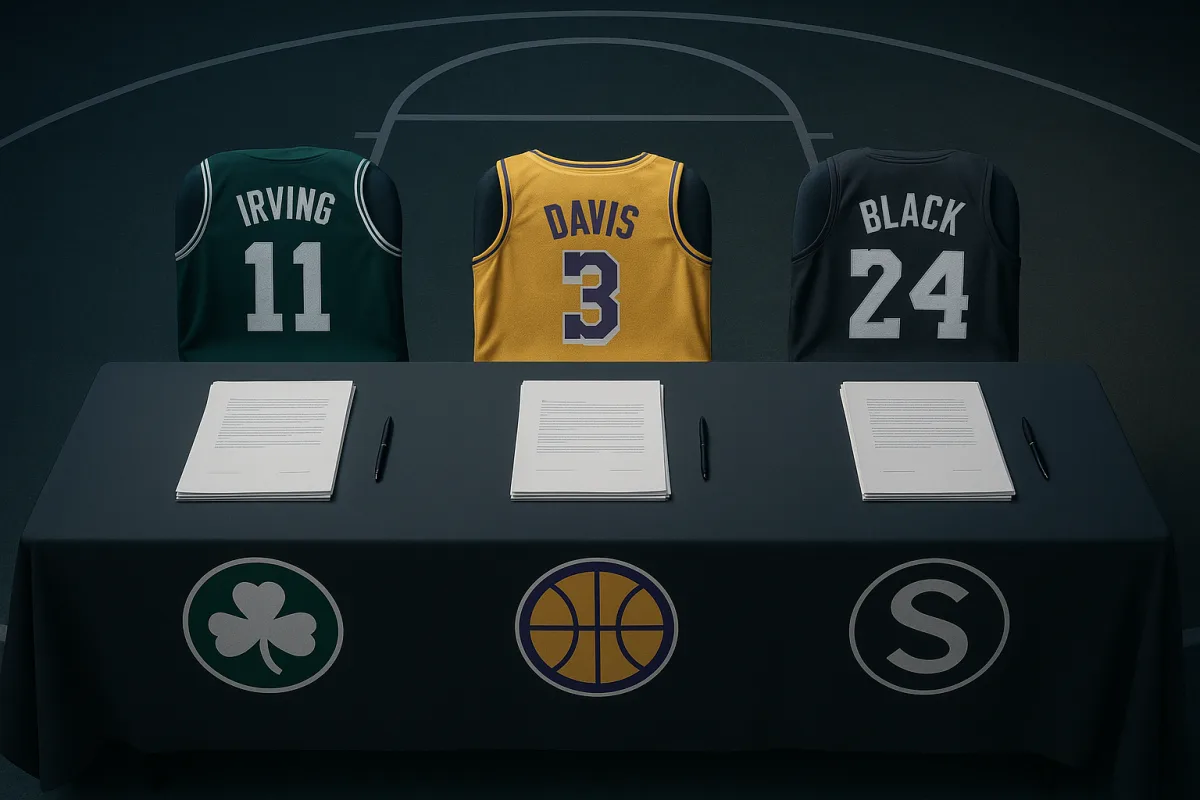
The quick list
Best overall: Kyrie Irving, for a contender that needs a late-clock ball handler and can live with an older roster timeline.
Best upside swing: Anthony Davis, for a team that needs elite interior production and has the contracts to absorb a massive next deal.
Best value for the future: Anthony Black, for a team seeking a large two-way guard without needing immediate All-NBA production.
Kyrie Irving’s 30.1 minutes per game are the cleanest snapshot of this market: teams are not shopping for depth, they are watching high-usage players whose roles could reshape a playoff series. The three headline cases carry radically different prices and risks.
Irving is the established offensive engine. Davis is the expensive star big auditioning on a losing team. Black is the younger, less available player whose value rises because he fits the modern playoff preference for size, ball handling and defensive flexibility.
| Player | Team situation | Age and role | Current production | Contract pressure | Likely acquisition cost | Main trade-off |
|---|---|---|---|---|---|---|
| Kyrie Irving | Dallas is 7-5, 7-3 when he plays | 34, lead guard | 21.6 points, 4.3 assists in 30.1 minutes | $39.4 million in 2026-27, then $42.4 million player option in 2027-28 | Premium win-now package, if Dallas even engages | Elite creation, but age and ACL recovery history |
| Anthony Davis | Washington is 4-9 | 33, starting center-forward | 25.6 points, 10.6 rebounds | $62.7 million player option in 2027-28 | Major outgoing salary plus picks or young players | Top-end defense and size, but huge financial exposure |
| Anthony Black | Orlando is 4-7 | 22, large guard | 17.8 points, 6.0 rebounds, 5.5 assists in 31.5 minutes | Restricted free agency approaching | High because Orlando says he is unavailable | Developmental upside, but limited evidence of availability |
Kyrie Irving is the cleanest basketball fit, not the cleanest trade target
The Athletic reported that Irving has returned from the torn left ACL suffered in March 2025 looking much like the player contenders remember. He is averaging 21.6 points, 4.3 assists and 3.2 rebounds, production that travels because it comes from self-created offense.
Dallas has gone 7-3 in Irving’s appearances, compared with a 7-5 overall record cited in The Athletic’s report. Those splits are small, but they fit the film-level logic: Irving reduces the number of possessions that end with a young offense searching for a bailout option.
His value is particularly clear next to 19-year-old franchise centerpiece Cooper Flagg. Flagg can attack tilted defenses, run in transition and defend bigger assignments, while Irving can organize the final eight seconds of a possession when initial actions fail.
That partnership changes Dallas’s motives. A team with limited control of its own first-round picks through 2031 cannot easily replace an efficient veteran co-star, and team president Masai Ujiri has publicly expressed curiosity about seeing Irving and Flagg together.
The reported contract framing needs care. The Athletic described Irving as potentially able to enter free agency through a player option worth about $42 million, while Sports Illustrated reported $39,416,562 for 2026-27 and a $42,416,562 player option for 2027-28, plus a 15 percent trade kicker. [4]
That structure makes Irving costly in two ways. An acquiring team would need to send enough salary and assets to satisfy Dallas, then face the possibility that Irving opts out after one season or commits to another expensive year.
There is no publicly confirmed no-trade clause in Irving’s deal. The immediate question is therefore not whether a transaction is mechanically possible, but whether Dallas would trade a player who has explicitly said he does not want rumors entering its locker room.
We would put Irving first on a contender’s board if it already has dependable wing defense and a credible primary star. We would skip him for a team looking to start a multiyear rebuild, because the purchase price and timeline point in opposite directions.
Anthony Davis has the biggest price tag beyond the package
Davis is producing like a star on a team with little room for present-tense optimism. The 33-year-old Washington Wizards big man leads the club at 25.6 points and 10.6 rebounds per game, and his 30-point, 15-rebound, four-assist performance against Detroit showed the full appeal.
A dominant Davis possession does not have to end in a post-up. He can erase a driving lane at the rim, finish a lob, clean up a missed shot or pull a center away from the basket, giving a contender answers at both ends.
The roster context is harsher than the basketball case. Washington is 4-9, and the Wizards have already committed four years and $212.9 million to Trae Young, according to The Athletic, while younger core pieces Alex Sarr and Kyshawn George will become extension eligible.
The Athletic’s David Aldridge and Josh Robbins reported there was “almost no chance” of a max deal from Washington for Davis. RealGM reported the Wizards were planning to evaluate his fit over the next 20 to 30 games before determining whether an extension or trade made sense. [7]
Davis’s $62.7 million player option for 2027-28 makes this an unusually demanding transaction. A buyer is not only paying for his current 25.6 points and 10.6 rebounds, it is pricing the injury history, the next negotiation and the salary-matching burden.
That burden limits the field. A contender needs enough movable money to build a legal trade, enough draft capital or young talent to interest Washington, and enough remaining depth to avoid turning Davis into the only capable big on the roster.
A Lakers reunion has been floated because of Davis’s past success in Los Angeles, but BasketballNews reported that the Lakers are very unlikely to have the assets for such a pursuit. [1] Until a specific bidder surfaces, this remains an audition rather than an active market.
We would pursue Davis only if he completes a defense that is already good enough to win four playoff rounds. His rim protection and rebounding can change a series, but a thin roster paying star-big money cannot assume health will solve its structural problems.
Anthony Black is the small-market test of patience
Black is the youngest and most intriguing name because his game has grown under pressure. With Jalen Suggs sidelined by a right knee bone bruise, Black stepped into the starting role and averaged career highs of 17.8 points, six rebounds and 5.5 assists across 31.5 minutes.
At 22, the 6-foot-7 guard archetype is expensive because it fits nearly every lineup. A large ball handler can initiate pick-and-roll, defend up a position and let a star wing begin possessions away from the ball.
Orlando’s 4-7 record and minus-5.0 net rating, which measures point differential per 100 possessions, create understandable speculation. The Magic have lost in the first round for three straight seasons and sit only $2.5 million below the second-apron threshold, according to The Athletic.
The salary map explains why rival executives are watching. Franz Wagner, Paolo Banchero, Desmond Bane and Suggs are all on long-term deals above $30 million annually, while Black is headed toward restricted free agency after no extension was completed in the summer.
But availability is the crucial distinction between Black and the two older stars. The Athletic reported team and league sources pushed back on the idea that he would become Orlando’s expendable piece, and Fadeaway World likewise reported that Orlando has no interest in trading him. [2]
That should drive the offer, not eliminate the player from consideration. A rebuilding club can hope that restricted free agency creates leverage later, but a contender should not plan its deadline around a player whose current team has repeatedly signaled retention.
Black’s unknown is not a reported flaw in his play. It is the cost of projection: a buyer would pay for a player who is producing now, while also betting he can become a playoff initiator against set defenses.
We would rate Black as the best long-term basketball investment of this group. We would not call him the best deadline target, because Orlando can reasonably value his future role more highly than any offer built around the uncertainty of his next contract.
The rest of the board: New Orleans and Phoenix
New Orleans has several names that can change the middle of the market, though each comes with a different problem. Trey Murphy III is the cleanest wing bet, averaging 15.6 points, 4.8 rebounds and 3.6 assists while owed $27 million, $29 million and $31 million over the next three seasons.
Herb Jones remains an elite defensive specialist, but his offensive role and playing time have declined, according to The Athletic. His contract rises from $14.8 million this season to $20.8 million next year, $22.5 million in 2028-29 and a $24.1 million player option in 2029-30.
Dejounte Murray and Jordan Poole are harder evaluations. Murray holds a $30.7 million player option for next season, while Poole is on an expiring contract and publicly campaigned for a reunion with Golden State, conditions that can narrow a buyer’s appetite.
Phoenix’s Jalen Green is another watch point. The 23-year-old scored 21 points per game in his final Houston season, then 17.8 in 32 games during his first Phoenix season and 11.8 through his first 10 games this year, per The Athletic.
The Suns are reportedly being watched for a possible Green-for-point-guard pivot. His $36 million player option next season means a team pursuing him would be acquiring a talented scorer whose role, efficiency and contract leverage all require answers.
Who each option suits
Kyrie Irving suits the established contender. You need a primary creator who can manufacture efficient offense after a first action breaks down, and you already have enough perimeter size to cover defensive matchups around him.
Anthony Davis suits the all-in contender with frontcourt depth. You need a player who can raise both your rim protection and finishing ceiling, but you also need outgoing contracts, assets and a plan for his next deal.
Anthony Black suits the patient team seeking a two-way guard. You value his 17.8 points, six rebounds and 5.5 assists, but you are prepared for Orlando to refuse calls and for restricted free agency to set the real price.
Trey Murphy III suits a contender seeking a scalable wing. His contract is easier to map than Davis’s or Irving’s, and his scoring, rebounding and connective passing can fit beside another team’s stars without demanding every possession.
Frequently Asked Questions
Who are the top NBA trade targets for the 2026-27 season?
The top trade targets are Kyrie Irving, Anthony Davis, and Anthony Black. Irving is the best immediate win-now option for contenders needing a late-clock ball handler. Davis offers elite frontcourt production but comes with a large contract. Black is the most valuable long-term asset, a young guard with two-way skills, though Orlando is not currently interested in trading him.
What are the risks and costs associated with trading Kyrie Irving?
Trading for Irving requires a premium win-now package due to his high salary of $39.4 million in 2026-27 and a $42.4 million player option in 2027-28, plus a 15 percent trade kicker. Dallas has incentives to keep him, especially since he has helped the team go 7-3 when playing. There is also uncertainty about whether Irving would opt out after one season or commit to the next, and no public confirmation of a no-trade clause.
How does Anthony Davis's contract affect his trade value?
Davis has a $62.7 million player option for 2027-28, making his acquisition costly beyond salary and assets exchanged. This large financial commitment adds risk for any team considering trading for him. Washington is evaluating his fit before deciding on an extension or trade, and no confirmed trade offers have been reported.
Why is Anthony Black considered a valuable long-term trade asset?
Black is a 22-year-old guard who has developed into a 17.8-point, 5.5-assist starter with defensive versatility. His youth and skill set fit modern playoff preferences for size and ball handling. However, Orlando currently has no interest in trading him, which raises the cost and availability concerns for potential suitors.
What impact do midseason NBA trades typically have on team performance?
Historical research shows that midseason trades often involve significant asset movement but do not systematically improve team performance. Player performance can decline after trades, and bottom-ranked teams rarely see meaningful gains. While trades generate excitement, they usually have limited impact on overall success.
How we researched this
This article was assembled from 2 published articles, 10 cited references.
Nothing here is based on hands-on testing. Where a figure or finding appears, it belongs to the source cited beside it, and the writing says so rather than implying otherwise. Every source is listed below so you can check it.
Sources
NBA trade watch: A Kyrie conundrum, AD's audition, Orlando’s Anthony Black question and more, The Athletic NBA
NBA trade watch: A Kyrie conundrum, AD’s audition, Orlando’s Anthony Black question and more, The New York Times
Lakers Rumor: Insider Provides Update on Anthony Davis Reunion - BasketballNews
New details revealed in Kyrie Irving's latest contract with Mavericks
Wizards To See How Anthony Davis Fits Before Deciding On Extension Or Trade - RealGM Wiretap
Anthony Davis Trade Rumors Put Wizards in Tough Spot - Yahoo Sports
Worker Relocations and Worker Performance: Evidence From the National Basketball Association
Related Articles

NBA Top Player Trade Candidates and Rankings for 2026
Explore NBA top player trade candidates and rankings for 2026, including detailed analysis of Michael Porter Jr. and Myles Turner.

Washington Wizards Roster Outlook and New Era Analysis
Explore the Washington Wizards roster outlook and new era, focusing on Trae Young, Anthony Davis, and defensive challenges for 2026-27.
NBA Player Trade Analysis
In-depth NBA player trade analysis comparing Kyrie Irving and Kawhi Leonard with insights on availability, fit, and playoff impact.
NBA Trade and Contract Updates for Stars and Teams 2026
Get the latest NBA trade and contract updates for 2026, including key player moves, team roster changes, and salary cap impacts.