
Bronny James Lakers Roster Moves Explained
Explore the Lakers' roster moves involving Bronny James and Dalton Knecht amid the NBA 15-player limit and contract guarantees.
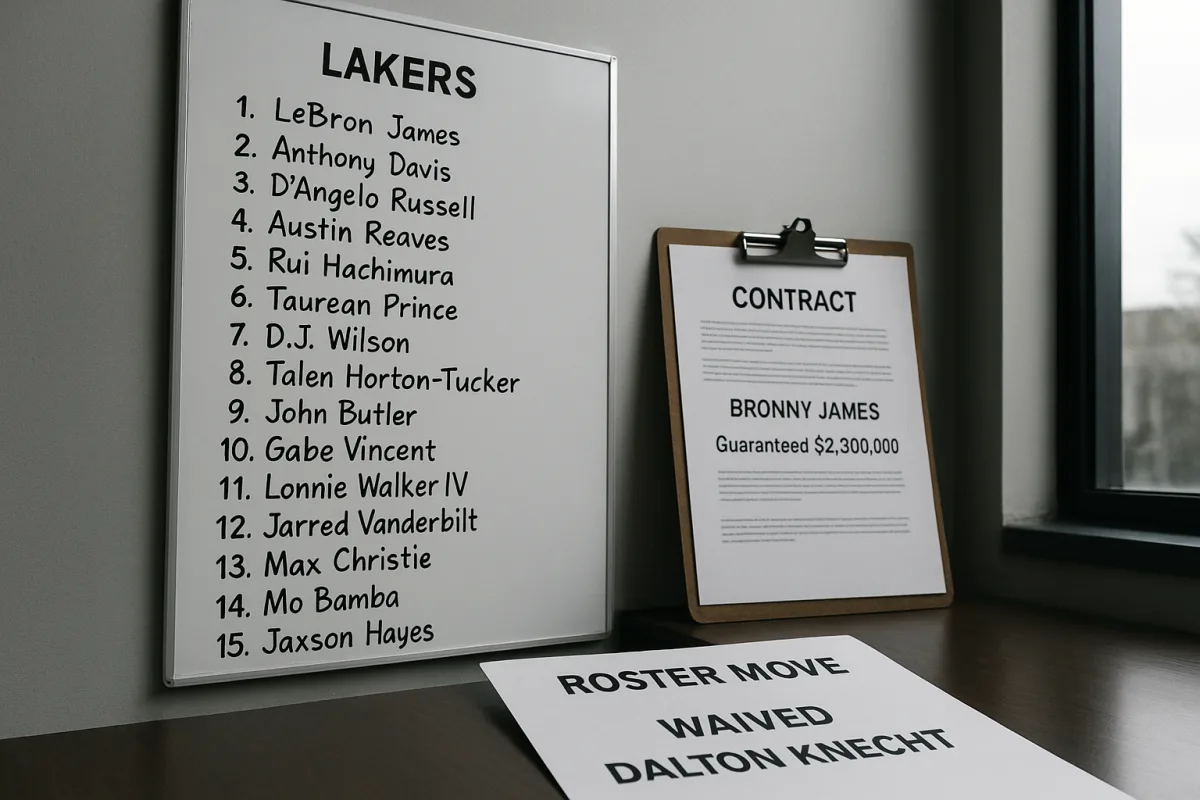
The number behind the Lakers’ decision: 15
The cleanest way to read the Lakers’ Bronny James and Dalton Knecht decisions is through one number: 15. An NBA team may carry no more than 15 players on standard contracts during the regular season, alongside up to three players on two-way contracts. [3]
That sounds like administrative trivia until a team reaches 16 standard contracts. Then it becomes a personnel decision with real basketball consequences. A front office cannot simply call the extra player “depth” and proceed into opening night.
NBC Sports reported that the Lakers were among several teams confronting this kind of roster crunch, with the Bucks and Grizzlies also needing to find solutions around crowded guaranteed-contract situations. [3] The Lakers had to create one standard-roster slot.
That distinction matters. The decision was not necessarily “Knecht versus Bronny” in a one-on-one basketball competition. It was closer to a constrained optimization problem: keep 15 players, protect the contracts already committed to, and try to turn the most movable surplus into help elsewhere.
Why a 16th contract changes every negotiation
When a team has 16 players for 15 regular-season standard slots, it has three broad paths. It can make a trade, waive a player, or find a contractual mechanism that changes the player’s status. Each path has different costs.
A trade is usually the preferred answer because it can solve two problems at once. It clears the roster spot while potentially bringing back a player who better fits a rotation need, often at center in the Lakers’ case.
Sportando reported that the Lakers explored Knecht trades with the Bucks, Bulls and Jazz among the teams connected to the situation. [5] Bleacher Report also characterized Los Angeles as looking for a way to reduce its roster count through a Knecht deal. [6]
The key word is explored. Public reporting identified potential conversations and interested teams, not a completed offer sheet, agreed compensation package or specific financial terms. That gap is where roster mechanics begin to dictate the outcome.
A team with an urgent need to reach 15 loses some bargaining leverage. Other clubs know the deadline exists. If Los Angeles needed a center but another team believed it could wait for Knecht to be waived, the Lakers had less reason to accept a weak return.
Hoops Wire reported that the Lakers ultimately waived Knecht after exploring trades. [4] That sequence matters more than the rumor cycle itself. Los Angeles appears to have treated a trade as the value-preserving option, then used the waiver as the compliance option.
What waiving a player actually does
Waiving a player means removing him from the active standard roster and placing him through the NBA’s waiver process. Other teams can claim the player under the terms established by the league’s rules and his existing contract.
If no team claims him, he becomes available to sign elsewhere, subject to the relevant free-agency rules. For the original team, however, being off the roster is not identical to being off the books.
The financial result depends on contract language, guarantees, offsets and whether another team claims the deal. Those details matter because a waived player can still count against a team’s cap or tax picture even after no longer occupying a roster slot.
That is why “just waive him” is often an incomplete response to a crowded roster. The Lakers could clear Knecht’s place on the 15-man list, but the transaction’s financial cost would depend on facts that were not publicly detailed in the reporting.
There is another limitation that prevents teams from treating waivers as a simple developmental shuffle. A player with meaningful guaranteed money cannot simply be waived and then brought back by the same team as a two-way player.
Two-way contracts are separate roster tools, not a storage locker for standard-contract players. They are designed for developmental flexibility, but they do not let a team evade the standard-roster limit by converting an already-guaranteed player after the fact.
That is the mechanical pressure behind the Lakers’ choice. Once the club had too many standard contracts, keeping every player was not an option. The meaningful choice was which player, if any, could be moved for value before the deadline forced a waiver.
Why Bronny James was not the easy release valve
Bronny James entered the 2026-27 season with a contract already carrying a clear organizational commitment. Contract-tracking outlet Fantasy Team Advice listed his 2026-27 cap hit at roughly $2.3 million. [7]
Sports NDTV reported that James’ 2026-27 salary of $2.296 million became fully guaranteed after the Lakers exercised his team option by the June deadline. [12] That is not a minor administrative point, it materially shapes a front office’s choices.
A fully guaranteed salary does not make a player unwaivable. Teams can waive guaranteed players. But it means the club generally cannot recover the money merely by removing the player from the 15-man roster, absent a claim or other contractual wrinkle.
More importantly, the Lakers had already acted before the October roster crunch. Exercising James’ option in June signaled that the organization intended to retain him for his third NBA season. [10][12]
That does not prove why Los Angeles valued him. There is no public Lakers explanation saying James was retained because of his family name, commercial value, projected development, locker-room considerations or a particular on-court role.
It does establish the timeline. James was not a late casualty of a crowded camp because the Lakers had previously chosen to guarantee his season. Knecht became the more available piece when the organization sought a trade route out of its roster problem.
The draft-position contrast is real but incomplete. Knecht was selected 17th overall, while James was selected 55th. That tells us how teams valued them on draft night, not necessarily which contract, development track or trade market had more strategic value two years later.
The basketball logic of shopping Knecht
The Lakers’ reported center search offers the strongest basketball explanation for why Knecht became the discussed trade piece. A wing shooter has value, but a team’s need can make that value more useful as trade currency than as internal depth.
On possession film, a center changes the geometry of a defense in ways a reserve wing often cannot. A credible screener can free a ballhandler from top-lock pressure, create a roller behind the first line of coverage and finish possessions with defensive rebounds.
That does not mean any center would have helped. The Lakers would need a big capable of surviving the coverages their perimeter personnel requires. A deep-drop center changes the pick-and-roll menu differently from a switchable defender or an aggressive level-of-screen defender.
Knecht’s potential appeal in a trade would stem from a simpler proposition. Shooting wings are easier for many teams to imagine fitting into existing offenses. They can space a corner, lift from the weak-side slot and punish a defense that overloads toward stars.
But the trade market apparently did not produce a workable conversion. Sportando’s report connected multiple teams to the Lakers’ search, while Hoops Wire’s subsequent report recorded the waiver rather than a completed deal. [4][5]
That outcome should temper two common overreads. It does not prove Knecht lacked NBA value, and it does not prove the Lakers were indifferent to losing him. It shows that potential value and tradable value are different things under a roster deadline.
A player can be useful, young and drafted highly, yet still fail to bring back the specific position a team needs. The other club must have a roster opening, want the player, accept the salary structure and be willing to surrender the appropriate big.
What this says about Lakers strategy
The Lakers’ move reads as a choice for immediate roster legality and optionality, not a clean ranking of their young players. By retaining James and waiving Knecht, the club protected an already-guaranteed commitment while resolving its excess standard contract.
Los Angeles also preserved the possibility of filling the available spot later. A vacant 15th slot can be useful during a season, particularly when injuries, buyouts or trade opportunities create a need that training camp did not fully reveal.
That flexibility has value, though it should not be overstated. An empty roster spot does not itself provide a capable rotation center. It merely gives the front office a legal place to put one if an acquisition opportunity appears.
The broader league context supports this reading. NBC Sports identified the Lakers, Bucks and Grizzlies as teams working through comparable roster pressure. [3] These are not always talent-evaluation failures, they are often the inevitable result of accumulating guaranteed contracts.
League incentives also shape how clubs think about young players. The NBA Board of Governors approved draft-lottery reforms intended to reduce incentives for deliberate losing, according to the Associated Press. [2] That makes cheap development and roster flexibility increasingly valuable for teams not pursuing a full teardown.
Axios framed Washington rookie AJ Dybantsa as part of a wider young-talent conversation in which teams manage development, visibility and long-term planning simultaneously. [1] The Lakers’ situation is not identical, but it belongs to that broader reality.
What cannot be proven from the waiver
Former NBA player Kwame Brown’s criticism that LeBron James damaged Knecht’s development should be treated as opinion, not established reporting. There is no cited team-insider account or possession-level evidence showing that LeBron James caused Knecht’s release.
The same caution applies to claims that retaining Bronny James was purely a marketing decision. A guaranteed contract and a roster spot show organizational preference, but they do not reveal the complete internal reasoning behind that preference.
Nor does the waiver settle whether James will outperform Knecht, or whether Knecht would have developed more effectively elsewhere. Those are future basketball questions, best answered by roles, minutes, shot quality, defensive assignments and opponent-adjusted tape rather than draft-slot rhetoric.
What is clear is the sequence. The Lakers exceeded the standard roster limit, sought to turn Knecht into frontcourt help, did not complete a publicly reported trade, and waived him to reach compliance while retaining James on his guaranteed deal. [3][4][5][12]
Frequently Asked Questions
Why did the Lakers waive Dalton Knecht instead of Bronny James?
The Lakers waived Dalton Knecht primarily due to the NBA’s 15-player roster limit and contractual considerations rather than a direct comparison of talent or draft position. Bronny James had a fully guaranteed contract for the 2026-27 season, making him a settled roster commitment, while Knecht was viewed as a movable asset the Lakers tried to trade before ultimately waiving him.
How does the NBA 15-player roster limit affect Lakers' decisions?
NBA teams can carry no more than 15 players on standard contracts during the regular season. The Lakers faced a roster crunch with 16 standard contracts, forcing them to either trade, waive a player, or alter contract statuses to comply. This limit made the Lakers prioritize clearing a roster spot while managing guaranteed contracts.
What is the impact of Bronny James' guaranteed contract on Lakers roster moves?
Bronny James’ fully guaranteed $2.296 million salary for the 2026-27 season secured his roster spot, limiting the Lakers’ flexibility. Because his contract was guaranteed and the Lakers exercised his team option, they prioritized retaining him over Knecht, who was more expendable in the roster compliance process.
What options do NBA teams have when they exceed the 15-player roster limit?
Teams with more than 15 standard contracts can pursue trades, waive players, or find contractual mechanisms to change player status. Trades are preferred as they can clear roster spots and bring in needed players. Waiving a player opens a roster spot but does not necessarily remove salary-cap implications or allow re-signing on a two-way contract if the player had guaranteed money.
How we researched this
This article was assembled from 1 video source, 6 published articles, 13 cited references.
Nothing here is based on hands-on testing. Where a figure or finding appears, it belongs to the source cited beside it, and the writing says so rather than implying otherwise. Every source is listed below so you can check it.
Sources
Mikey Williams Junior Year Day In The Life At Sac State! — Overtime
Lakers waive Dalton Knecht, will retain Bronny James — The Athletic NBA
Kyrie Irving hints at retiring before early 40s. 'Not the same NBA I fell in love with as a kid' — The Athletic NBA
Lakers looking for ‘workable trade’ to send out Dalton Knecht, acquire center — SB Nation
LeBron Log: Debut history, taking charge and a limited-edition SLAM cover — NBC Sports Philadelphia
Five reasons for optimism about Celtics, and some lingering questions — NBC Sports Boston
Bucks Reacts Survey: Has your level of optimism changed after the preseason? — SB Nation
NBA's board of governors passes anti-tanking changes to draft lottery
Facing roster crunch, Lakers, Bucks, Grizzlies reportedly exploring trades - NBC Sports
Lakers to waive Dalton Knecht after exploring trades - Hoops Wire
Lakers exploring Dalton Knecht trade, with Bucks, Bulls and Jazz among interested teams - Sportando
New Lakers Rumors Reveal Potential Dalton Knecht Trade Landing Spot as LA Tries to Cut Down Roster
Bronny James (G) - Los Angeles Lakers Contract: $2.3M (2026-27) — Cap Hit & Free Agent Status | FTA
Lakers made inevitable decision to solve roster crunch before Opening Night
Lakers Announce Final Decision on Bronny James for 3rd NBA Season - Athlon
Nba Draft 2026: Bronny James’ $2.3M Los Angeles Lakers Contract Is Now Fully Guaranteed
Watch Bronny James and Lakers Roster Moves on Youtube
Related Articles

Sixers Trade Activity and New Era in 2026 Season
Explore the Sixers' 2026 trade activity and new era, including key roster moves and strategy shifts around Embiid, Brown, and LeBron James.

Lakers Roster Challenges and Trade Options in 2026
Explore the Lakers' 2026 roster challenges, defensive issues, and trade options for a wing defender amid salary cap limits.
Jonathan Kuminga Timberwolves Signing: Contract and Team Fit
Explore Jonathan Kuminga's Timberwolves signing, contract details, and how he fits into Minnesota's roster and salary cap strategy.

New York Knicks 2026-27 Roster Moves and Season Preview
Explore the New York Knicks 2026-27 roster moves, preseason analysis, and key player updates including Brunson’s MVP case and Towns’ contract.