
Bronny James Preseason Struggles Raise Lakers' Doubts
Explore Bronny James' preseason struggles and Lakers' doubts about his NBA readiness and ball-handling performance.
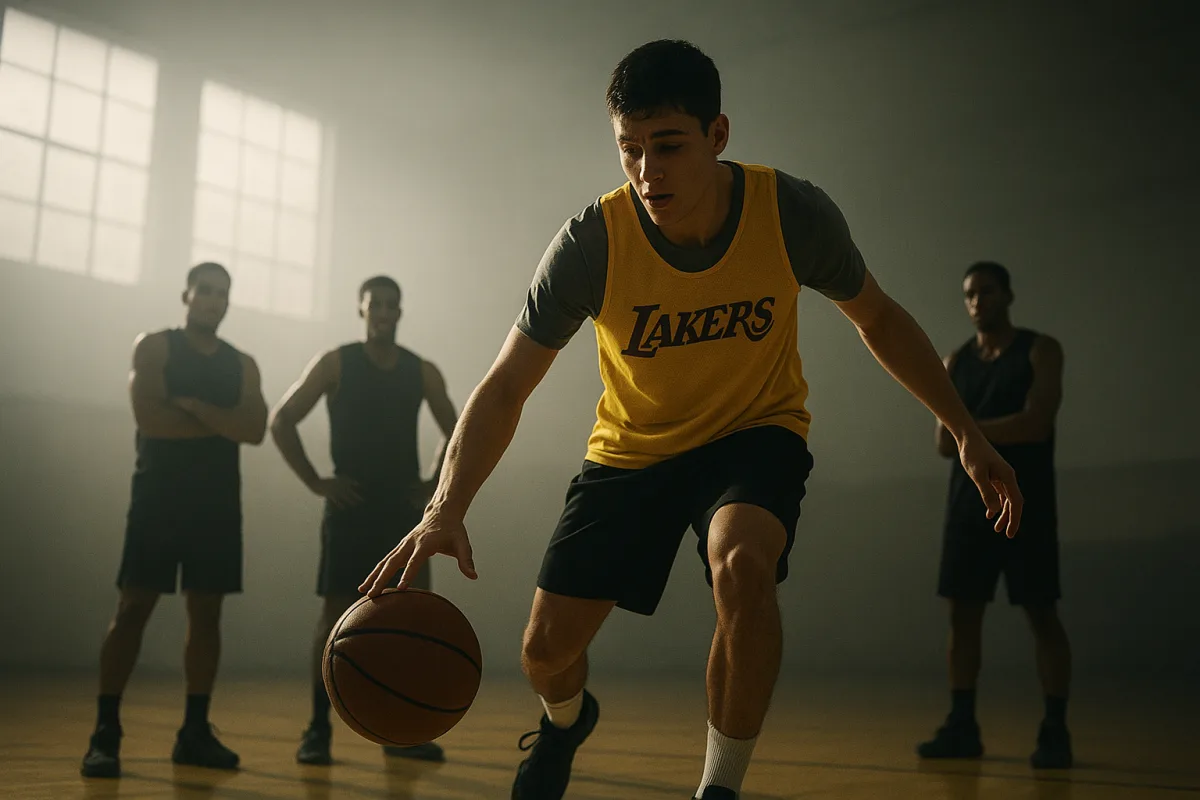
Bronny James’ preseason has shifted from a development story to a roster-pressure story
The shift is in the evidence, not just the tone
The plain shift is this: Bronny James is no longer being discussed primarily as a novelty, a second-round developmental bet, or LeBron James’ son. His preseason possessions have put the question on the floor: can he function as an NBA guard when defenses pressure the ball?
That is a sharper question than whether he can make a few shots in October. The Los Angeles Lakers have given James minutes, ball-handling responsibilities and preseason opportunities, but the results have exposed a recurring issue with his current role. [3]
Across four preseason games, James logged 11 points, 13 assists and 12 turnovers while shooting 26.7 percent from the field and 14.3 percent from three. Those numbers are small-sample results, but 12 turnovers in limited minutes are not noise in the same way a cold shooting week can be. [3]
A missed jumper ends a possession. A live-ball turnover often starts the opponent’s transition offense before the defense is set, and it can erase the very defensive value a small guard needs to supply to stay playable.
James went scoreless in 11 minutes against Golden State on Oct. 13, taking two shots, recording one rebound and one steal, and turning the ball over four times. That game sharpened a trend already visible in the previous exhibitions. [3]
The sequence matters more than the score. When a guard cannot get from initial ball pressure into the first action cleanly, the offense enters its set late, the second side never develops, and teammates are pushed into emergency creation.
That is why the criticism has converged around ball handling and decision-making. TheFlightMike’s analysis identified James’ trouble against pressure, while Uncut Hoops focused on the turnover count and his difficulty operating as a lead guard. Their tone and standards differ, but they are reacting to the same possession-level problem.
The more useful version of that critique is not that James “cannot play,” as some commentary has argued. It is that his present offensive role asks for more self-creation and pressure navigation than he has consistently shown he can deliver.
Redick’s comments are candid, but not a rejection
The strongest reporting comes from the Lakers coach, not from the reaction channels. NBC Sports reported that JJ Redick said, “I don’t think he’s played well in the four preseason games,” after the Golden State loss. [3]
That is unusually direct for a young player on a guaranteed contract. Redick did not hide behind generic language about learning, reps or the preseason not mattering. He acknowledged that the game performance has fallen below the standard.
But the rest of Redick’s answer matters just as much. He said James had a productive summer and September, and that the guard had practiced well before struggling in exhibition games. [3]
Redick also pointed to the lineups. James has spent many second-half minutes alongside two-way players, and in the Golden State game he shared the floor with Rafael Castro, whom Redick said had been with the team for only three days. [3]
That does not prove lineup context caused the turnovers. The independent research brief is right to treat the effect of those units as unverified, because Redick’s account is a coach’s explanation, not a controlled lineup study.
Still, the distinction is important. A guard surrounded by unfamiliar teammates has fewer reliable outlets, less timing on handoffs and cuts, and a greater chance that a reasonable pass becomes a turnover because the receiver reads the action differently.
The counterpoint is equally important. NBA guards are expected to survive imperfect lineups. If the ball pressure is beating James before a play begins, an unfamiliar screener or missed weak-side cut is not the whole explanation.
This is where the phrase “Lakers’ loss of confidence” needs restraint. The public record supports concern, a more difficult rotation path and a candid coaching assessment. It does not include a front-office statement that Los Angeles has decided James cannot develop.
Opportunity has changed the standard
Preseason often offers established players a low-stakes runway. For fringe roster players, young second-round picks and two-way candidates, it is closer to a live audition, even if coaches still prioritize health and experimentation.
James has had enough usage for the Lakers to evaluate meaningful questions. His 17.5 minutes per game were not ceremonial appearances, and the assists show that Los Angeles did not simply station him in a corner. [3]
That usage creates a tougher lens. A player receiving lead-guard touches must organize the possession, recognize the first defender’s leverage, and know when to move the ball early rather than dribble into traffic.
James’ 13 assists should not be dismissed. Assists measure passes that directly lead to baskets, and they show he has found teammates often enough to create some positive offensive possessions. [3]
But assists alone do not establish that a player can run offense. A 13-assist, 12-turnover preseason ledger is nearly a one-to-one exchange, and it says the successful reads have been accompanied by too many possessions that never reach a shot attempt.
The tape question is also narrower than the broadest public criticism suggests. The issue is not simply that James is an undersized guard. Many guards survive without size because they bring one bankable offensive skill, such as shooting, manipulation of help defense or low-turnover decision-making.
For James, shooting has not stabilized enough to simplify the job. If defenders can go under ball screens or crowd his handle without paying for it, he must beat the first defender more consistently or make the next pass earlier.
That was already part of the pre-draft debate. The Ringer’s scouting analysis questioned whether James was ready and cited the need for more development, while Bleacher Report identified reliance on jump shots and limited advanced creation as key concerns. [6][8]
The preseason has not invented those concerns. It has put them into an NBA context, with defenders able to turn a loose handle or delayed read into transition the other way.
Why the roster creates doubt now
The Lakers’ roster math is the practical reason this topic has escalated. Los Angeles entered the final preseason stretch with 16 players on standard contracts, one more than the regular-season limit, creating an immediate decision point. [10]
That does not mean James is automatically the player in danger. His contract situation makes his case different from that of a camp invitee, and the first two years of his four-year, $7.89 million Lakers deal are fully guaranteed. [1][2]
The third year has a partial $1.3 million guarantee, while the fourth season is a $2.49 million team option. Those terms give the organization time to develop him, but they do not create rotation minutes by themselves. [1][13]
The relevant competition is not a hypothetical argument about whether James deserved to be drafted. It is the current guard hierarchy, the number of players who can bring the ball up, and whether Los Angeles can afford a non-shooting, turnover-prone developmental guard in a win-now rotation.
A front office can retain a young player and still conclude that he needs G League reps. Those are separate choices. Keeping the asset is a contract decision, while playing him is a nightly matchup and possession-management decision.
That distinction is missing from the harshest public takes. Uncut Hoops has framed James’ ongoing opportunities as evidence of special treatment, but that claim goes beyond the evidence available in public reporting.
James’ family connection unquestionably makes his development more visible. It does not give outside commentators access to Lakers decision-making, and no reported internal front-office communication establishes that his minutes or roster status are being handled outside normal evaluation.
There is, however, a reasonable basketball basis for a more patient approach. James has flashed point-of-attack activity defensively, an area Redick emphasized when he initially explained the Lakers’ development priorities for him.
The problem is that defensive disruption has to survive the rest of the possession. If James is pressured into turnovers on offense, or loses track of cuts away from the ball, the overall shift can become too volatile for a playoff-oriented team.
Public criticism is converging, but its quality varies
The trend has grown because different kinds of outlets are now making overlapping claims. Lakers coverage has documented the numbers and Redick’s blunt evaluation, while scouting outlets have returned to the same questions that existed before the 2024 draft. [3][6][8]
The Ringer reported an NBA general manager’s view that James was “nowhere near ready” and should return to school. OutKick separately cited a scout who described his NBA outlook as “brutal,” pointing to his college and combine profile. [6][7]
Those assessments should be read as pre-draft evaluations, not fresh proof of what happened in this preseason. Still, they explain why a 12-turnover four-game stretch has activated such a strong response from analysts.
The Yahoo and Yahoo Sports excerpts pointing blame at James’ developmental path are not detailed enough to support a broader claim about who caused his struggles. They are evidence of the criticism cycle, not evidence of a diagnosis. [5]
The temptation is to turn every weak Bronny James possession into a referendum on nepotism, LeBron James, or the Lakers’ credibility. That framing may generate attention, but it hides the actual basketball decision in front of Los Angeles.
The smaller, more actionable question is whether James can become a low-mistake complementary guard. He does not need to become a primary creator to justify a long NBA career, but he must make a lineup’s offensive structure easier rather than harder.
That could mean playing more off the ball, attacking closeouts instead of starting every possession at the top, and becoming a credible catch-and-shoot option. It could also mean limiting his on-ball reps until his handle catches up.
A G League assignment would fit that plan better than it would fit the public narrative. It would let James get repeated high-volume reads against pressure, build chemistry with a stable group, and make mistakes without placing a contending team’s rotation under strain.
What a player-development project should take from this
For anyone planning a player-development project, James’ preseason is a useful warning against assigning a role before the underlying skills support it. A guard can be a willing passer without being ready to quarterback an offense.
Start with the first two seconds of a possession. Can the player receive pressure, protect the dribble, identify the help defender and enter the set on time? If not, adding more pick-and-roll volume may simply multiply bad reps.
The next priority is role clarity. A player with defensive energy and secondary passing feel may develop faster as a connector, attacking tilted defenses and guarding the point of attack, rather than as the initial organizer.
Then measure turnovers correctly. Total turnovers matter, but film should separate a loose-handle giveaway, a late read against a trap, a miscommunication, an offensive foul and a risky pass that generated the correct idea but poor execution.
James’ current numbers are not a final judgment, and preseason does not provide enough possessions to make one. They are enough to identify an urgent developmental target: reduce the possessions where pressure prevents the Lakers from running offense at all.
That is why Redick’s mixed message is the right one to hold onto. James has not played well, the roster squeeze is real, and the public criticism has a factual basis. But good practices, difficult lineups and a still-open development timeline mean “doubt” is not the same thing as a final verdict.
Frequently Asked Questions
What are Bronny James' main struggles in the NBA preseason?
Bronny James has struggled primarily with ball handling and decision-making under NBA-level defensive pressure. He has turned the ball over 12 times in four preseason games and shot poorly, with a 26.7% field goal percentage and 14.3% from three-point range. These turnovers often result in live-ball possessions for opponents, which disrupt the Lakers’ offense and defense.
How has JJ Redick assessed Bronny James' preseason performance?
Lakers coach JJ Redick has been candid, stating, “I don’t think he’s played well” in the preseason games. However, Redick also noted that James had a productive summer and practiced well, and he attributed some struggles to unstable lineups and inexperienced teammates on the floor with James.
Why are the Lakers doubtful about Bronny James' role?
The Lakers face a crowded guard rotation and a 16-player roster limit, making it difficult to secure James a consistent NBA rotation spot. His preseason turnovers and difficulty initiating offense under pressure raise questions about whether he can fulfill the lead guard role the Lakers have tested him in, making a G League development path more plausible.
What do Bronny James' preseason turnovers indicate about his development?
James’ 12 turnovers in limited minutes suggest he is not yet reliably able to handle NBA-level ball pressure and create offense without costly mistakes. These turnovers highlight ongoing issues with his handle and decision-making, which are critical skills for a guard expected to initiate offense.
Can Bronny James handle NBA-level ball pressure effectively?
Current evidence from the preseason indicates that James struggles to navigate NBA-level ball pressure effectively. His turnovers and the resulting disruption to the offense suggest he has difficulty transitioning from initial pressure into clean offensive actions consistently.
How we researched this
This article was assembled from 3 video sources across 2 channels, 3 published articles, 15 cited references.
Nothing here is based on hands-on testing. Where a figure or finding appears, it belongs to the source cited beside it, and the writing says so rather than implying otherwise. Every source is listed below so you can check it.
Sources
The Lakers Just Gave Up on Bronny James — TheFlightMike
Bronny James IS THE WORST PLAYER IN THE NBA — Uncut Hoops
Bronny James KEEPS GETTING WORSE — Uncut Hoops
Lakers coach JJ Redick on Bronny James: 'I don't think he's played well' in preseason games — CBS Sports NBA
‘You killed him’ – NBA icon points blame for Bronny James’ LA Lakers struggles — Yahoo
‘You killed him’ – NBA icon points blame for Bronny James’ LA Lakers struggles — Yahoo Sports
Bronny James signs guaranteed contract with the Lakers - Los Angeles Times
JJ Redick on Bronny James: 'I don't think he's played well in the four preseason games' - NBC Sports
JJ Redick evaluates Bronny James after four NBA preseason games - Archysport
Redick Defends Bronny Despite Preseason Struggles - Frankstride
Bronny James' NBA Outlook Brutally Torched By GM And Scout | OutKick
2024 NBA Draft: Did Bronny James Prove He's NBA-Ready in 1st Year at USC?
Lakers Facing Bronny James Decision After JJ Redick’s Announcement - Athlon
Bronny James' preseason struggles raise questions about Lakers roster spot | News Minimalist
Reddick's Candid Assessment Signals G League Path for Bronny - Coldmast
Lakers News: Full Details Revealed on Bronny James' LA Contract
Bronny, sobre LeBron James: "Él tiene su propio camino y yo, el mío"
La pesadilla de pretemporada pone en seria duda el futuro de Bronny James con los Lakers - MARCA USA
Watch Bronny James' Struggles and Lakers' Doubts on Youtube
Also from the sources
Related Articles
Philadelphia 76ers Preseason Struggles and Player Dynamics
Analyze Philadelphia 76ers preseason struggles, key player performances, and evolving roster dynamics including Embiid, James, and Brown.
LeBron James 76ers Preseason Impact and Team Dynamics
Explore LeBron James' 76ers preseason impact, his playing style, and how he influences team offense and Embiid's role.

NBA Media Day Insights 2026: Top Players and Team Updates
Get key NBA Media Day insights from top players and teams, including Wembanyama, Leonard, Harper, and Bronny James for the 2026 season.
NBA Training Camp Signings and Roster Battles Explained
Explore NBA training camp signings and roster battles, including contract types and player roles in team depth and rotation decisions.