NBA 2026-27 Title Race Analysis and Competitive Landscape
Explore the NBA 2026-27 title race analysis with insights on contenders, key players, and team strategies shaping the competitive landscape.
2026-27 NBA Season Preview: How to Read a Crowded Title Race
First, separate actual contenders from teams with attractive names
The coming season has more recognizable talent concentrated on viable teams than a typical year. That does not automatically make every star pairing a contender. The useful question is whether a team can create a good shot after the opponent takes away its preferred first action.
Oklahoma City remains the cleanest answer in the West. Hoops Reference’s opening-night review emphasized that the Thunder were already deep before a healthier Jalen Williams and other returning rotation pieces restored lineup flexibility. Their advantage is not merely Shai Gilgeous-Alexander’s scoring. [4]
Against a switching defense, Oklahoma City can place Gilgeous-Alexander in a ball screen, then attack the weakest mismatch without abandoning spacing. Against a trapping defense, it has enough passing and secondary ball handling to keep the possession alive rather than forcing a bailout shot.
San Antonio presents the more interesting challenge. Victor Wembanyama is entering his third season at 22 after a Finals run in which he reportedly averaged 27 points, 11 rebounds and roughly three blocks in the playoffs. [1] The defensive floor is obvious. The offensive test is less glamorous.
Watch whether the Spurs can force a defense to choose between helping at the rim against Wembanyama and conceding clean perimeter looks. If Stephon Castle and Dylan Harper consistently punish the second defender, San Antonio can be a first-tier threat rather than a difficult matchup. [1]
Minnesota belongs in that same discussion, but for a different reason. The Timberwolves’ LaMelo Ball trade is a bet on possession quality. Ball averaged 20.1 points and 7.1 assists across 72 games in 2025-26, while Anthony Edwards averaged 28.8 points over 61 games. [13]
The important tape question is whether Ball lets Edwards begin possessions as a scorer rather than an initiator. SWISHOUT noted early actions in which Edwards relocated to the corner or came off pin-downs while Ball pushed the ball ahead. That is the correct experiment.
Do not use Ball’s assist total as the sole verdict. A pass only becomes an assist if the recipient makes the shot. Instead, watch whether Minnesota reaches its first organized action earlier, whether Edwards catches with an advantage, and whether transition chances rise after defensive stops.
There will be tradeoffs. Ball’s decision-making and defensive engagement have always mattered as much as his creativity. Minnesota has to preserve enough size and point-of-attack resistance around him that its quicker offense does not come at the expense of the defense that built its prior postseason identity.
Then, learn what each East contender needs when the game slows down
The East is not short on top-end names. It is short on teams that have already demonstrated an answer to every late-game coverage. That makes the regular season especially useful, because it will reveal whose preferred offense survives repetition.
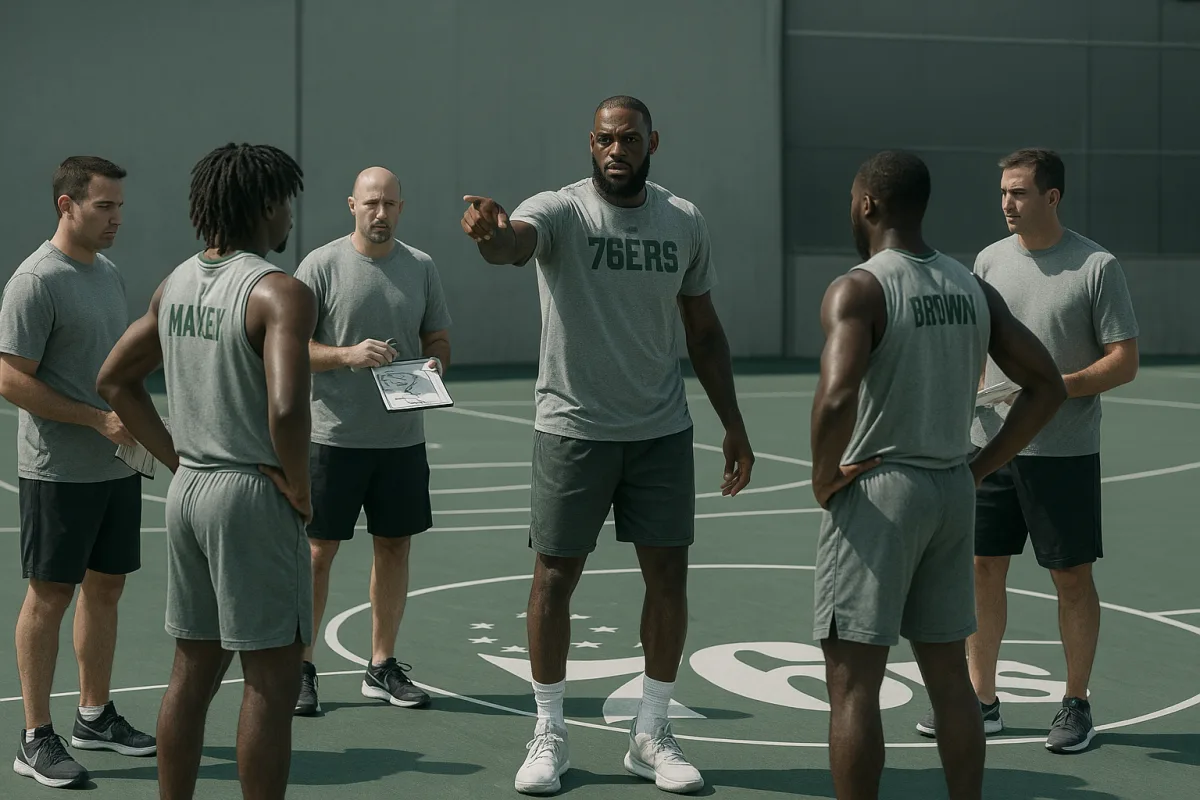
Philadelphia has the largest range of outcomes. A.M. Hoops frames LeBron James and Jaylen Brown joining Joel Embiid and Tyrese Maxey as the league’s biggest spotlight story. That is fair, but the on-court concern is less theatrical: too many initiators can still produce stagnant possessions.
The Sixers should be judged by their hierarchy. Maxey’s speed is most valuable when he can push after misses and attack tilted defenses. Embiid is most dangerous when the offense creates a deep seal, an elbow mismatch or a clean short-roll decision, not when he must manufacture everything late.
Hoops Reference’s opening-night breakdown argued that Embiid moved effectively, rotated well and handled perimeter switches better than expected against New York. That is encouraging, but one game does not erase availability concerns or determine a season’s defensive baseline. [4]
Miami’s Giannis Antetokounmpo fit is more schematic. The Heat can put pressure on the rim and generate open threes because Giannis attracts help before he reaches the restricted area. The concern is who creates a stable look if a playoff defense walls off the paint.
That is why the Heat should be evaluated against disciplined half-court defenses, not only against opponents they overwhelm in transition. If Miami’s wings and guards can make the extra pass after the initial help rotation, Giannis becomes the force multiplier the roster was built to maximize.
His contract also makes this a high-stakes window. Basketball-Reference lists Antetokounmpo at $58,456,566 annually on a four-year deal that includes a 2027-28 player option. [8] The Heat need not win a title immediately, but they need evidence that their late-game offense has a durable shape.
Boston is a different kind of test. The Celtics replaced Jaylen Brown’s downhill creation with Paul George’s off-ball shooting, connective passing and secondary creation. That may improve the flow of their ordinary possessions, while reducing their margin for error when Jayson Tatum cannot generate paint pressure.
SWISHOUT and Hoops Reference both identified the same basketball issue from different angles. George can fit a movement offense, but he is not a like-for-like replacement for Brown as a physical, self-created scoring option. That distinction matters when teams switch everything.
Tatum’s recovery must remain part of the evaluation. Early return from an Achilles injury is not proof of full restoration. When Boston faces switching defenses, track his burst on the first step, his willingness to attack the rim, and whether he can draw help instead of settling.
Toronto may be the East’s most revealing watch. SWISHOUT described a team whose defense carried a stagnant half-court offense, then added Kawhi Leonard as a closer and self-creator. The fit makes sense if Leonard reduces the need for every possession to become a difficult wing isolation.
The actionable benchmark is simple. Watch Toronto after the initial action fails. If Leonard can create a shot without pulling the other wings out of rhythm, the Raptors’ defense has a chance to translate into a high seed. If not, the offense remains vulnerable despite better individual talent.
Do not confuse pace and box-score noise for sustainable offense
Opening weeks create misleading evidence. A team can score 120 because it made contested threes, faced an undermanned opponent, or received an unusual bench shooting performance. None of those outcomes tell you whether its half-court process is sound.
Minnesota’s 98-shot opener against Miami, cited by SWISHOUT, is a useful example. More attempts can signal better transition creation and fewer turnovers. It can also reflect extreme three-point variance. The repeatable part is the speed of the first decision, not the final shot count.
The Los Angeles Lakers offer another practical case. Walker Kessler’s value beside Luka Dončić and Austin Reaves is not measured only through blocks and alley-oops. He changes the geometry of both ends: rim protection behind vulnerable guards, hard screens and a direct roll target.
Kessler signed a four-year, $130 million contract after the trade, beginning at $32.5 million in 2026-27. [9] That price reflects a specific expectation. He must defend without constant fouling, contain the ball long enough for help to recover, then finish simple plays offensively.
Watch the Lakers against teams that can pull Kessler into space. If opponents force him to defend repeated high pick-and-rolls, the perimeter defenders must navigate screens better. If they cannot, Kessler’s rim protection will be asked to solve a problem that starts far from the rim.
Denver remains relevant precisely because it does not need a reinvention. Nikola Jokić enters healthy, according to Axios’s season preview. [1] The Nuggets’ question is whether their perimeter support can survive the possessions where opponents deny his preferred post entry and top-lock off-ball cutters.
Approach young teams and uncertain rosters with a narrower standard
Not every watchable team must be a championship pick. Washington is a good example. With rookie AJ Dybantsa alongside Trae Young and Anthony Davis, the Wizards have enough competing timelines that the season should be assessed through role clarity rather than the standings.
Watch who owns the fourth-quarter ball, who spaces around that player, and whether Dybantsa is asked to make manageable reads. A rookie learns more from attacking a rotating defense than from being handed impossible isolations against a set defense.
Dallas is similarly difficult to project. The Mavericks have a new front-office leader in Masai Ujiri, a new coach in Dusty May, Kyrie Irving returning from an ACL tear, and a roster crowded with frontcourt players. [10][12][16]
The early schedule will make any record-based judgment even less useful. Dallas’s first six opponents combined for a 292-200 record last season, according to Fantasy Nerds. [11] A poor opening record could reflect transition and opposition quality rather than a definitive failure.
Instead, chart whether Dallas finds lineups that fit Cooper Flagg’s development. Kyrie Irving’s health and effectiveness matter, but the franchise cannot let every possession become an audition for its veteran core if it wants Flagg to develop as a primary decision-maker.
Charlotte is another team where the roster logic deserves scrutiny. Hoops Reference noted that the Hornets traded Ball for Naz Reid, a first-round pick and pick swaps, leaving a deeper shooting group but without an obvious full-time offensive organizer.
The Hornets may defend better and move the ball more evenly. But evenly distributed touches are not the same thing as creation. When opponents switch and the first option fails, identify who bends the defense. If no one does, Charlotte’s attractive depth will have a hard ceiling.
Keep the lottery reform and injury news in proper perspective
The NBA’s new 3-2-1 lottery system is a future variable, not an explanation for the current regular season. It begins with the 2027 draft and applies through 2029. [2][14] Claims that it already ended tanking are premature.
The approved format expands lottery teams from 14 to 16, flattens odds and adds penalties that can include reduced odds or draft-position changes for tanking behavior. [14] Those rules may affect incentives later, but there is no evidence yet that they have changed current effort levels.
Injuries are more immediate. Indiana welcomed Tyrese Haliburton back from a ruptured right Achilles with 23 points and 12 assists in nearly 34 minutes on October 23, but one successful return does not answer durability questions across an 82-game schedule. [4]
For Indiana, monitor his movement before the ball arrives. If Haliburton is sprinting into early offense, relocating after passes and defending without obvious hesitation, the Pacers can return to their preferred pace. If his minutes or movement narrow, their entire offensive identity changes.
T.J. McConnell’s hamstring absence is also worth tracking because second-unit organization matters more when a lead guard is returning from a major injury. FanDuel reported no timetable after he missed the October 23 game. [4]
Finally, avoid projecting availability onto Sacramento’s Ben Simmons. Rotoballer lists his Achilles injury as season-ending. [3] That is not a minor rotation adjustment. It changes the Kings’ defensive versatility, transition ball handling and the lineup combinations they can realistically test.
The best way to follow 2026-27 is therefore not to chase the loudest transaction or the first week’s standings. Follow the possessions that recur in April: the switch, the trap, the weak-side rotation, the late-clock bailout and the lineup that still produces a clean shot when the first plan is removed.
Frequently Asked Questions
Which NBA teams are the main title contenders in 2026-27?
In the West, Oklahoma City and San Antonio stand out as primary contenders, with Oklahoma City showing depth and flexibility and San Antonio relying on Victor Wembanyama’s defensive impact and developing offensive support. Minnesota also belongs in the discussion due to the LaMelo Ball and Anthony Edwards partnership. In the East, Philadelphia, Miami, Boston, and Toronto are considered contenders, each facing distinct challenges in creating effective offense against playoff defenses.
How do key players affect the 2026-27 NBA title race?
Key players like Shai Gilgeous-Alexander (Oklahoma City), Victor Wembanyama (San Antonio), LaMelo Ball and Anthony Edwards (Minnesota), Joel Embiid and Tyrese Maxey (Philadelphia), and Giannis Antetokounmpo (Miami) significantly influence their teams' prospects. Their ability to create good shots under defensive pressure and adapt to different game situations is crucial. Player health and availability, such as that of Tyrese Haliburton, Kyrie Irving, and Ben Simmons, also heavily impact team strategies and chances.
What are the strategic challenges for NBA teams in 2026-27?
Teams must find ways to generate quality shots after opponents take away their preferred first options, especially against switching and trapping defenses. For example, Oklahoma City uses ball screens and spacing to exploit mismatches, while San Antonio needs to balance rim protection with perimeter shooting threats. Eastern contenders must solve creation problems when defenses switch, load the paint, or remove first options, particularly in late-game situations.
How do injuries impact NBA teams' chances in 2026-27?
Injuries introduce significant uncertainty into forecasts. For instance, Tyrese Haliburton returned from a ruptured Achilles but his long-term durability is uncertain. Ben Simmons is out for the season with an Achilles injury, affecting Sacramento’s lineup. Other players like T.J. McConnell, Khalifa Diop, and Tyler Bilodeau have short-term injuries that could alter team rotations and effectiveness. Availability fluctuations for key players can change what teams are able to run on both ends of the floor.
What factors determine success in the 2026-27 NBA season?
Success depends on a team’s ability to adapt offensively when defenses disrupt their preferred actions, maintain defensive resilience, and manage player health throughout the season. Efficient decision-making, especially in late-clock situations, and the capacity to create stable offensive looks under playoff-level pressure are also critical. Additionally, depth and lineup flexibility, as seen with Oklahoma City, contribute to sustained competitiveness.
How we researched this
This article was assembled from 5 video sources across 3 channels, 16 cited references.
Nothing here is based on hands-on testing. Where a figure or finding appears, it belongs to the source cited beside it, and the writing says so rather than implying otherwise. Every source is listed below so you can check it.
Sources
The NBA Has Finally Reached Peak Competition — SWISHOUT
What You Need To Know Before the Best NBA Season Ever — A.M. Hoops
5 BIGGEST Lessons Learned From NBA Opening Night — Hoops Reference
5 Weird NBA Teams I Don't Know What To Make Of — Hoops Reference
NBA's board of governors passes anti-tanking changes to draft lottery
T.J. McConnell Out Oct. 23 Against Mavericks Due To Hamstring Injury | FanDuel Research
Dallas Mavericks 2026-27 Season Preview: New Regime, Kyrie's Return & Fantasy Outlook
Dallas Mavericks Face Grueling 2026-27 Schedule to Open Season - Fantasy Nerds
Watch NBA Season Preview and Competitive Landscape on Youtube
Also from the sources
Related Articles
NBA Contenders and Pretenders for the 2026-27 Season
Explore the NBA contenders and pretenders for 2026-27, including a detailed Knicks vs. Pistons analysis and championship odds.
Toronto Raptors Underrated Contenders in the 2026 NBA Season
Explore why the Toronto Raptors are underrated contenders, focusing on defense, Kawhi Leonard's impact, and roster changes in 2026.
Philadelphia 76ers Early Season Performance and Player
Analyze the Philadelphia 76ers' early season performance and player roles, focusing on Maxey, Brown, James, and team offensive strategies.
LeBron James 76ers Title Contention and Team Dynamics
Explore LeBron James' impact on the 76ers and their realistic title contention prospects for the 2026-27 NBA season.