
NBA Rising Stars Contract Extensions and Salary Cap Impacts
Explore contract extension updates for NBA rising stars and how the 2026-27 salary cap shapes team decisions and player negotiations.
Start with the calendar, not the rumor
Extension coverage often turns a procedural question into a personality story. The useful first question is simpler: what can the player sign now, what option deadline changes the leverage, and what cap restriction changes the team’s appetite?
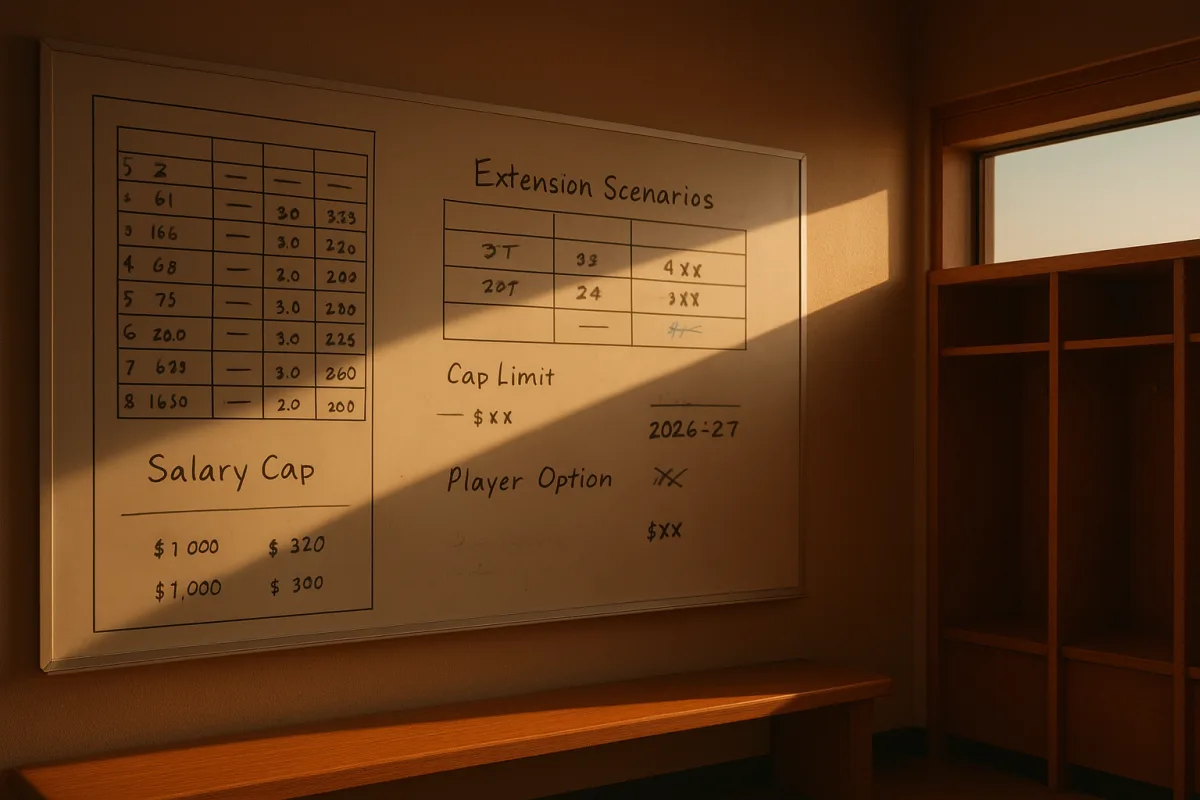
The NBA set the 2026-27 salary cap at $164.961 million, with the luxury-tax line at $200.428 million, the first apron at $209.015 million, and the second apron at $221.686 million. Those are not abstract benchmarks. [1]
A front office operating near the second apron does not merely pay more tax. It loses roster-building routes, which means every extension must be read as a decision about future lineup continuity and transaction flexibility.
That framework matters particularly with the New York Knicks and Oklahoma City Thunder. Both clubs have core players worth retaining, but their contract questions are really tests of whether a contender can preserve its best five-man shapes.
Read Brandon Miller’s case through on-ball workload
Charlotte Hornets wing Brandon Miller is eligible for a five-year extension worth as much as $275 million after his 2025-26 season. The Hornets have not completed an agreement, despite reporting that his eventual number could surpass Amen Thompson’s five-year, $208 million deal. [7]
The actionable point is not to treat that reported comparison as a forecast. The independent record does not establish a reliable market range or standard extension length for players with Miller’s specific offensive profile and draft pedigree.
Miller averaged 20.2 points, 4.9 rebounds and 3.3 assists in 30.3 minutes across 65 games last season. Those figures establish production, but they do not answer the contract question on their own. [2]
On tape, the question for a scoring wing is whether his points survive possession after possession when the defense loads up. Can he initiate against a switch, make the weak-side read when help tags the roller, and still create a quality late-clock shot?
That distinction is important because Charlotte’s post-trade roster places more responsibility on Miller. A player who finishes designed possessions is valuable, but a player who begins them, commands help, and creates the next advantage changes a franchise’s offensive ceiling.
For readers tracking negotiations, watch the Hornets’ early-season usage rather than searching for a fabricated “Miller market.” Note which possessions he starts, whether he handles against the opponent’s best perimeter defender, and how often Charlotte trusts him after the first action fails.
If Miller is repeatedly placed in empty-corner pick-and-rolls, asked to attack switches, and used as the passer against the low man, that is stronger evidence of organizational belief than a vague report about offensive upside.
There is no reason to frame an unsigned extension as a failure for either side. Charlotte has a player it can build around, while Miller has every incentive to make the largest possible sample of primary-creator possessions before accepting a number.
Put Cason Wallace’s reported number against Oklahoma City’s roster math
Oklahoma City guard Cason Wallace has reportedly discussed structures in the $25 million annual-average range. That is a logical starting point for a young perimeter defender with a growing offensive case, but the Thunder’s cap sheet makes the route complicated. [6]
The Thunder’s estimated 2026-27 payroll is roughly $221.86 million, already just above the officially announced $221.686 million second apron. That figure is more useful than any comparison to another team’s recent guard contract. [1][6]
Shai Gilgeous-Alexander is listed at $40.81 million for 2026-27, while Jalen Williams and Chet Holmgren are each listed at $41.25 million. All three are foundational commitments, not movable accounting entries in a normal roster conversation. [6]
This is where box-score thinking can mislead. Wallace’s value is not simply 8.6 points, 3.1 rebounds and 2.6 assists, although those were his reported averages across 77 games last season.
His defensive utility comes from changing what a lineup can cover. A guard who can take a difficult point-of-attack assignment allows Gilgeous-Alexander to conserve energy, lets bigger wings stay connected to shooters, and makes switching less punishing against second-side ball movement.
Wallace’s reported 1.9 steals per game and Second Team All-Defense recognition point toward disruptive defense, but steals alone are not the reason to pay him. The evaluation should focus on screen navigation, rear contests, closeout discipline, and whether he can stay attached without fouling. [6]
The offensive question is equally specific. In Oklahoma City’s high-skill environment, Wallace does not need to become a 25-point scorer. He needs to punish the concessions defenses make after they overload Gilgeous-Alexander, Williams, or Holmgren.
That means catch-and-shoot volume, quick decisions on the second side, and enough ball handling to keep a possession alive when a set breaks down. A $25 million valuation is easier to defend if Wallace becomes a lineup stabilizer rather than merely a low-usage specialist.
For Thunder followers, the practical signal is not whether the club praises Wallace publicly. Watch which salary is moved, which rotation player is replaced internally, and whether Oklahoma City can create room without weakening the versatile defensive lineups that made Wallace valuable.
Understand why Karl-Anthony Towns is a deadline case
Karl-Anthony Towns’ situation is more immediate and more public. The Athletic reported that he said the Knicks’ decision to table extension discussions was “news to me,” and he called the development disappointing. [5]
That reaction should not be reduced to frustration alone. Towns is eligible for a four-year extension worth up to $276 million, while reporting has placed New York’s prior offer concept nearer $200 million total. [4][8]
The gap matters, but the option matters more. Towns has a $61 million player option for next season, and he must decline it by October 19 to open the path for in-season extension negotiations.
Declining the option would mean walking away from $61 million in guaranteed salary. It could produce more long-term security if an agreement follows, but it does not guarantee that New York, or another club, will ultimately provide equal value in free agency. [3][5]
The Knicks’ concern is not hard to see. Owner James Dolan has reportedly instructed the organization not to cross the second apron, a stance that makes each additional commitment affect the choices around the rest of the rotation. [5]
On the court, Towns is not interchangeable with a conventional high-scoring big. His shooting range pulls a center from the paint, which can widen driving lanes and make a second-side pass more dangerous when New York’s wings draw help.
But that spacing value must be weighed against the rest of a title-contending lineup. If the Knicks pay Towns at a level that limits their ability to retain defensive connective tissue, the offense may retain its star power while losing the coverage versatility needed in May.
Readers should therefore separate two claims. Towns can be essential to New York’s best offensive possessions, and the Knicks can still have legitimate reasons to protect their financial routes before committing to a long extension.
Track Josh Hart as part of the same lineup equation
Josh Hart is also extension-eligible, and New York holds a $22.4 million team option on him for next offseason. Reporting from Marc Stein and Jake Fischer indicated that the Knicks were prioritizing Towns over Hart after pausing discussions. [5]
That ordering makes basketball sense before it makes financial sense. Towns is a high-volume offensive center of gravity, while Hart’s value emerges through the possessions between stars: defensive rebounding, transition pushes, extra rotations, and immediate decisions without holding the ball.
Hart’s utility is particularly visible when an opponent forces New York into multiple efforts. A defensive rebound that becomes an early push can prevent the defense from setting its matchups, and a wing rebound can preserve size without sacrificing pace.
Still, a strong role player can be indispensable to a lineup without being the first extension solved. The Knicks must decide whether Towns’ spacing and scoring are the irreplaceable element, then price the support players around that premise.
That is why reports that New York has paused talks with both players should not automatically be read as a verdict on Hart. It is a sequencing move under a hard cap environment, and sequencing is often the real substance of a negotiation.
Do not turn Deuce McBride chatter into a transaction forecast
Deuce McBride has surfaced in trade speculation connected to New York’s finances. The reporting identifies a possibility, not a confirmed plan, and it should be handled with that level of certainty. [5]
There is no public, official evidence establishing McBride’s trade value, the number of interested teams, or a specific return New York could command. Those details remain confidential, dynamic, and dependent on injuries, contenders’ needs, and contract matching.
From a basketball standpoint, McBride’s appeal is easy to describe. A guard who can pressure the ball, compete over screens, and make a quick catch-and-shoot decision can fit beside high-usage scorers without demanding touches.
From a roster-management standpoint, describing that appeal is not the same as assigning a market price. A team can value McBride internally because of its own scheme while another front office sees a smaller role or a different positional need.
The practical reading is to wait for a concrete trigger: an actual proposal, a cap-driven deadline, or a rotation shift that reduces McBride’s minutes. Until then, the proper label is possibility, not inevitability.
Use possessions to judge who has leverage
Contract reporting often invites readers to pick a side. The better method is to identify what each player changes when the offense reaches its second or third action, because that is where playoff possessions separate from clean regular-season sets.
Miller’s leverage grows if he proves he can run Charlotte’s hardest possessions. Wallace’s grows if Oklahoma City cannot replicate his defense-and-decision package with cheaper internal options. Towns’ grows if New York’s spacing drops visibly without him.
Hart’s leverage appears in the lineups that survive ugly possessions, the missed shots, the scramble closeouts, and the contested rebounds. McBride’s value will be clearest in his defensive assignments, not in speculative trade-machine returns.
The next useful updates will be official options, signed extensions, payroll moves, and role changes on the floor. Until one of those changes arrives, reported figures should be treated as negotiating positions, not completed basketball decisions.
Frequently Asked Questions
What are the latest contract extension developments for rising NBA stars?
Brandon Miller, eligible for a five-year extension worth up to $275 million after the 2025-26 season, has not finalized a deal with the Charlotte Hornets. There is no reliable public comparable to establish his market value, so his contract situation remains unsettled. The Hornets are observing his early-season usage to assess his role before agreeing to terms.
How does the 2026-27 NBA salary cap affect contract extensions?
The 2026-27 salary cap is set at $164.961 million, with the luxury tax line at $200.428 million, and apron levels at $209.015 million and $221.686 million. Teams operating near or above the second apron face restrictions that limit roster-building flexibility, making contract extensions a strategic decision about maintaining lineup continuity and financial flexibility.
What factors influence Brandon Miller's contract extension?
Miller’s extension depends on his ability to handle primary offensive responsibilities, such as initiating possessions, creating against defensive switches, and making late-clock plays. The Hornets are evaluating whether he can consistently perform as a primary creator rather than just a finisher, which will influence the size and length of his extension.
Why is Cason Wallace's contract extension complicated by the Thunder's payroll?
The Oklahoma City Thunder’s estimated 2026-27 payroll is about $221.86 million, already above the second apron of $221.686 million. Adding a reported $25 million annual contract for Wallace would push the team further above this threshold, limiting their flexibility. This payroll situation makes structuring Wallace’s extension difficult without significant financial moves.
What is the significance of Karl-Anthony Towns' October 19 player-option deadline?
Karl-Anthony Towns’ October 19 deadline to decide on his $61 million player option is crucial because declining it would forfeit guaranteed income and introduce financial uncertainty. The New York Knicks aim to avoid exceeding the second apron, so Towns’ decision impacts the team’s salary cap flexibility and negotiations with other players, affecting roster construction and championship prospects.
How we researched this
This article was assembled from 6 published articles, 8 cited references.
Nothing here is based on hands-on testing. Where a figure or finding appears, it belongs to the source cited beside it, and the writing says so rather than implying otherwise. Every source is listed below so you can check it.
Sources
Karl-Anthony Towns on Knicks tabling player extensions: 'It was news to me' — The Athletic NBA
Sixers Unlikely To Replace Ariel Hukporti Before December — RealGM
Knicks To Prioritize Re-Signing Karl-Anthony Towns Over Josh Hart, Could Trade Deuce McBride — RealGM
Cason Wallace, Thunder Discussing Deal In $25M Annual Average Range — RealGM
Brandon Miller Could Sign Richer Extension Than Amen Thompson — RealGM
Karl-Anthony Towns 'Very Disappointed' By Knicks' Decision To Pause Extension Talks — RealGM
NBA sets salary cap for 2026-27 season at $164.961 million | NBA.com
Brandon Miller Stats, Height, Weight, Position, Draft Status and more | Basketball-Reference.com
New York Knicks: When Can Karl-Anthony Towns Become a Free Agent?
Knicks Face Growing Possibility of Losing Karl-Anthony Towns Amid Contract Talks - HEAVY
Karl-Anthony Towns contract saga shows how tough it will be to keep Knicks together - CBS Sports
Oklahoma City Thunder Salaries & Salary Cap Sheets | NBA Cap Tracker
What Will Brandon Miller's Next Contract Look Like, and Will He be Worth it?
Related Articles
NBA Trade and Contract Updates for Stars and Teams 2026
Get the latest NBA trade and contract updates for 2026, including key player moves, team roster changes, and salary cap impacts.

Ausar Thompson Contract Extension and Defensive Impact
Explore Ausar Thompson's $155M contract extension and how his defense shapes the Detroit Pistons' future.

Steph Curry Warriors Contract Future and Over-38 Rule
Explore Steph Curry's contract future with the Warriors and how the Over-38 Rule shapes his extension options and team roster decisions.

Stephen Curry Contract Talks and Warriors 2026-27 Outlook
Explore Stephen Curry contract talks, NBA rules, and how his decisions shape the Warriors' 2026-27 roster and salary cap outlook.