NBA Rivalries and Chaotic Moments: Luka Doncic Trade Fallout
Explore NBA rivalries and chaotic moments, focusing on fan protests and controversies after Luka Doncic's trade and league responses.
Dallas turned a trade into an arena conflict
On February 2, 2025, the Dallas Mavericks traded Luka Dončić, the 25-year-old franchise player who had led them to the 2024 NBA Finals, to the Los Angeles Lakers. The reaction quickly moved beyond disagreement with a basketball transaction. [1]
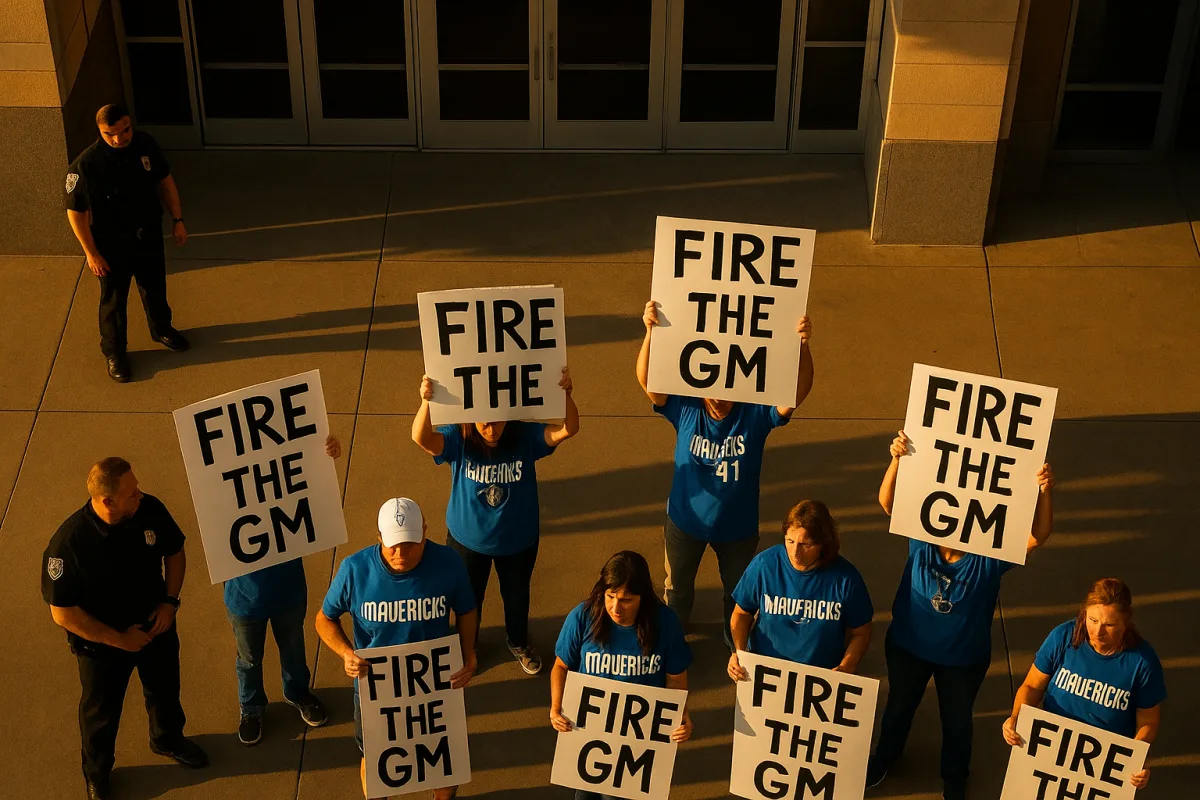
Fans protested outside American Airlines Center before Dallas’s February 8 home game, directing “Fire Nico” chants at general manager Nico Harrison. CBS Texas reported that the trade had created an unusually public breach between a front office and its own ticket-buying base. [1]
That breach looked different from the usual visiting-player hostility. Dončić had not left Dallas in free agency, demanded a trade, or played poorly in a postseason loss. Mavericks management chose to move him, which concentrated fan anger upward.
The Dime channel’s roundup captures the visual language of that backlash: a fan-organized mock funeral, chants at home games, and a return game in which Dončić performed under the emotional weight of a crowd that still regarded him as theirs. Le Monde reported that Dončić scored 45 points in his April 2025 return to Dallas. [4]
From a basketball standpoint, the trade argument was built around roster construction. Harrison’s public defense centered on acquiring Anthony Davis, an elite defender, and on the old championship premise that defense travels through the playoffs.
But a front office cannot sell that premise in isolation. Dončić’s offensive value was not only his scoring, it was the possession-to-possession structure he supplied: high-volume pick-and-roll creation, late-clock shot generation, and passing that gave role players cleaner attempts.
That is why the Dallas anger became so durable. Fans were not reacting only to a star’s departure. They were reacting to the removal of the player who organized the offense, carried playoff usage, and had recently put the franchise on the Finals stage.
The fan response crossed into enforcement
On February 11, a Mavericks fan was removed from a game after appearing on the jumbotron while mouthing “Fire Nico.” CBS Sports reported that arena personnel said the removal followed a violation of the fan code of conduct. [2]
Other fans were ejected during the early post-trade home games, with Athletic Business reporting that the team cited the NBA’s Fan Code of Conduct while handling protests and disruptive behavior. [5] That distinction is important for anyone reading a viral clip.
The available reporting supports heightened security, ejections, and concern over threats directed at Harrison. It does not establish a broad police crackdown on ordinary “Fire Nico” chants, nor does it document arrests connected to the organized protests.
Police and arena security can look similar from the upper bowl or through a cropped phone video. If you are building a story around a supposed handcuffing or removal, confirm whether it involved law enforcement, team security, an ejection, or a later ban.
The NBA’s published Fan Code of Conduct prohibits disruptive, abusive, threatening, or hateful behavior. It gives teams room to eject fans and impose bans, but it does not lay out a separate process for coordinated demonstrations against team executives. [9]
That gap matters because a protest can be loud without being prohibited. A chant aimed at a general manager is different from a threat, slur, physical confrontation, or interference with play, even if all can be grouped together in a team statement about “fan behavior.”
The commissioner could not reverse the deal
Commissioner Adam Silver became part of the Dallas story because fans wanted an authority above the Mavericks to intervene. His answer was direct: “I can’t veto trades,” as Sports Illustrated reported after the Dončić deal. [8]
Silver said he understood why Dallas fans were upset, but CBS Texas reported that he deferred to the Mavericks’ basketball operation, saying the organization had made the decision it believed served its interests. [1]
That was not an act of league discipline or a commissioner rescue. It was a statement of governance. The NBA office can police tampering, cap violations, player conduct, and some transaction procedures, but it does not re-grade a team’s basketball judgment because supporters hate it.
For fans, that can feel unsatisfying because the commissioner is visible while the executive decision-makers are not. For a team, though, it establishes a hard line: ownership and management bear the consequences of their roster calls.
The evidence for commissioner action in this episode is thin. Silver expressed empathy and clarified his lack of veto authority, but no reported league sanction, reversal, or special intervention addressed the Mavericks’ trade or the fan protest campaign. [1] [8]
Rivalries now have more than one court
Dime’s chronology of recent feuds runs through several kinds of NBA conflict: Joel Embiid and Karl-Anthony Towns moving from social-media barbs to an on-court confrontation, Trae Young becoming a recurring antagonist at Madison Square Garden, and Draymond Green’s conflicts with Rudy Gobert and other opponents.
Those examples have a shared feature: the basketball game remains the trigger, but the conflict gains force through clips, quotes, posts, and fan repetition. A hard foul or a gesture no longer ends with the final horn.
The Knicks and Hawks offer the clearest crowd-facing version. Young’s 2021 playoff performance against New York, followed by his shushing gesture and later celebration at center court, gave Knicks fans a concrete on-court grievance that could be carried into later meetings.
That sequence differs from Dallas. Young became a villain because he beat the Knicks in meaningful possessions. Dončić became a symbol of what Dallas management had removed, even though he remained popular with the Mavericks fans booing the decision.
The league had already been forced to respond to a run of fan incidents during the 2021 playoffs. Sky Sports reported that the Knicks, 76ers, and Jazz banned fans after separate misconduct cases, while the NBA said fan-behavior rules would be vigorously enforced. [6]
The NBA also circulated a memo reminding teams to address unruly fan conduct proactively, according to KSL.com. [7] Teams therefore have established procedures for individual behavior, even when the surrounding rivalry or protest remains emotionally larger than one fan.
Why the temperature has risen
First, player movement has changed the emotional logic of rivalries. Fans now process a trade not only as a transaction but as a referendum on organizational competence, loyalty, player empowerment, and the team’s willingness to absorb short-term pain.
Second, every conflict has a replay economy. A player’s stare-down, a fan chant, a security escort, or a coach’s quote can circulate separately from the possession that produced it. The clip becomes the event for viewers who never saw the game’s rhythm.
Third, teams are operating in an environment where stars have enormous tactical and commercial importance. When a front office moves a player who controls the offense, sells jerseys, and anchors national games, the response can outgrow the usual cycle of criticism.
This does not mean every tense matchup is a meaningful rivalry. The strongest rivalries have repeatable basketball stakes: playoff meetings, matchup problems, disputed physicality, or a player who consistently changes the opponent’s shot diet and late-game options.
The Warriors-Grizzlies clashes highlighted in Dime’s video fit that model more closely. The 2022 series produced physical plays, public comments, and contrasting team identities, but it also had actual postseason consequences, with Golden State ultimately winning the championship.
Dallas is more revealing because its conflict has no opposing franchise at the center. The main antagonism was between a fan base and its own basketball decision-makers, with the Lakers serving as the visible beneficiary of the trade.
What to track in your own rivalry project
Start with a possession log before you start with the quotes. Identify the game, score margin, series context, player matchup, foul, ejection, or late-game action that gave the conflict its original basketball meaning.
Then separate three layers: what happened on the court, what participants said afterward, and what fans or social platforms added. That structure keeps a hard foul from becoming a fabricated assault narrative, or a security removal from becoming an unsupported police story.
Use precise labels for discipline. An ejection is not a ban. A team-issued ban is not a league suspension. A commissioner comment is not a league action. Those differences change who has power, who bears responsibility, and what may happen next.
We would also track the crowd’s target. If fans are booing an opponent, the rivalry may be game-driven. If they are chanting at their own executive, coach, or ownership group, you are covering institutional trust, and the basketball event is only the spark.
The Dallas case is the model to watch. A single roster decision created protests, security questions, commissioner comments, a hostile home-arena atmosphere, and a player’s emotionally charged return, all without the NBA stepping in to undo the trade.
Frequently Asked Questions
What caused the Dallas Mavericks fan protests after Luka Doncic trade?
The protests were driven by fan anger toward Mavericks management for trading Luka Dončić, the franchise player who had recently led the team to the NBA Finals. Fans targeted general manager Nico Harrison with chants like “Fire Nico” and organized symbolic protests, expressing frustration over losing the player who structured the offense and carried playoff usage.
How does the NBA handle fan disruptions during controversial trades?
The NBA enforces a Fan Code of Conduct that prohibits disruptive, abusive, threatening, or hateful behavior. Teams can eject fans and impose bans for violations, but there is no specific league policy addressing organized protests against team executives. Security focuses on individual disruptions rather than broad demonstrations.
What role did Adam Silver play in the Luka Doncic trade controversy?
NBA Commissioner Adam Silver expressed empathy for Dallas fans’ frustration but clarified that he does not have the authority to veto trades. He deferred responsibility for the decision to Mavericks management, emphasizing that the league does not re-grade a team’s basketball judgment based on fan reactions.
What security measures are taken during NBA fan protests?
In response to the protests, the Mavericks increased security at home games, including ejections of disruptive fans and heightened protection for team executives facing threats. Police and arena security worked to manage individual incidents, but there was no broad crackdown or arrests related to the protests.
How we researched this
This article was assembled from 1 video source, 9 cited references.
Nothing here is based on hands-on testing. Where a figure or finding appears, it belongs to the source cited beside it, and the writing says so rather than implying otherwise. Every source is listed below so you can check it.
Sources
Luka Dončić thanks Mavericks fans in heartfelt message | NBA.com
NBA memo targets fan behavior, reminding teams to address unruly acts proactively | KSL.com
NBA's Adam Silver Is 'Empathetic' for Mavs Fans After Bombshell Luka Doncic Trade
Watch NBA Rivalries Turning Chaotic and Controversial Moments on Youtube
Related Articles
Lakers vs Heat Game Highlights and Key Matchups Analysis
Explore Lakers vs Heat game highlights and key matchups, including Luka Doncic's performance and Lakers' top offensive and defensive strategies.
Stephen Curry Ankle Breaker on Luka Doncic Explained
Detailed analysis of Stephen Curry's ankle breaker on Luka Doncic and its impact on the Warriors' comeback win over the Lakers.
Steph Curry vs Luka Doncic Analysis: Key Moments and Impact
In-depth analysis of Steph Curry's dominance over Luka Doncic, including key plays, defensive strategies, and game impact.
Lakers Offensive Strategy with Luka Doncic's Leadership
Explore the Lakers' offensive strategy featuring Luka Doncic's pocket pass and leadership driving team success.