
NBA Eastern and Western Conference Dynamics Explained
Explore NBA Eastern and Western Conference dynamics, offensive strategies, and team challenges in the 2025-26 season.
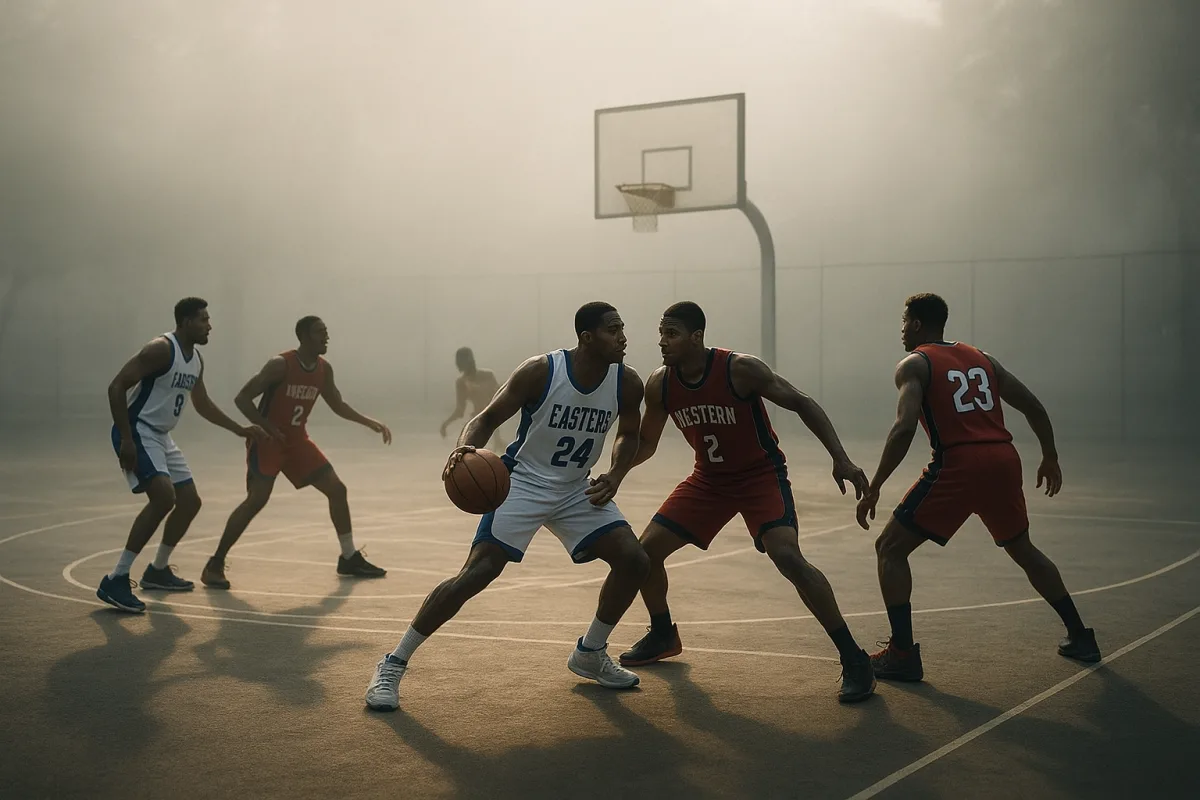
Watchability is about options, not standings
The simplest way to explain the East-West contrast is not by listing stars or counting projected contenders. It is by looking at the number of viable choices a team can create within one half-court possession.
That sounds abstract, but it is visible on tape. A watchable offense makes the defense choose between two or three bad answers: help on a drive, stay home on a shooter, switch a screen, tag a roller, or concede a mismatch.
A less watchable offense can still have talented players and win regular-season games. Its possessions simply become easier to map. The ball reaches one familiar location, the defense loads up there, and the eventual shot depends on difficult individual shot-making.
This distinction matters because the available evidence does not support a simple claim that the East has overtaken the West competitively. In 2025-26, Western Conference teams went 621-609 against Eastern teams, a .505 winning percentage. The East finished .495. [13]
So the better claim is narrower: the East currently appears more interesting because its relevant teams have more contrasting ways to build a possession. That is a better television product than a conference where several recognizable franchises are trapped between an old core and a delayed rebuild.
SWISHOUT’s analysis of the Eastern Conference gets at that difference, even when its broad enthusiasm is stronger than the standings require. The appeal is not that every Eastern team is equally good. It is that their tactical questions are easier to identify.
What a possession pathway actually is
A possession pathway is the sequence by which an offense gets from an initial alignment to a worthwhile shot. The first action is not necessarily intended to score. Often, it is intended to force a coverage commitment.
Take a standard high pick-and-roll. The ballhandler uses a screen near the top of the floor while the screener heads toward the rim. The defense must decide whether to switch, drop its center, hedge, trap, or fight over.
Each coverage has a cost. Drop coverage protects the rim and avoids giving up a roll dunk, but can surrender pull-up jumpers. Switching removes the advantage of the screen, but may create a smaller defender on the big man.
The offense’s job is to make that initial answer produce a second problem. If the low man rotates to stop the roller, a corner shooter opens. If the defense stays attached to the corners, the roller may have a clear lane.
That is why spacing is not merely a team’s three-point percentage. Spacing is the degree to which defenders believe they must remain connected to shooters. A mediocre shooter who is ignored does not stretch the floor in the relevant tactical sense.
The best offenses also have a counter when the initial pick-and-roll is denied. They can flow into a post-up, a dribble handoff, a re-screen, a swing-swing sequence, or a weak-side cut. The possession remains alive without becoming improvised.
This is the East’s strongest watchability argument. Its leading teams do not all ask the same question. New York can create through physical wing play and continuity. Cleveland can put pressure on the point of attack. Miami can turn rim pressure into spot-up decisions.
Those systems can fail. A good team is not automatically a good watch. But when the personnel and actions make the defense reveal its priorities, the game has something for a viewer to study besides whether a difficult jumper happened to fall.
Philadelphia’s challenge is sequencing, not star count
The Philadelphia 76ers are the cleanest example of why talent accumulation does not automatically create a complete offense. NBA.com reported that LeBron James signed with Philadelphia in July 2026. [3] SWISHOUT’s Eastern Conference analysis also places James alongside Embiid, Maxey, and Jaylen Brown.
The key tactical question is not who takes the most shots. Field-goal attempts are a volume statistic, not a measure of possession quality. A player can lead a team in attempts because he creates good looks, because the offense stalled, or because defenses invited certain shots.
The important question is who initiates, who screens, and who occupies the weak side. If Embiid receives a post entry with James standing above the break and Maxey waiting on the wing, Philadelphia has not yet created an advantage. It has only gathered talent.
A useful version of the offense would sequence those players. James could initiate a side pick-and-roll, Embiid could screen or seal the smaller switch, and Maxey could attack the second closeout after the defense collapses toward the paint.
Brown’s value in that structure would not require him to reproduce a primary-creator workload. He could punish a tilted defense, particularly by cutting or attacking a rotating defender. That is different from asking him to beat a set defense repeatedly from a stationary isolation.
The cost is touches and spacing. Embiid is most dangerous when he can operate from the post or elbow with room to face up. James is most effective with shooting around him and a credible rim threat. Maxey needs lanes, not a crowded middle.
That is why the Sixers are compelling, rather than automatically solved. A lineup with several high-usage players becomes watchable when each player’s action creates the next player’s advantage. It becomes cramped when every possession starts with a different star waiting for his turn.
Health should be discussed carefully here. Reporting documented Embiid’s 2025 left-knee arthroscopic surgery and subsequent attempts to return consistently, while later reports noted additional shin, knee, ankle, and hip issues. [5][6] Those are not current availability reports.
Likewise, Fox Sports documented James’s prior foot and elbow injuries, but there is no fresh report establishing a present limitation. [4] There is also no specific current availability information for Brown. The responsible read is uncertainty, not a diagnosis.
The West’s real collapse is loss of optionality
The Western Conference has not collapsed in the literal competitive sense. It still won the 2025-26 interconference season series, and Axios reported Denver reaching the Finals after earning the West’s top seed in 2025. [2][13]
Its problem is more structural. Several Western franchises entered the decade trying to contend with older, expensive cores. When those bets miss, the normal recovery mechanism is asset optionality: draft picks, cap flexibility, movable veterans, and young players on cheap contracts.
The Clippers have lost the most important part of that mechanism. The NBA’s September 2026 punishment included a $30 million fine and forfeiture of five first-round picks, covering 2029 through 2033, in the Kawhi Leonard salary-cap circumvention case. [1]
That penalty matters beyond its headline value. A first-round pick can be used in at least three ways: draft a low-cost contributor, trade for an established player, or function as insurance when an aging roster finally needs to be dismantled.
Without those picks, a front office cannot easily buy its way out of a mistake. Other teams know the club lacks leverage. A veteran sell-off produces less return, and a prospective trade partner has fewer reasons to meet the asking price.
The NBA found that the Clippers facilitated off-court income and endorsement arrangements for Leonard through four companies, paid personal expenses, exchanged business connected to those deals, and failed to report improper solicitations. [1] The Clippers rejected the findings, but no appeal or arbitration route is available in current reporting. [15]
Owner Steve Ballmer received a one-year suspension, team executives Gillian Zucker and Lawrence Frank were also suspended, and Leonard was fined $700,000. [1] Those punishments do not alter a defensive coverage. The pick forfeitures absolutely alter roster-building possessions years from now.
SWISHOUT’s Western Conference analysis describes this as a collapse, and that word fits if it refers to future choices rather than merely current wins. A team can retain recognizable veterans and still be worse off because its next useful possession of organizational leverage has vanished.
The available player-development record offers little basis for pretending the Clippers can simply replace those picks internally. Public information identifies recent selections, including Kobe Brown, Jordan Miller, Cam Christie, Yanic Konan Niederhäuser, Mohamed Diawara, Keaton Wagler, Baba Miller, and Henri Veesaar, but lacks comprehensive evidence on their NBA impact. [9]
That uncertainty is itself the point. Contenders can survive a disappointing young player when they own more picks and maintain flexibility. A penalized team with an older roster cannot assume that an unproven prospect will become the missing two-way wing or reserve creator.
Why the East feels alive
The East’s watchability is therefore less about a clean conference-wide superiority claim than about clearer possession identities. The New York Knicks, Philadelphia, Cleveland, Miami, Boston, and Detroit each present different questions about where a defense must commit.
The standings also keep the argument honest. Charlotte finished 44-38 and Miami 43-39 before the 2026 postseason, while Brooklyn, Indiana, and Washington occupied the bottom of the conference. [10][11] Watchability does not mean every market is stable or every team is a contender.
It means a viewer can see why a game is being decided. Is the defense switching? Is the corner defender tagging the roll? Is the center forced to defend in space? Is the offense generating a second-side attack, or merely handing the ball back to its star?
That is the contrast worth watching. The East offers more teams whose lineups can answer those questions differently. The West still has elite teams, but too many of its middle-tier clubs are carrying the residue of failed all-in decisions.
A conference becomes compelling when its teams possess multiple ways to win a possession. A conference feels depleted when too many teams are waiting for a future transaction, lottery result, or financial reset before they can credibly change what happens on the floor.
Frequently Asked Questions
What makes the NBA Eastern Conference more watchable than the Western Conference?
The Eastern Conference is considered more watchable because its teams offer distinct and legible offensive identities that create multiple meaningful decisions within a possession. Unlike the West, which often relies on familiar, easier-to-map possessions centered on individual shot-making, the East’s offenses force defenses to choose between several difficult coverages, making the game more engaging to watch. This watchability is about tactical variety rather than simply which conference won more games.
How do offensive strategies differ between the NBA East and West?
Eastern Conference teams tend to have more contrasting ways to build possessions, involving multiple options that force defenses into complex decisions such as switching, dropping coverage, or tagging rollers. Their offenses flow through various actions like pick-and-rolls, post-ups, dribble handoffs, and weak-side cuts, maintaining possession alive without relying solely on individual talent. In contrast, Western Conference offenses often funnel the ball to one familiar spot, making their possessions more predictable and less varied tactically.
What are the challenges for the Philadelphia 76ers with their star lineup?
The main challenge for Philadelphia is sequencing and role clarity rather than simply having star talent. With Joel Embiid, Tyrese Maxey, LeBron James, and Jaylen Brown on the floor, the team must carefully manage who initiates plays, who screens, and who occupies weak-side spaces to avoid crowding the same floor areas. Without clear offensive roles and coordinated actions, the lineup risks stalling by just gathering talent instead of creating tactical advantages.
How did the Eastern and Western Conferences perform against each other in 2025-26?
In the 2025-26 season, Western Conference teams held a slight edge over Eastern teams in interconference play, posting a .505 winning percentage with a 621-609 record. The Eastern Conference finished with a .495 winning percentage against the West. This indicates that while the West was marginally better in head-to-head results, the East’s watchability advantage is not due to superior competitive performance.
Why is the Western Conference facing a collapse in optionality?
The Western Conference’s collapse in optionality partly stems from teams like the Los Angeles Clippers losing flexibility due to sanctions that include forfeiting five future first-round draft picks (2029–2033). This loss removes the usual rebuilding routes after expensive veteran rosters fail, limiting the team’s ability to create new tactical options or roster adjustments. Additionally, several Western franchises are caught between aging cores and delayed rebuilds, reducing the variety of offensive choices they can present.
How we researched this
This article was assembled from 2 video sources, 1 published article, 16 cited references.
Nothing here is based on hands-on testing. Where a figure or finding appears, it belongs to the source cited beside it, and the writing says so rather than implying otherwise. Every source is listed below so you can check it.
Sources
Ranking the NBA’s Western Conference After a Wild Offseason — Blazer's Edge
NBA suspends Clippers owner Ballmer, fines team $30M, Kawhi Leonard $700K in cap circumvention case
Nuggets in NBA playoff run as West's No. 1 seed for the first time
LeBron James heads back East, signs deal with 76ers | NBA.com
Joel Embiid will return to the Sixers lineup after missing five games
Eastern Conference Standings & Playoff Projections | NBA MarketRank
NBA Playoff Predictions: The Opta Supercomputer Projects the Postseason Bracket | Opta Analyst
NBA Eastern vs. Western Conference Record by Season | Basketball-Reference.com
Los Clippers estudian denunciar a la NBA porque no aceptan su sanción
East vs. West has been an unexpectedly even matchup this season | NBA.com
Watch NBA Eastern and Western Conference Dynamics on Youtube
Also from the sources
Related Articles
Philadelphia 76ers Preseason Struggles and Player Dynamics
Analyze Philadelphia 76ers preseason struggles, key player performances, and evolving roster dynamics including Embiid, James, and Brown.
Toronto Raptors Underrated Contenders in the 2026 NBA Season
Explore why the Toronto Raptors are underrated contenders, focusing on defense, Kawhi Leonard's impact, and roster changes in 2026.
LeBron James 76ers Title Contention and Team Dynamics
Explore LeBron James' impact on the 76ers and their realistic title contention prospects for the 2026-27 NBA season.
NBA Eastern Conference Outlook and Knicks' Position
Explore the NBA Eastern Conference outlook and the New York Knicks' position as they defend their title in the 2026-27 season.