AJ Dybantsa Injury: Impact on Wizards' Season Opener
Get the latest on AJ Dybantsa's injury and how it affects the Washington Wizards' season opener and early season performance.
The shift is from debut anticipation to timeline management
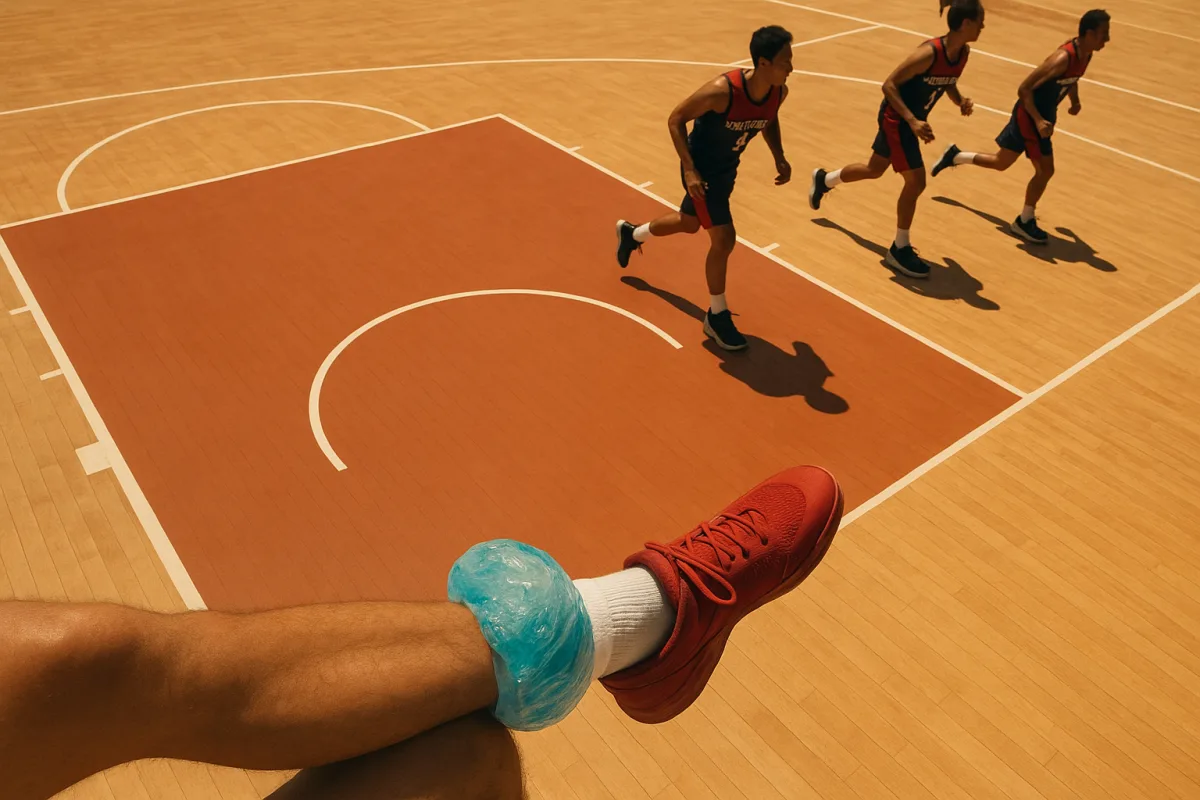
The immediate change is straightforward: the Washington Wizards’ season opener is no longer AJ Dybantsa’s NBA debut. The No. 1 overall pick has been ruled out against Milwaukee after spraining his left ankle against New Orleans in the preseason finale. [2][4]
That is not merely a one-game availability note. It changes the opening-week conversation from what Dybantsa can add to Washington’s offense into what evidence would justify bringing him back.
CBS Sports reported that Dybantsa rolled the ankle after playing 15 minutes against the Pelicans on October 16. Coach Brian Keefe then classified him as day-to-day while confirming he would not play October 21. [2]
Sportsnet and the NBA’s syndicated injury reporting reached the same practical conclusion, Dybantsa is out for the opener. [4][8] That convergence matters because it separates a speculative social-media timeline from a broadly confirmed availability decision.
The important limitation is equally clear. None of the credible reporting specifies whether the injury is a Grade 1 or Grade 2 sprain, whether there was imaging, or which functional benchmarks remain before clearance. [2][3]
That missing information is why “day-to-day” should not be translated into “back Friday.” Day-to-day describes the team’s current listing, not a promise that the player will be ready for Washington’s next game.
What the reporting is actually showing
The most consistent theme across the coverage is restraint. CBS Sports described Washington as unwilling to rush its rookie back for the opener and risk aggravating the injury, while RotoWire continued to list him day-to-day. [2][3]
That is a meaningful reporting trend because independent outlets are repeating the same core facts, an ankle sprain, an opener absence, and no public long-term timetable. They are not supplying contradictory recovery dates.
Bleacher Report, KSL Sports, NBC4 Washington, NBC Sports and USA Today all framed the news around Dybantsa being unavailable for the opener. Their excerpts add confirmation of the immediate status, not new medical detail.
The distinction matters. A cluster of reports can make a fact stronger, but it does not make the unknowns disappear. Repetition is not a diagnosis, and no public report supplies one.
There was some encouraging short-term information. Dybantsa reportedly participated in shooting work by October 18, two days after the injury, while remaining day-to-day. [3] Shooting, however, is not the final test for an NBA wing.
A player can take stationary or lightly scripted shots well before he can absorb a hard closeout, plant after a downhill drive, or change directions while tracking a cutter. Those are different demands on the ankle.
This is where injury coverage often drifts too quickly into optimism. The public can see a player shoot, but it cannot see the medical staff’s response to swelling, balance work, force production, or next-day soreness.
Why the opener is a poor place to force a return
The timing explains Washington’s approach. Dybantsa was injured in the final preseason game, leaving only a handful of days before a regular-season matchup that would be physically and tactically demanding.
Opening night also offers little developmental value if the player is limited. A rookie wing who cannot fully sprint in transition or trust his plant foot will naturally make safer reads and avoid contact windows he needs to learn.
That affects the tape more than the box score. If Dybantsa receives the ball on a wing catch, his value is partly in whether he can attack a tilted closeout, force help toward the nail, and create the next pass.
An ankle limitation changes that possession before it changes his scoring total. He may decline the drive, settle for a contested pull-up, or lose the ability to stop sharply enough to defend the counterattack.
Washington could still have put him on the floor as a decoy or spot-up option. But that would be a compromised version of the developmental role a rebuilding team should want to evaluate from its top selection.
The Wizards are not in a position where one October game should outweigh a rookie’s ability to build full-speed reps over the rest of the season. That is an organizational decision, not an indictment of Dybantsa’s toughness.
No direct medical expert has commented publicly on Dybantsa’s specific case. Any claim that he is definitely at heightened risk from a quick return would therefore go beyond the available evidence.
General recovery guidance is still useful, within limits. Broad ankle-sprain timelines often place Grade 1 injuries around two to four weeks and Grade 2 injuries around four to eight weeks, depending on symptoms and function. [5]
But Dybantsa’s grade is undisclosed. Applying either range directly to him would be false precision, particularly because the reporting has not identified the specific structures involved or his response to movement work.
Research on return after syndesmotic, or high-ankle, injuries is even less applicable unless Washington identifies Dybantsa’s injury that way. Those injuries have different recovery profiles, and no public report has made that classification. [6]
The basketball cost is real, but it cannot yet be measured
It is tempting to declare that Dybantsa’s absence will reshape Washington’s season. The available evidence does not support that claim, because no 2026-27 regular-season game has been played as of the reporting cutoff.
There is no Wizards offensive rating without him, no defensive film of a revised starting group, and no possession sample showing whether another wing can absorb his intended usage. Those numbers simply do not exist yet.
What can be said is narrower. Washington loses a scheduled opportunity to give its highest-profile rookie live reps against Milwaukee’s schemes, physicality and transition pressure in a game that counts.
Dybantsa averaged 12.8 points, 3.8 rebounds, 1.8 assists and 1.5 steals across four preseason games. Those figures describe a very small exhibition sample, not proof of what his regular-season role would become.
The assists and steals are more informative than a raw scoring average only in context. They suggest involvement across possession types, but they do not tell us whether those plays came against starters, bench units, switching defenses, or broken-floor opportunities.
That is why preseason production should not be used to calculate Washington’s expected loss in points. A player’s value changes with lineup context, matchup, role assignment and the quality of the opponent’s game-planning.
Still, preseason tape has practical value. The 15 minutes against New Orleans before the injury were likely meant to be part of the final rehearsal for how Dybantsa would be integrated into competitive lineups. [2]
The injury interrupts the continuity of that rehearsal. Instead of stacking possessions and learning the timing of NBA help defense, he will spend the opening phase of the schedule rebuilding physical confidence and rhythm.
The likely rotation response
Washington has not announced a formal contingency rotation. That absence of information should keep analysts from presenting a projected starting five as though it were a team decision.
Sports Illustrated identified Bilal Coulibaly and Tre Johnson as plausible players who could see altered opportunities with Dybantsa unavailable. [7] That is a reasonable roster-level possibility, not a confirmed plan.
The two possibilities would not solve the same basketball problem. A replacement’s task is not simply to fill a vacancy at wing, but to take specific responsibilities, floor spacing, secondary creation, defensive assignments and transition coverage.
If Coulibaly receives more minutes, the question is likely to be whether Washington asks him to take the more demanding perimeter matchup or to operate as a connective wing around its creators. Those are different workloads.
If Johnson’s role grows, the possession-level question changes toward guard-wing shot creation and decision-making. More touches for a young scorer can raise offensive upside while also increasing the number of difficult reads he must make.
Neither adjustment is automatically good or bad. The film will determine whether the substitute maintains spacing, makes the low-man rotation on time, and keeps the ball moving after the first advantage disappears.
The meaningful season effect, then, is developmental sequencing. Dybantsa will miss at least one chance to establish baseline NBA habits, while teammates receive information-rich minutes that Washington might otherwise have allocated differently.
How to plan around an uncertain return
For fantasy players, bettors and anyone producing a Wizards preview, the correct model is a probability range. The confirmed fact is one missed game, not a confirmed multi-week absence and not a confirmed weekend debut.
CBS Sports noted that Washington’s first two games are at home, with Toronto following Milwaukee. [2] That creates a near-term checkpoint, but it does not create a medically grounded deadline.
A sensible short-term expectation is that Washington will prioritize functional movement over calendar pressure. General ankle rehabilitation emphasizes protection, swelling control, progressive range of motion, balance work and pain-free basketball-specific testing before return. [5]
That does not mean Dybantsa cannot return quickly. A mild sprain can resolve efficiently, and his reported shooting work is a positive sign. It means the public evidence cannot tell us whether he has passed the harder tests.
The most useful next update will not be a vague note that he “looked good.” It will be confirmation that he has practiced without restriction, handled change-of-direction work, and is no longer carrying a game-status designation.
Until then, the evidence supports a restrained read. Washington has lost its No. 1 pick for the opener, the likely replacement minutes are unconfirmed, and the eventual season impact depends more on recovery quality than on one October absence.
Frequently Asked Questions
What is the status of AJ Dybantsa's injury?
AJ Dybantsa suffered a left ankle sprain during the preseason finale on October 16, 2026. As of October 20, he is listed as day-to-day but has been ruled out for the Wizards’ season opener on October 21 against Milwaukee. The exact severity of the sprain has not been publicly disclosed.
How will AJ Dybantsa's injury affect the Wizards' season opener?
Dybantsa will not play in the season opener, which means the Wizards must adjust their rotation. While players like Bilal Coulibaly and Tre Johnson are potential replacements for his minutes, the team cannot replicate the specific developmental opportunities that Dybantsa would have received as the No. 1 overall pick.
What is the expected recovery timeline for AJ Dybantsa's ankle sprain?
No official recovery timeline has been provided. Typical ankle sprain recovery ranges from 2–4 weeks for mild sprains to 4–8 weeks for more severe cases, but without knowing the injury grade, the timeline remains uncertain. The team is managing his status on a day-to-day basis.
Who will replace AJ Dybantsa in the Wizards' lineup during his absence?
While the Wizards have not officially announced a replacement, analysts suggest that Bilal Coulibaly and Tre Johnson are the most plausible options to fill Dybantsa’s minutes in the lineup for the opener.
Why is the Wizards cautious about rushing AJ Dybantsa back?
The Wizards are avoiding rushing Dybantsa back to prevent aggravating the ankle injury. Although he participated in shooting drills shortly after the injury, more demanding basketball movements that stress the ankle are necessary before he can safely return, and the team is prioritizing his long-term health over an early return.
How we researched this
This article was assembled from 1 video source, 8 published articles, 9 cited references.
Nothing here is based on hands-on testing. Where a figure or finding appears, it belongs to the source cited beside it, and the writing says so rather than implying otherwise. Every source is listed below so you can check it.
Sources
The Kings Are Starting Ben Simmons — TheFlightMike
No. 1 overall pick AJ Dybantsa will miss Wizards' season opener with ankle injury — CBS Sports NBA
AJ Dybantsa Out for Wizards' Opener with Injury, Latest Timeline for Star to Make NBA Debut — Bleacher Report
AJ Dybantsa ankle injury sidelines No. 1 pick for opener — KSL Sports
Wizards' top draft pick AJ Dybantsa out for season opener with ankle injury — NBC4 Washington
No. 1 pick AJ Dybantsa to miss Wizards season opener with ankle injury — NBC Sports
AJ Dybantsa injury update bad news for Wizards' opener vs Bucks — USA TODAY Sports
How long will MPJ be a Net? Does controversy matter? — SB Nation
Saliou Niang, former NBA Draft pick, cleared to compete for LSU, which has given up RJ Luis Jr. eligibility fight: Reports — Yahoo Sports
No. 1 overall pick AJ Dybantsa will miss Wizards' season opener with ankle injury - CBS Sports
Wizards No. 1 pick AJ Dybantsa ruled out for season opener vs. Bucks - Sportsnet.ca
Return To Sport After Ankle Syndesmosis Injury: Meta-Analysis — Physio Network
Who do the Wizards Start with AJ Dybantsa Injured for Season Opener
Watch AJ Dybantsa Injury and Wizards Season Impact on Youtube
Related Articles
Ben Simmons Achilles Injury Impact on Kings and Career
Explore Ben Simmons' season-ending Achilles injury and its impact on his career and the Sacramento Kings' lineup and strategy.
Washington Wizards Roster Outlook and New Era Analysis
Explore the Washington Wizards roster outlook and new era, focusing on Trae Young, Anthony Davis, and defensive challenges for 2026-27.
NBA Rookies 2026-27 Impact and Rising Stars Analysis
Explore the NBA rookies' impact and rising stars in the 2026-27 season with detailed role and performance analysis.
LA Clippers Media Day: Challenges and Penalties Explained
Explore the LA Clippers Media Day insights, penalties, and lineup challenges including lost draft picks and leadership changes.