
NBA Legends Team Dynamics
Explore NBA legends team dynamics, from the 1992 Dream Team to modern players like OG Anunoby, and how role clarity drives success.
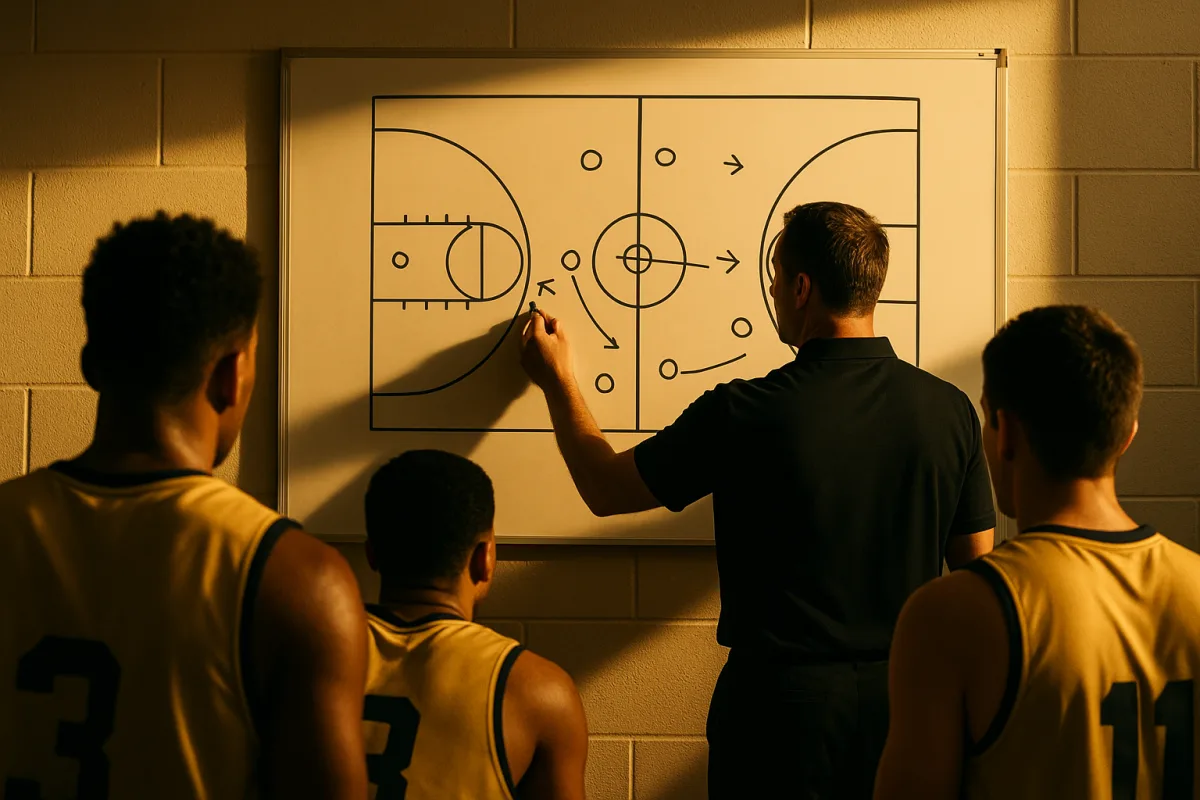
The real advantage is fewer decisions
Basketball history often turns roster construction into a talent contest. Put enough Hall of Famers together, the thinking goes, and the game will sort itself out. The best units do something more practical: they make the next decision obvious.
That is the common thread in the 1992 Dream Team, the 1996 Chicago Bulls, and modern contenders built around high-usage creators. Each had stars, certainly. More importantly, each established clear answers to basketball’s repeating questions.
Who brings the ball up? Who attacks the first mismatch? Who spaces the weak side? Who rebounds when the shot goes up? Who takes the opponent’s primary scorer? A coherent lineup assigns those jobs before the possession becomes frantic.
This is why a lineup can look better on film than its individual scoring totals suggest. The important measurement is not only who creates points, but how often five players reach the correct spacing and matchup solution without pausing to negotiate.
TheRealMindCrime’s reaction to Basketball Time Machine’s Dream Team feature lands on the useful part of the mythology. Magic Johnson and John Stockton were not valuable because they accumulated assists in isolation. They prevented a roster full of scorers from competing for the same possession.
A point guard in that environment does not need to prove he can create every shot. He has to recognize which defender has helped too far, which scorer has a favorable angle, and when a simple entry pass is superior to a difficult dribble move.
That distinction matters. A pass-first organizer does not make other stars less important. He lowers the cost of having them together, because Michael Jordan, Larry Bird, Charles Barkley and Karl Malone can begin their work from advantageous positions.
The Dream Team’s hierarchy was functional, not ceremonial
The 1992 United States team won its Olympic games by an average of 43.8 points, and its limited timeout use reflected dominance rather than some mystical absence of coaching. Strategic timeouts were largely unnecessary, with stoppages used for clock-management purposes. [6]
That margin did not come solely from shooting overmatched opponents. The lineup’s structure made defensive mistakes expensive. If an international defense loaded up against Jordan, Bird could punish the help. If Bird’s back limited his movement, another elite passer or scorer entered.
Basketball Time Machine’s collection of player recollections captures the practical absurdity of those substitutions. Patrick Ewing could sit and David Robinson could replace him. Jordan could rest and Clyde Drexler could take the wing role without changing the offense’s basic geometry.
The mechanism was redundancy, but not duplication. The roster had multiple transition finishers, multiple interior defenders and multiple passers. It did not require every player to dominate the ball, which is usually where super-team experiments become turn-taking exercises.
Charles Barkley’s scoring lead in Barcelona is a useful example. It does not establish that he was the roster’s best player in every setting. It shows that a unit can identify the available advantage and repeatedly feed it.
When Barkley ran the floor against smaller or slower opponents, the possession became simple. The ballhandler advanced it quickly, wings filled lanes, and Barkley reached the rim before the defense could build a wall. That is not freelance brilliance. It is role clarity.
The cost of this model is that someone must sacrifice familiar privileges. An NBA star accustomed to calling for isolations has to screen, run wide, defend a different position, or accept that a teammate’s matchup is the possession’s priority.
That is why “everybody knew their role” should not be treated as decorative praise. It means the group accepted a hierarchy that could change from possession to possession without becoming a referendum on status.
The 1996 Bulls show the defensive version
The Chicago Bulls’ 1996 Finals win over the Seattle SuperSonics is often remembered as an uncomplicated coronation. Basketball Time Machine’s game-six breakdown instead makes clear how much labor was required to preserve Chicago’s shape late in the series.
Seattle was compromised when guard Nate McMillan’s back injury in Game 1 reduced its defensive options. The Sonics then fell into a 3-0 deficit after a 22-point Game 3 loss, but the matchup was not simply Jordan overwhelming everyone. [8]
Seattle won Game 4, 107-86, after Chicago’s premature championship preparations became a motivational and emotional error. Former Bull Steve Kerr later described the episode as “terrible karma,” an acknowledgment that series control can vanish when a team stops doing its routine work. [5]
On tape, Chicago’s advantage was less about one impossible Jordan shot than about connected responsibilities. Scottie Pippen could initiate offense, Jordan could operate from the post, Rodman could erase a missed shot with an offensive rebound, and Longley could pass from the high post.
Those assignments altered Seattle’s coverage. A trap on Jordan created a four-on-three behind it. Help toward Pippen exposed the weak-side shooter. A defender rotating to contest the first attempt still had to find Rodman, who was already pursuing the rebound.
The Bulls did not need five stars making simultaneous individual claims. They needed one player to force the rotation, another to read it, and three others to occupy defenders honestly. That is the anatomy of a functioning possession.
Seattle had legitimate answers. Gary Payton could pressure ballhandlers, Shawn Kemp could protect the rim from the weak side, and Detlef Schrempf gave the offense a skilled forward connector. But injuries and foul pressure narrowed the margin for those solutions.
The lesson is not that older basketball was purer or simpler. Chicago also used early offense, post entries, back cuts and spot-up shooting. The difference is that its spacing was organized around midrange and post threats rather than today’s near-constant three-point volume.
OG Anunoby is the modern connector version
Hoop Dungeon frames New York forward OG Anunoby’s 2026 playoff run through spectacular results, particularly his shooting and late-game impact. The stronger takeaway is not that he suddenly became a conventional first option. It is that he solved multiple lineup problems at once.
Anunoby posted a 72.1 percent true shooting percentage in the 2026 playoffs. True shooting percentage estimates scoring efficiency by incorporating two-point attempts, three-point attempts and free throws, rather than treating every field-goal attempt as equal. [1]
That number is useful, but it needs discipline. It does not prove he produced the greatest playoff efficiency run ever, despite claims made in the Hoop Dungeon feature. The available research does not provide a verified all-time comparison for that assertion.
His 49 percent three-point shooting, 44 makes on 90 attempts, matters because it changes defensive help rules. A defender assigned to Anunoby cannot casually abandon the corner or wing to crowd Jalen Brunson’s driving lanes.
That is the first connector job: hold spacing without demanding the ball. The second is attack the closeout created when the defense does help. The third is defend a bigger player, a quicker guard, or a transition assignment without forcing a substitution.
Anunoby’s clutch effective field-goal percentage was 55.8 percent in the final five seconds of the shot clock, the best mark among 14 players with at least 30 such attempts. Effective field-goal percentage gives extra value to made threes, but excludes free throws. [1]
The distinction matters because late-clock data does not say Anunoby created every possession from scratch. It says that when a possession had broken down, his shot selection and finishing remained unusually productive within that defined sample.
That is why former players’ comparisons to Pippen should be handled carefully but not dismissed. The comparison is about function, not identical talent. Both could defend up a position, work without constant touches, and make the star’s offensive environment easier to manage.
Bench units either preserve the rules or break them
Hoops Reference’s attempt to rank all 30 bench units uses useful criteria: high-end talent, depth and positional balance. The key film-room question underneath those categories is whether the second unit can preserve the first unit’s operating rules.
A reserve scorer is not automatically a helpful sixth man. If he needs long isolations, avoids defense, or cannot play beside the starting creator, he may raise the bench’s point total while making the overall rotation less stable.
The modern sixth-man role has moved well beyond emergency scoring. Teams increasingly want reserves who can switch assignments, initiate a secondary pick-and-roll, shoot after a drive-and-kick pass, or cover for a starter’s specific weakness. [2]
Jordan Clarkson’s 18.4 points per game in winning the 2020-21 Sixth Man Award described high-volume bench scoring. It did not, by itself, measure defensive flexibility, matchup scalability or whether his minutes fit every lineup configuration. [3]
That is the essential caution with box-score arguments, including the LeBron James debate raised by Uncut Hoops. Raw totals can tell us how much a player produced. They cannot independently tell us whether a lineup’s possessions remained coherent against playoff coverage.
LeBron’s Los Angeles Lakers were swept by the Oklahoma City Thunder in the 2026 first round, while he averaged 23.2 points, 7.3 assists and 6.7 rebounds across 10 playoff games. [4] Both facts can be true without reducing the discussion to either praise or blame.
A late-career star may still produce efficiently while a team lacks enough two-way connectors, reliable secondary creation or defensive answers. Conversely, a great supporting structure can improve a star’s environment without making that star’s production illegitimate.
The historical throughline is straightforward. The Dream Team had an overwhelming supply of role-compliant greatness. The Bulls had a championship structure built around complementary responsibilities. Modern benches and connectors decide whether that structure survives the minutes when plans become less clean.
That is the basketball argument worth carrying across eras: not which legend accumulated the most impressive résumé line, but which five-man group gave itself the clearest answer when the defense forced the next hard decision.
Frequently Asked Questions
How did NBA legends like the 1992 Dream Team structure their team dynamics?
The 1992 Dream Team structured their dynamics by assigning narrow offensive roles centered on elite passing, transition pressure, and defensive switching. Their stars accepted these defined roles to avoid competing for the same possession, creating a functional hierarchy where substitutions maintained the offense’s geometry without requiring every player to dominate the ball.
What role clarity principles did the 1996 Chicago Bulls use to win the title?
The 1996 Bulls assigned specific possession-related tasks: Jordan and Pippen created offense while Rodman, Longley, and others solved defensive and rebounding problems. This clear division of responsibilities allowed them to maintain team shape and exploit defensive rotations, emphasizing connected roles over individual star claims.
Why is reducing difficult decisions important in NBA team success?
Reducing difficult decisions makes the next action on each possession obvious, preventing players from pausing to negotiate roles or options. This clarity lowers the cost of having multiple stars on the floor by ensuring spacing, matchups, and responsibilities are pre-assigned, leading to more efficient and cohesive team play.
How do modern NBA role players like OG Anunoby fit into star-led lineups?
OG Anunoby exemplifies a low-usage connector who becomes indispensable by fitting shooting, cutting, and defensive assignments into a star-led structure. His efficiency and ability to preserve lineup rules show how role players contribute beyond scoring, supporting the team’s overall coherence and spacing.
What makes the 1992 Dream Team's hierarchy functional rather than ceremonial?
The Dream Team’s hierarchy was functional because players accepted changing priorities from possession to possession without it reflecting on status. Roles were clearly defined and flexible, allowing stars to sacrifice familiar privileges and focus on team advantages, which prevented the offense from becoming a turn-taking exercise among superstars.
How we researched this
This article was assembled from 5 video sources across 5 channels, 1 published article, 8 cited references.
Nothing here is based on hands-on testing. Where a figure or finding appears, it belongs to the source cited beside it, and the writing says so rather than implying otherwise. Every source is listed below so you can check it.
Sources
Ranking EVERY Bench Unit From All 30 NBA Teams — Hoops Reference
NBA Legends Explain Why Playoff OG Anunoby Was INSANE.. — Hoop Dungeon
Charles Barkley COOKS LEBRON'S FAKE GOAT CASE — Uncut Hoops
96 NBA Finals Chicago Bulls vs Seattle Supersonics — BTM Basketball Time Machine
TRMC REACTS - NBA Legends on Why the Dream Team is the Best Team Ever — TheRealMindCrime
The Bounce: The NBA's best forward now resides in Miami — The Athletic NBA
Og Anunoby True Shooting Percentage In 2026 Playoffs | StatMuse
The Evolution of the Sixth Man Role in Modern NBA Systems - New Arena
Utah Jazz guard Jordan Clarkson wins 2020-21 Kia NBA Sixth Man Award | NBA.com
The 1992 Dream Team: The Greatest Basketball Team Ever Assembled | The Basketball Fans
Watch NBA Legends and Historical Perspectives on Youtube
Also from the sources
Related Articles
Philadelphia 76ers Early Season Performance and Player
Analyze the Philadelphia 76ers' early season performance and player roles, focusing on Maxey, Brown, James, and team offensive strategies.
NBA Media Day Insights 2026: Top Players and Team Updates
Get key NBA Media Day insights from top players and teams, including Wembanyama, Leonard, Harper, and Bronny James for the 2026 season.
NBA Player Breakouts and Trade Rumors Shaping 2026 Season
Explore NBA player breakouts and trade rumors in 2026, analyzing how trades reshape roles and impact breakout opportunities.
NBA Legends' Perspectives on Today's Game and Players
Explore NBA legends' insights on how past skills and coaching translate to today's game and players across eras.